








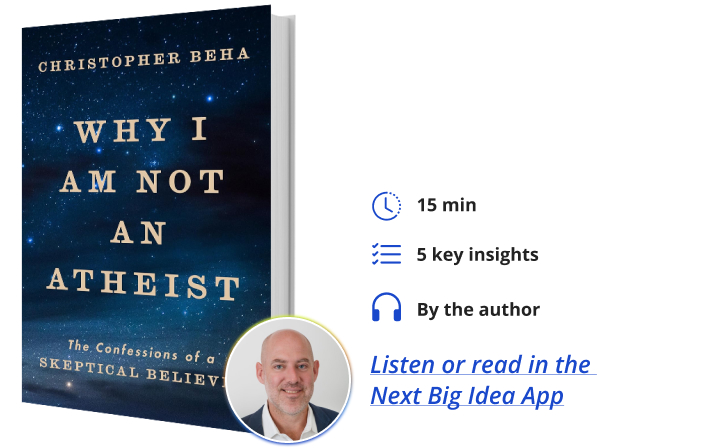
Below, Christopher Beha shares five key insights from his new book, Why I Am Not an Atheist: The Confessions of a Skeptical Believer.
Christopher is a novelist and essayist. He is the former editor of Harper’s Magazine and author of four previous books, including The Index of Self-Destructive Acts, which was nominated for the 2020 National Book Award.
What’s the big idea?
After a personal journey from adolescent altar boy to adult atheist, writer Christopher Beha concluded that the most accurate description for himself is as a “skeptical believer.” His thought process in choosing his own belief system holds lessons for engaging with life’s most urgent questions—and answering them for yourself.
1. Science can’t tell us how to live.
I was a sophomore in college when I left the Catholic Church in which I’d been raised. The foundational claim of most Western religions—that some all-powerful, benevolent entity created the universe and cares personally for everything in it—just didn’t seem consistent with the damaged, disordered, suffering world I saw all around me. So, I gave up on belief in God, and I set out to discover what to believe instead.
Many atheists would say I’d made a fundamental mistake. If I was looking for something to believe, then I hadn’t really left religion behind. Atheism is not just another creed, they would say, but a rejection of all creeds. True atheists deal in evidence, facts, reason, and knowledge—not in “beliefs.”
The first lesson I learned on my spiritual and intellectual journey was that this simply isn’t so. If we define a “belief” as something we hold to be true without factual evidence, then all people—atheists included—have beliefs. It isn’t possible to do without them because we all must decide how to live our own lives, and that question can’t be answered on a factual basis.
Since the rise of modern empiricism in the 16th and 17th centuries, we’ve dreamed of devising a science of human behavior. Not just a social science that can describe and explain the way humans generally act, but a practical science that can tell us how we should act.
We want to know before we get started what kind of life will make us happy, give us satisfaction, and contribute most to the good of the world. We want to eliminate the possibility that we will be haunted by regrets. We want a system that can make difficult choices for us with the kind of mathematical precision and certainty that science provides in so many areas. Despite the astonishing progress science has otherwise made, we are no closer to achieving that goal than we were five hundred years ago.
What’s more, even if we could outsource our decisions to some perfectly programmed happiness machine, there’s good evidence that we wouldn’t want to. Paradoxically, having this burden lifted would not make us happy, because making hard decisions for ourselves is an essential part of a flourishing life.
2. What we do depends on what we hope.
As a young atheist, I knew with certainty that I wanted to be a writer, but I had very little idea how to go about doing it. Should I take out loans to attend a graduate program, with the aim of becoming a full-time professor? Should I follow my brother to law school and make a solid living while dedicating mornings and weekends to my novel? Should I find a job tending bar or waiting tables—work that made no use of the degree I’d just earned but offered more flexibility and time? Should I buy a one-way ticket somewhere exotic, gain firsthand experience that might make for interesting material, and figure things out as I went?
Evidence-based research wasn’t much help. I could find examples of great, successful writers who’d taken these paths, but I could equally find examples of people who’d flamed out on all these paths. What I most wanted to know—Was I going to make it?—was not a question anyone could answer for me.
“None of these questions can be answered scientifically, but in answering them, we build a life.”
If I’d simply wanted to know my odds of success, I could have found the answer easily enough. In fact, I already knew the answer: not high. But I was trying to decide how much to commit myself despite this knowledge, because I knew that without commitment, my odds would go from slim to none. The real question I was asking was: Should I allow myself to hope that I might be one of the ones who makes it?
All around me, my friends were asking their own questions: Should I take the well-paying finance job or apply to graduate school in a subject I’ve come to love studying for its own sake? Should I stay together with my college boyfriend or experience a bit of life as a single adult? Should I move back to the town where I grew up to be near my sick mother or test myself in the big city? While asking these questions, they were really asking: What kind of person do I hope to become?
As we moved along in life, the stakes of our questions only got higher: Should I get married? Should I have kids? Should I stay in my imperfect marriage for the sake of those kids? Should I change careers at a late stage? Should I keep fighting for what I believe to be right, even though my efforts don’t seem to be making any difference? Should I keep working to improve myself, or learn to accept myself as I am?
None of these questions can be answered scientifically, but in answering them, we build a life. Our answers are more important than anything science can tell us. They reflect our values, priorities, and sense of the way the world works and the way it ought to work, far more than they reflect any rational assessment of empirical evidence. Most of all, they reflect what we permit ourselves to hope.
We marry, despite knowing how many marriages end in divorce. Or we choose not to marry someone we’re not sure we love, even though we know a better option might not be out there. We have kids despite knowing that raising them will be both incredibly difficult and incredibly expensive. Or we choose not to have kids, despite being told by everyone around us that the difficulty and expense are worth it in the end. We forgive a straying spouse despite knowing that infidelity is usually not an isolated incident. Or we make the decision not to forgive, to end an unhappy marriage, despite knowing that divorce will have a punishing effect on many areas of our lives.
We make these decisions not because the evidence suggests they are the “right” ones but because something in us allows us to hope that our commitment in one direction or another will be rewarded. Or else we choose not to hope, not to commit. We choose to be guided simply by what the numbers tell us, and one day we have precisely those things we had been following the algorithm in order to escape: regrets.
3. The Big Questions come for all of us eventually.
Not long after my initial rejection of belief in God, I was diagnosed with Stage Three lymphatic cancer. In the weeks that followed, I had scans to determine whether the cancer had spread beyond what is generally understood to be the point of no return. As it happens, it had not. I had surgery to remove a tumor the size of a golf ball from under my arm, and I waited for the biopsy that would tell me whether my cancer was a variety generally responsive to treatment. As it happens, it was. Once that treatment started, I waited several months to see whether my case would respond as expected. As it happens, it did. I got incredibly lucky, but along the way, I spent a lot of time uncertain whether I would live to see my own graduation.
This experience made me more prone than most college kids to worry over existential questions, and particularly to ask myself what was or was not reasonable for me to hope. I wanted from a young age to have some sense of the point of it all. I wanted to live a life of personal meaning, and I didn’t think I had much time to do it. All of this made me somewhat unusual among my peers.
“I wanted to live a life of personal meaning, and I didn’t think I had much time to do it.”
I’m now forty-six years old, and this impulse no longer feels unusual. In recent years, I’ve seen friends who seemed to be speeding through life, moving from success to success, come to a stop. Having achieved the pinnacle of professional success and sent their kids out into the world, they suddenly have more time than they’ve had since our college days. Like Wile E. Coyote running off the cliff, they have finally taken a moment to look down, only to discover that they left solid ground behind years ago.
Some people I know are asking considerably harder questions than “Should I go to grad school?” Do I have the courage to give up the drugs and alcohol that somehow took over my life along the way? Is it too late to repair the relationships I’ve destroyed? Do I even want to go on living through this suffering? Some people, thankfully, never have cause to ask these more extreme questions, but nearly everyone I know around my age—perhaps especially those who seemed least introspective 25 years ago—has faced some version of a reckoning.
Certain historical events prompt such reckonings on a widespread scale. A combination of the pandemic lockdown, climate pessimism, reduced economic prospects, and political unrest seems to have made younger generations more prone than my own was to grapple with these questions at a young age. But everyone must grapple with them eventually.
4. Skepticism is the first step toward belief.
What are we meant to do with the fact that life faces us with questions that can’t be rationally answered? The proper response to this reality is skepticism. This term has become a simple synonym for “doubt,” and we tend to associate it specifically with doubt in religious matters. We are all occasionally skeptical about one thing or another, but when we describe someone as “a skeptic” in the most general sense, we almost certainly mean this person does not believe in God.
But skepticism, properly understood, involves recognition of the impossibility of certain human knowledge. It means rejecting religious certainty and rational proofs for the existence of God, but it also means rejecting certainty in other areas. It means rejecting the idea that science delivers certain knowledge about the ultimate workings of reality. It means rejecting certainty about our own ethical and political beliefs. It means rejecting the idea that our lives are puzzles that could one day be definitively solved.
And yet we must go on living. Rather than being the opposite of faith, true skepticism requires some form or faith. It tells us that we have needs that reason can’t meet, that we must inevitably embrace a life of belief. But it encourages us to recognize our beliefs as beliefs. This doesn’t mean that we don’t “really” believe them, but it means that we will not seek to impose them on others, precisely because we know they can’t be rationally justified.
When we hope for something, we put our faith in it. Because it tells us that the fundamental human questions can’t be answered through reason, skepticism encourages us toward that kind of hope. Rather than being a hindrance to faith, it is a necessary condition for it.
5. No one really knows anything about God.
Strictly speaking, no one can say anything about God, because no one really knows anything about God. God surpasses human understanding.
Some atheists get frustrated with believers who talk this way. In their view, mysticism is a kind of philosophical cheat. As they see the matter, most religious believers throughout most of history have believed in gods as entities in the world, bearded men who live on the mountaintop or in the sky, people with ears to hear our prayers and mouths to respond, people with hands to hold the hammers and lightning bolts with which they like to strike us.
“Belief can’t deliver us from skepticism.”
As modern science has made this belief less plausible, such atheists contend, people who still want all the benefits of belief have retreated to an odd kind of belief that isn’t really a belief in anything. They might tell you that they believe, they might even think they really do believe, but the moment you try to pin them down, these sophisticated quasi-believers fall back on talk about mystery and unknowing.
Historically, this narrative is objectively false. In fact, mysticism is as old as religion itself. People have always understood the divine as a concept that outstrips human understanding and our stories about it as limited human efforts to come into contact with that force.
This view particularly came into its own with the advent of monotheism. Judaism, Christianity, and Islam all have robust mystical traditions that far predate the Scientific Revolution. In fact, these traditions have flourished most in those times—like the era of Medieval scholasticism—when other religious forces have insisted that God can be fully known through reason. It is not an attenuated echo of belief or a compromise with the modern world to put your faith in a God whom you can’t describe or understand.
What these traditions have asked at their best is not that we understand God but that we place our hope in God. As I’ve said above, we have to place our hope in something. Is a God who completely transcends our understanding enough of a something to hang these hopes on? Will such a belief help us navigate life? One thing that the mystical tradition has been willing to say about God is that God is love. If we take this belief to heart, then we do have a certain way to answer the big questions: when in doubt, do what love demands.
It’s not always easy to live up to this rule, or even to know what course of action the rule commands. The rule can’t give us certainty. Belief can’t deliver us from skepticism. But that’s all right, because it’s possible to be a skeptic and a believer both.
Enjoy our full library of Book Bites—read by the authors!—in the Next Big Idea App: