












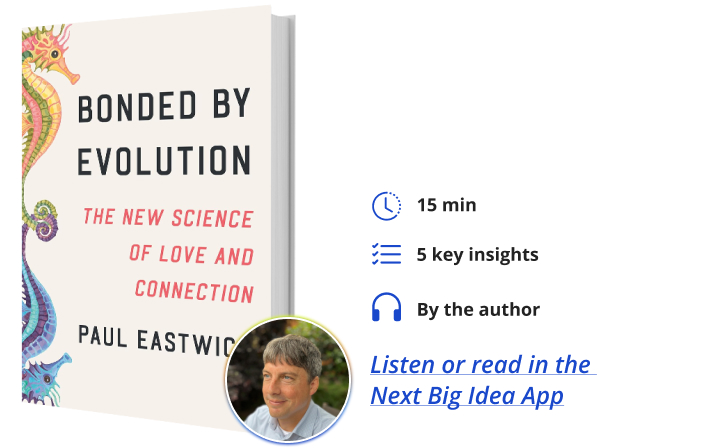
Below, Paul Eastwick shares five key insights from his new book, Bonded By Evolution: The New Science of Love and Connection.
Paul is a Professor of Psychology at UC Davis, where he serves as the head of the Social-Personality Psychology program and the director of the Attraction and Relationships Research Laboratory. He has published over 100 scientific articles, hosts the podcast Love Factually, and has had his work and writing featured in outlets like the New York Times, The Atlantic, and NPR.
What’s the big idea?
Advice about attraction is everywhere, and some theories—like the mating market, stark gender differences, or biology as destiny—sound convincing. But they’re far less accurate than we think. Evolutionary psychology, properly understood, points instead to more hopeful and practical truths about how great relationships actually begin and grow.
1. The mating market is time limited.
A classic concept in evolutionary theories about human mating is something called mate value. It’s the idea that some people are desirable, and some people are not. Pretty straightforward, and it seems patently obvious. Not everyone is equally attractive.
This is important because—again, classically—mate value mattered because attraction is like a market. There are winners and losers. If you’re hot, you can land anyone! If you’re not, you’ll have to settle. In this worldview, the sad reality is that the 10s get the 10s and the 2s get the 2s.
This idea is right, but only in a very narrow sense because mate value assumes that attractiveness is objective. However, we only sort of agree on who is hot and who is not. Odds are, at the party, the person you were super into was not the same person your friend was into.
Critically, this disagreement over desirability becomes more true over time, as people get to know each other. We know this because we can track agreement over time in networks of friends and acquaintances as they spend time together. After a few months, people barely agree at all about who is desirable and who is not. When we first saw this in the data, we were stunned, but it the outcome is repeatable.
To put numbers on it: Imagine a group of mixed gender friends and you’re making binary hot-or-not judgments. If you think someone is hot, the odds that your friend agrees with you is a mere correlation of .06, which is a 53 percent chance—barely better than a coin flip! That is, you think “she’s incredible” and your friend thinks “not for me.”
The upside is that when people spend time getting to know each other, odds are that you will decide someone is a 10 even if no one else thinks that. The hope is that this person thinks you’re a 10, too, even if the others don’t agree.
2. Gender differences are overblown.
It has long been assumed that men and women are very different—so different that undergraduates may learn about men’s and women’s preferences in different chapters of the textbook. Now, it is true that many of the more famous and foundational ideas about the evolutionary psychology of mating focused on differences between men and women. But many of those differences don’t mean what we think they mean.
“You might see a difference in what men and women say, but no difference in what men and women want.”
For instance, the claim that women prefer ambitious partners more than men do. Is this statement true? It depends. When scientists started studying this question, they gave people surveys with lists of traits and people circled numbers on scales to indicate how much they liked those traits. In these cases, yes, it’s true that women give higher ratings than men on attributes like ambitious and successful.
But humans didn’t evolve to fill out rating scales. What we really want to know is: Does a partner’s ambition make him or her more appealing? This captures what people actually want: Do you pick the ambitious partner instead of the not-so-ambitious one?
We can do studies where we introduce men and women to a bunch of potential romantic partners, like at a speed-dating event. Do women like the ambitious men more than the unambitious men? Yes, they have a mild preference for ambition in these men. But when we look at the men’s preferences for the women, it’s exactly the same. They like the ambitious women a little more than the unambitious ones. In other words, ambitious partners are more appealing than unambitious ones, and this is equally true for men and women.
When it comes to what men and women want, you might see a difference in what men and women say, but no difference in what men and women want. This isn’t just an initial attraction story—we see this in ongoing relationships, too. The qualities that make for a happy, attached relationship include things like finding a partner who supports you, laughs at your jokes, and you find especially attractive. None of those factors differ by gender.
3. Biological determinism is a trap.
What do you think of when you hear that a particular human behavior or preference is “evolved?” Studies have shown that people assume that evolved preferences are especially resistant to change. Consider men’s greater interest in casual sex: Tell people that this is due to evolution and they are more likely to think that there’s nothing we can do about it.
This belief is called biological determinism. If biological determinism were true, it would mean that there are fewer places to intervene between the biological source and the real-world behavior. This belief is the source of considerable confusion and conflict when it comes to evolutionary psychology.
Some people openly endorse forms of determinism and see it as an explanation for commonalities across cultures. Other people use the inverse logic: If something were evolved, that would mean it’s hard to change, which in and of itself feels like a regressive excuse, so evolutionary psychology sucks. This whole line of reasoning is a mess. It’s important to resist biologically deterministic thinking, for two reasons.
“It’s important to resist biologically deterministic thinking.”
The first reason is that biological determinism isn’t true in any generalizable or useful way. Yes, sometimes biological things are hard to change—ask anyone going through withdrawal symptoms. But sometimes they’re easy to change. Humans evolved in a context where we moved long distances every few months; many of us are now partial to staying put, with no negative consequences. Poor eyesight is largely genetic; it’s also easy to fix by popping some glasses on your face. And sometimes learned things are hard to change! For example, there are far better alternatives to the qwerty keyboard—an intentionally bad keyboard arrangement designed to prevent old typewriters from getting jammed—but nobody wants to change it because it would be so hard to unlearn the way we type.
The second reason is that biological determinism takes reasonable debates about our evolved psychology and turns them into internet toxicity. In the online black pill and incel subcultures, folks take evolutionary findings to an extreme by using determinist logic. For example, men who believe that a person’s attributes are genetically set, your mate value is fixed, and women are hardwired to detest you. This use of determinism fosters misogyny and rage.
Whether you are a fan or skeptic of evolutionary psychology, don’t conflate “this preference has evolved” with “this preference is difficult to change.” People are biased to link these things, but doing so is both untrue and dangerous.
4. Compatibility is crucial, but unpredictable.
One of the cardinal rules of close relationships is that compatibility is key—some pairs work beautifully together, and some are disastrous. Naturally, this is something you’d want to be able to predict, especially if you are running a dating app. In the early days of online dating, people were claiming that it was possible to give people some questionnaires, identify compatible partners, put them together, and let the predictable outcomes unfold. But as this science has matured, it has turned out to be far harder to do this than we thought. Those app creators were probably just making things up.
Similarity matching based on traits and attributes yields minimally effective results. Mate preference matching based on dealbreakers is not a great approach either. If we can’t intuit compatibility, can algorithms see the answers? Machine learning studies that attempt to determine combinations that reliably work—extraverted men with anxious women, or avoidant men with women high in openness—also fail as predictors.
It’s not that we can’t predict anything. We can tell you who is popular. But who is compatible with whom? No, we can’t predict compatibility before two people ever meet.
5. A relationship is what you make it.
We labor under the misimpression that humans do something called mate choice, like I’m perusing for a pair of shoes. In this analogy, there is a moment when, after careful evaluation, I eventually say, “This pair looks good,” and I commit by making the purchase. I can’t begin to express what a bad way this is to think about how relationships take shape. Not to say that people can’t do this, but it’s far from typical.
The typical process is better captured by the phrase: “That was nice, let’s do it again.” We had a nice time hanging out at that party—I laughed a lot. When I see you at the bar next week, I’m likely to pull up a seat next to you. Now repeat this process 1,000 times.
“We have to construct a history together, and that history often takes on a life of its own.”
And yes, I’m talking about sex, too. In humans, it’s shocking the extent to which sex is decoupled from reproduction, relative to other animals. Even in the absence of modern birth control, humans have sex all the time when conception is not possible. Why? Because it’s part of this testing and re-testing process.
People do this because bonds have to be built. We have to construct a history together, and that history often takes on a life of its own. It morphs into something we call the tiny culture of the relationship: The rituals, the patterns, the pet names that people use for each other. These tiny cultures bring an enormous amount of meaning and joy to people’s lives because it’s what makes each relationship feel special and wholly unique.
Earlier, I explained that we aren’t necessarily attracted to people who are similar to us. What I neglected to mention is that we sure think similarity matters! But it’s not because the traits or values or interests you reported in advance are crucial; it’s because couples tend to lean into the things that they have in common. These cultures are what give us the sense that similarity matters. As you build a relationship, you build it around a few core similarities. But it doesn’t really matter what the similarities are. It could be a mutual love of rock climbing, or Japanese cinema, or music, or writing, or the ways that your jobs intersect, or any or all of the above.
Better than any kind of purchasing metaphor to understand relationships, think instead about two kids playing in a sandbox, constructing some sort of structure together without a blueprint, and with only a vague idea of where things are headed. Sometimes, those sandcastles crumble suddenly. And sometimes they turn out to be truly majestic—you look at it and say, “Wow, we built that!”
Enjoy our full library of Book Bites—read by the authors!—in the Next Big Idea App: