












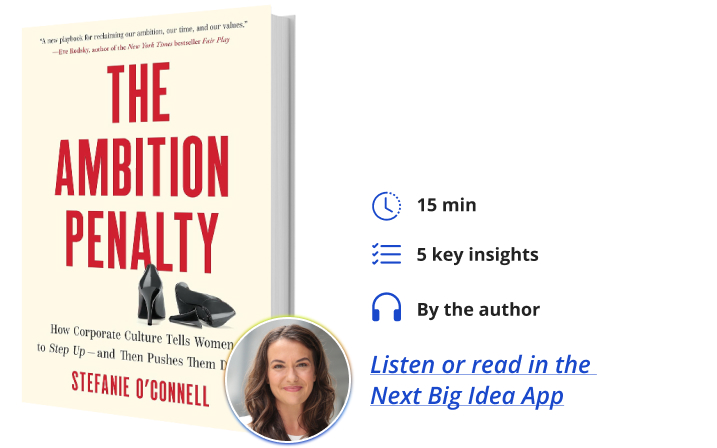
Below, Stefanie O’Connell shares five key insights from her new book, The Ambition Penalty: How Corporate Culture Tells Women to Step Up―and Then Pushes Them Down.
Stefanie is an award-winning financial journalist whose work has been published in Slate, Bloomberg, Newsweek, USA Today, Glamour UK, Business Insider, and CNBC.com. She wrote, hosted, and coproduced the Webby Award-winning podcast Money Confidential and publishes the Too Ambitious newsletter.
What’s the big idea?
The belief that women need to be more ambitious is a myth. The real problem is that workplaces and society often punish women for acting on their ambition, and this shifts attention away from the systemic changes needed to achieve equality.
Listen to the audio version of this Book Bite—read by Stefanie herself—in the Next Big Idea App, or buy the book.
1. Women don’t lack ambition—they face an ambition penalty.
For decades, popular career advice for women has rested on the assumption that women are less ambitious than their male peers: that they aren’t paid as much because they don’t speak up, ask for more, or negotiate their salaries. Or that they remain underrepresented in positions of corporate and political power because they aren’t confident enough, aren’t willing to self-promote, or don’t seek out leadership positions.
This overlooks all the data showing that women do speak up but are still more likely than their male peers to be penalized for expressing the same confidence and assertiveness. And how women do negotiate but remain less likely than their male counterparts to get the raises and promotions they’ve requested—not because they are worse negotiators, but because they are women who “dared” to ask for more.
In case after case, research shows how the very behaviors that men (particularly cis, straight, white, able-bodied men) can reliably implement to get ahead are perceived as a liability instead of an asset when enacted by women. It’s not that women’s advancement is stalled out because women are not ambitious enough, it’s because of the ways women’s professional and public ambition remains disproportionately undermined, unsupported and punished when they act on it. This is what I refer to as the ambition penalty.
2. Empowerment isn’t self-help.
The myth of the gender ambition gap falls into a broader trend of framing gender inequality as a personal problem that a few simple changes in any woman’s individual behaviors or choices can solve, as opposed to a systemic failure, reinforced through chronic exclusion, bias and discrimination—such that even when women practice the same behaviors or make the same choices, they are not able to access the same outcomes as their male peers.
This personalization of the problem, which imagines that a woman’s greatest obstacle to economic, political, or personal power is herself, has been reframed as empowerment. It promises women that they can self-optimize their way out of inequality while conditioning all of us to overlook the actual systems of power that reproduce inequitable outcomes, no matter how much ambition women claim.
More than proving ineffective, researchers have repeatedly documented how this self-help style of empowerment undermines women’s actual advancement. It’s shown to increase acceptance of gender discrimination, as well as increase the perception that women are responsible for their own underpayment, under advancement, and underrepresentation. While simultaneously reducing support for systemic changes and policies that are proven to reduce these inequities.
3. The “right” way to get ahead is still to be a man.
The impossibly fine line between being labeled too ambitious and not ambitious enough is just one of the many ways in which being perceived as too much or too little of anything has become an effective way of limiting women’s opportunities, advancement and pay, even as more explicit discrimination and bans on women’s participation fall away.
For example, a 2023 paper found that women were not discriminated against in the ‘we can’t promote her because she’s a woman’ sense; instead, women’s other identity characteristics were weaponized against them through double standards that were not applied to their male peers.
“The myth of the gender ambition gap falls into a broader trend of framing gender inequality as a personal problem.”
A young woman might be labeled too young to be a leader, while a young man of the same age might have his age reframed as an asset, like fresh, new thinking. Similarly, an older woman is more likely to be dismissed as too old for leadership, while a man of the same age is more likely to be seen as having valuable expertise and experience.
In total, the researchers identified 30 such characteristics that are weaponized against women in this way, setting them up to face not just one but many double standards that enable their exclusion while pretending gender has nothing to do with it.
4. Overestimating women’s progress fuels backlash against them.
There has not been a meaningful reckoning with the ineffectiveness of these individualistic empowerment and career strategies directed at women, in part, because there has not been a meaningful reckoning with all the progress women have not made.
Despite popular claims that it’s men who are falling behind, the gender pay gap in the United States widened in 2025 for the second year in a row. Women were paid 18.6 percent less than their male peers on average—about 81 cents on the dollar. Black women were paid 68.3 percent and Hispanic women were paid 64.5 percent as much as white men, on average.
This average 81-cent-on-the-dollar pay gap women face today is the same as the wage gap in 2005, two decades of individual “empowerment” later. And four decades after women started outpacing men in college, too.
Despite women’s educational gains, a 2023 analysis shows that men still make up about 83 percent of senior leadership in corporate America. And more recent data show women’s access to political and corporate leadership backsliding the past three years in a row.
Meanwhile, a growing share of men report believing gender inequality is no longer a real issue. A misperception that is particularly damaging is that those who overestimate women’s progress in accessing equal opportunity and outcomes also express lower support for gender equality initiatives and are more likely to undermine progress toward achieving the gender equality they already overestimate.
5. The myth of the ambition gap stands in the way of a better workplace for everyone.
Myths, like the ambition gap, keep us distracted and divided, so we don’t come together to support solutions that work better for all of us—across identities.
Instead of advocating for more transparent pay structures and equitable rewards, we blame women for not asking for more.
Instead of challenging a workplace culture that rewards destructive and exhausting zero-sum competition, we blame women for being mean girls or “queen bees.”
“Despite women’s educational gains, a 2023 analysis shows that men still make up about 83 percent of senior leadership in corporate America.”
Instead of demanding greater fairness and accountability from our organizations and their leaders, we blame women for not “hustling” hard enough.
Instead of organizing around policies that support our ambitions both in and outside the workplace, we blame women for not being committed to their careers.
By recognizing how the ambition penalty plays out in women’s working lives, we can start to see that the assumptions behind this blame game are wrong. We can also start to see what they cost all of us.
By making us feel like these were our personal problems, rather than collective, liberatory issues for all women and all people, we’ve been effectively isolated and cut off from our collective power. The collective power that has a strong track record of creating social and cultural change for the many, not just the few. And with far greater impacts and outcomes than any one individual can achieve on their own.
Enjoy our full library of Book Bites—read by the authors!—in the Next Big Idea App: