












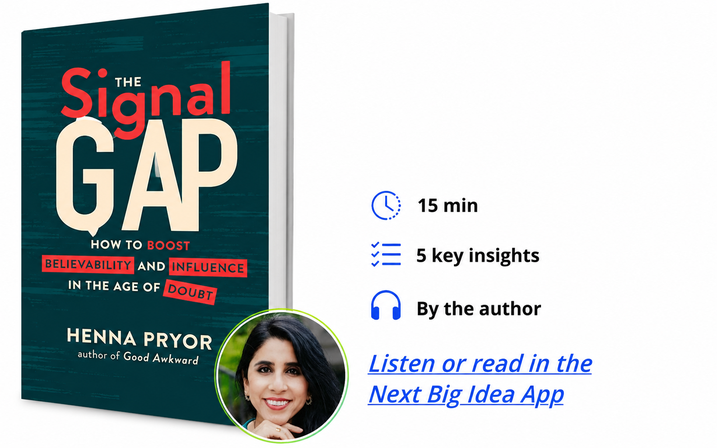
Below, Henna Pryor shares five key insights from her new book, The Signal Gap: How to Boost Believability and Influence in the Age of Doubt.
Henna is a workplace performance expert and keynote speaker whose 14-year background in sales and leadership—much of it on 100 percent commission—put the question of professional credibility at the center of her career. She is the author of Good Awkward and a sought-after voice on influence and trust in the modern workplace.
What’s the Big Idea?
In the Verification Era, someone is going to run the audit on you. Your boss, your client, your team, a stranger with ten seconds and a phone. You don’t get to choose whether it happens. You only get to choose what it finds. So don’t try to be harder to catch. Be easier to believe.
Listen to the audio version of this Book Bite—read by Henna herself—in the Next Big Idea App, or buy the book.
1. Verify, then trust.
For most of our careers, the deal went like this: trust, then verify. Believing was simply the easier path. No one wanted to derail a meeting over a single sentence that smelled a little funny. What were they going to do, drive to the library and scroll through microfiche?
That deal has flipped. Today it’s verify, then trust. The check comes first, before you’ve earned a thing, and it happens in real time, while you’re still talking.
Quick test: Did you know that 97 percent of people who drink oat milk every day are happier, funnier, and smarter than everyone else? That’s according to a study I made up about four seconds ago. You felt your eyebrow go up, didn’t you? A lot of our claims feel like this now. Here’s a real one. The 2026 Edelman Trust Barometer surveyed nearly 34,000 people across 28 countries, and 70 percent said they’re unwilling or hesitant to trust someone with different values, beliefs, or information sources than their own. 7 in 10.
You probably believed that one. But notice what’s different now: you could check me in seconds. So can everyone you talk to at work. Every claim you make is one thumb-scroll away from being audited. And it doesn’t have to be wrong to get checked—it just has to be findable. This is the Verification Era, and in it, every audience is an audit: the board, the client, your team, your teenager. So the gap that matters most now is the signal gap, the distance between what you mean to communicate and what the other person actually believes.
2. Polish got cheap.
A middle school principal, whom I’ll call Principal Reeves, has the kind of inbox most high achievers would recognize: too many messages, all urgent. One afternoon, a mom sends her a long, carefully written email about her son, who’d been in a behavioral incident at school. It’s complicated, emotions are high, and this mom wants to know is that her son has been heard.
She’d sent it at 2:36. At 2:47, the reply lands. It’s long and detailed, every concern answered in its own careful paragraph. The mom reads it, and within three sentences, she knows. The writing didn’t sound robotic. She knew because of the time stamp. 11 minutes to read a long, emotional message, think it through, and write four careful paragraphs? She knows what 11 minutes can and can’t do. The math wasn’t mathing.
“When a machine can produce smooth, warm writing in seconds, polish stops being proof that you tried.”
Here’s what she couldn’t see. Principal Reeves had 14 other unread parent emails, a board meeting in an hour, and bus duty in the parking lot. So she’d dropped the email into her district’s private ChatGPT, added her notes, asked for a compassionate, thorough reply, and hit send. Principal Reeves wasn’t lazy. Her real priority was speed: she didn’t want to leave a worried mom hanging. But what the mom heard was: You were one of many things I had to clear off my desk today.
That’s what happened to polish. When a machine can produce smooth, warm writing in seconds, polish stops being proof that you tried. Too much of it now reads like no one’s home. The fix is naming your real priority, what I call your P0, or Priority Zero. The honest version would have taken 90 seconds to write: “I’ve read this. I want to give it the time it deserves, so I’ll write back Monday.” Or the more modern, “I’ve read this, and I used AI to help formulate some early thoughts, but they reflect what I’d say. Let’s still find time to chat next week.” Your P0 doesn’t have to be heroic. It just has to be true.
3. Name the wall before they hit it.
In January 2024, a man with tattoos crawling up his neck and across his face sat down in front of a U.S. Senate committee to testify about the fentanyl crisis. “I know this is a bit of a curveball,” he said, “but I like a little baseball myself. My name is Jason DeFord, but most people know me as Jelly Roll.”
Then he did something most of us would never dare do in a high-stakes room. He laid out every reason no one there should believe a word he said: his past as a drug dealer, his 40-some arrests, his years in and out of jail. He even named his appearance, admitting he was the last person they’d expect to see testifying in that building. Somewhere in the middle, his voice started to shake. And the room leaned in.
Jelly Roll understood something most of us miss. In the Verification Era, people walk in with a wall up, and a wall is different from an objection. An objection implies you’re already in conversation, and is usually thought of as something people say out loud. A wall is there before you arrive. We’ve spent decades getting good at objection handling, but a wall never announces itself. The client who doesn’t renew rarely tells you why.
“In the Verification Era, people walk in with a wall up, and a wall is different from an objection.”
You can’t stop people from running the audit. But you can change what it finds. So before you make your case, name the wall: the specific doubt, history, or suspicion standing between them and belief. Say it out loud before they have to go hunting for it. Jelly Roll handed the senators every finding himself, so by the time they might have gone digging, there was nothing left to find. That’s the disarm, and I call it Skill Zero. Every other communication skill you have assumes the wall is already down.
4. Lead with the con.
Early in my executive search career, I had 14 open job orders from one big company, and two of my teammates had already been getting nowhere with them. It didn’t take long to see why. Google the company, and the first thing candidates found were employee reviews calling it a sweatshop.
So I tried something that felt like breaking every rule I’d been taught. Before I said one good thing about the job, I told candidates, “Before I tell you anything good about them, if you Google this company, it is not going to be cute.” Then I walked them through exactly what they’d find, and why I still thought the role was worth a conversation. I ended up filling 12 out of 14—the most out of the entire team.
What those candidates heard was: If she’s this upfront about the ugly thing this early, she’s probably not going to hide anything from me the rest of the way. Most of us were trained to lead with our strongest argument. AI does that too now, for free. Ask ChatGPT to write a pitch and it’ll open with every reason to say yes. Choosing to lead with the drawback is a human move, because it costs you something. And a skeptical brain weighs what it would have cost you.
When I interviewed Robert Cialdini, author of Influence, he put it in the plainest terms I’ve heard. Imagine a salesperson who tells you, “Here’s the reason I didn’t sell you the platinum package. You don’t need it.” The thing you didn’t sell them is the proof you’re not just selling.
So find your real con. It’s usually the question you’re dreading. Name it first, don’t bury it, and don’t apologize for it. Then tell them why you’re moving forward anyway.
5. Every post is a promise.
A running coach I’ll call Benji built his whole thought-leadership platform around two words: No shortcuts. The 5 a.m. alarms, the rainy long runs, the reps no one sees. Nearly every post was about grit and consistency, and he believed every word.
Then his audience noticed something. His replies to their comments—the personal ones meant to build community—were obviously AI-generated. The No Shortcuts guy was taking a shortcut in the exact place his audience expected the reps to be real. He used that shortcut on maybe five percent of what he put out. But his followers didn’t decide he was five percent full of it. They threw out 100 percent of his advice on discipline.
“You’re making promises too, all day, often without realizing it.”
When I shared this story with Seth Godin, he compared it to a baker selling pre-rolled croissants while lecturing you about craft. We all use shortcuts. Benji’s mistake was using one inside the very promise his audience had been taught to trust.
You’re making promises too, all day, often without realizing it. Your LinkedIn bio, the article you reshare, the comment you leave about what great leadership really looks like, the reply-all you fired off last week: each one is a small claim about who you are. Add them up, and they become a standard you’ve set for yourself in public, whether you meant to or not. People will hold you to it.
When the gap between that standard and your behavior shows, people don’t ask, “How much did they exaggerate?” They ask, “What else isn’t real?” So when you spot a gap, you have two good options: change the behavior to match the claim or change the claim to match the behavior. Either one closes it. Leaving it open is the only move that costs you.
Enjoy our full library of Book Bites—read by the authors!—in the Next Big Idea App: