











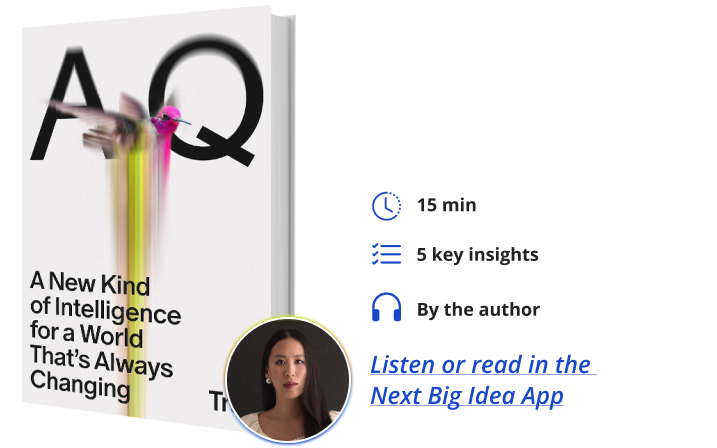
Below, Liz Tran shares five key insights from her new book, AQ: A New Kind of Intelligence for a World That’s Always Changing.
Liz is a leadership coach to the CEOs and founders of some of the world’s fastest-growing companies. Her work has been featured by the Today Show, The New Yorker, the New York Times, Bloomberg, Fast Company, Entrepreneur, and other outlets.
What’s the big idea?
The most consequential divide in modern society is not economic or political. It’s psychological. The gap between people who can adapt to constant change (high Agility Quotient) and those who feel undone by it is shaping everything from workplaces to mental health.
1. AQ, or the Agility Quotient, is the primary intelligence needed for today’s world.
One of my primary responsibilities when I worked in venture capital as an executive at a top firm was to try to understand what all the most successful founders in our portfolio had in common. I started with a personality assessment for every founder we deemed successful, and then I also had long conversations with them about their childhood influences, education, and current hobbies.
At the end of a two-year research period, I discovered that all the most successful, happy, and fulfilled leaders have just one thing in common: they’re always changing. Not only are they always developing themselves, but they also have a standout capability to handle change, uncertainty, and the unknown. This is what we call the agility quotient, or AQ.
And it’s not just leaders. According to the Journal of Managerial Studies, employees with high learning agility are promoted more and receive higher salary increases than their low-agility peers. A study from the University of Minnesota showed that agility is a better predictor of an employee’s potential for career advancement than IQ. It no longer matters how smart you are. In a world where stability is a myth, AQ is the primary aptitude that matters.
2. IQ is a relic of the past.
Intelligence, as a concept, is only 150 years old. It emerged in the late 1800s in France, as mandatory education was adopted and the government suddenly needed a way to rank and place students efficiently in the right classrooms. The historic context that initiated this was the shift from an agrarian to an industrial society.
The norm had been that you grow up and then work on your family’s farm. But suddenly, cognitive abilities became important because you might abandon that farm and go work in a factory or industry somewhere. In addition to school systems, the government and military also needed a mechanism for sorting, ranking, and placing people into the right groupings—thus the concept of IQ was born.
“IQ and EQ are no longer sufficient to explain how we can thrive.”
IQ reigned as the go-to primary intelligence until the 1990s, when globalization and a shift to knowledge work ushered in a new era in which teamwork, collaboration, and communication suddenly became more important. You might be working with someone in London while you are based in Tokyo, and you need to understand how to work with and communicate with them effectively and efficiently. This was the beginning of EQ, a measure of your interpersonal skills. The term was then popularized by Daniel Goleman’s 1995 book, Emotional Intelligence: Why It Can Matter More Than IQ. Over the past 35 years, school systems and corporations around the world have focused on developing EQ skills in their students and employees.
In the midst of our new technology revolution, with AI changing everything we know about work, IQ and EQ are no longer sufficient to explain how we can thrive. Agility Quotient—the ability to handle change, uncertainty, and the unknown—is the intelligence most suited for the world today.
3. You can future-proof yourself.
Think about the very beginning of your career, those early days when you were looking for a job and imagining what your life might become. Did you ever imagine you would end up here? I’d venture a guess that you’d likely be surprised about where you are now. That’s because change is no longer linear but exponential, which means we’ve become bad at predicting where the future is going.
For instance, members of Gen Z, currently the youngest generation in the workforce, are predicted to have 18 jobs spanning six career paths in their adult lives. Compare this to Baby Boomers, who often held one job for decades and received a pension upon retirement.
The same type of instability also holds true for our personal contributions. According to Harvard’s re-skilling lab, the hard-won technical skills we’ve spent our whole careers cultivating, like computer programming, accounting, and social media marketing, have a half-life of just five years. In most tech sectors, that’s more like two-and-a-half years.
Without a doubt, there’s no chance we can imagine where the future is going to take us. This is why we, as ambitious professionals, must shift our focus from investing in our job titles to investing in ourselves by developing highly transferable, durable skills that will make us strong, capable generalists who can thrive in any future terrain.
“Members of Gen Z are predicted to have 18 jobs spanning six career paths in their adult lives.”
Durable skills are human-oriented, broad-based skills like receiving feedback, learning aptitude, self-advocacy, persuasion, and, of course, agility. While technical skills will always be important, they can and will expire faster than we believe. When we invest in ourselves and our durable skills, we become timeless, unique, and invincible.
4. Successful businesses intentionally cultivate cultures of AQ.
When Satya Nadella took over as CEO of Microsoft in 2014, it was a low AQ organization. The stock price had been pretty much stagnant, and the public viewed Microsoft as a bureaucratic beast that had missed out on Big Tech trends like mobile and social networking. Nadella was inheriting a pretty tough job. There were many sweeping strategic decisions that he needed to make. What Nadella understood was that before he could make these strategic decisions, he first needed to overhaul the entire culture by teaching Microsoft how to be a high-AQ organization. He styled this initiative as a shift from a know-it-all culture (IQ-based) to a learn-it-all culture (AQ-based).
Nadella got started building an entirely new culture. He and his team populated the company with stories of what a Learn-It-All mindset looked like, and then he filled the hallways with supportive visuals and put quotes on coffee mugs. The mugs became so popular that people started collecting and trading them.
Finally, Nadella rallied his entire team, and they repeated this AQ-oriented philosophy over and over again until it was ingrained in every employee. Of course, Nadella did push new processes, but he knew that a high AQ, learn-everything mindset mattered most.
Microsoft has been immensely successful under Nadella’s leadership. Stock price has risen 1,000 percent since he became CEO, and the company has pivoted away from Microsoft Office to invest in cloud computing and AI. These bets have paid off. At points, Microsoft has been the world’s most valuable company. Even in 2025, the company’s stock was up 23 percent and was outperforming the S&P 500.
If you want your company, or even just your team, to be successful, it means recruiting for high-AQ people, training employees to raise their AQ, and building a holistic company culture that prioritizes change, agility, and comfort with ambiguity.
5. Embrace your AQ archetype.
Imagine yourself in the Sonoran Desert, a harsh expanse of land that stretches from Arizona to Mexico, where the temperatures climb as high as 120 degrees. The heat and dryness are why thousands of migrants, hikers, and adventurers have died while traversing the Sonoran Desert. What would you do if you had to survive out there?
My answer to that is research. I would obsessively read everything I could about the Sonoran Desert—its flora, fauna, and climate—and then I would write down every worst-case scenario that I could imagine. This is because my AQ archetype is the Novelist. Think of a novelist sitting at their desk, dreaming up a story, and then writing down the plot.
“When we invest in ourselves and our durable skills, we become timeless, unique, and invincible.”
That is exactly how the Novelist archetype operates. They have a vision, and then they design a step-by-step plan to get there. The downside of being a Novelist is that we are not so good at reactive change, meaning the change that we did not ask for. For instance, when a flight gets canceled or a meeting gets rescheduled, this type of commotion throws the Novelist into a frenzy. They just can’t handle the curveballs that life throws at them.
The opposite of a novelist is the Firefighter. They’re the person you call in an emergency. They are excellent in chaos. They’re good at creative problem-solving in high-octane situations (hence the name Firefighter). Because they’re so good at handling anything at the last minute, they often forget to do the type of long-term strategic vision setting that the novelist excels at. Instead, the firefighter says, “Well, I’ll just wing it, so why even bother making a plan?”
The third archetype is the Astronaut. This type is great at both proactive change, which the Novelist thrives on, and reactive change, which the Firefighter does so well. In fact, they’re fast at change. The downside of being an Astronaut, however, is that they’re a lot faster than the people around them, and they can become quite impatient when their colleagues, friends, or family members don’t understand. They change their minds quickly, but are not the best at explaining their decisions. If you’re an Astronaut and want to make things frictionless with those around you, take the time to slow down and explain your context.
Finally, the last type is the Neurosurgeon, and this is the Astronaut’s opposite. The Neurosurgeon is slower, intentional, and not one to change their mind on a dime. In fact, it takes them quite a while to make up their mind about anything, whether it’s deciding to propose to a partner, buy a house, or even something as small as buying a new sweater. The Neurosurgeon wants to make sure that they put a high degree of research and intentionality into any decision that they make. This might mean that the Neurosurgeon seems to have lower AQ, but in truth, the neurosurgeon can be one of the most high-AQ archetypes because once they have set their mind to something, they never give up until it is accomplished.
Part of thriving in this world that requires AQ is understanding your archetype and how to make the most of the hand you’ve been dealt.
Enjoy our full library of Book Bites—read by the authors!—in the Next Big Idea App: