








Below, Virginia Eubanks shares five key insights from her new book, A Guide to Open Water Lifesaving: Lessons on Love, Care, and Survival: A Memoir.
Virginia is an investigative journalist whose work has appeared in The New York Times Magazine, Harper’s Magazine, The Guardian, Nature, and Scientific American. She is an associate professor of political science at the University of Albany, State University of New York.
In 2015, Virginia’s partner, J., was the victim of two violent attacks. In the months and years that followed, they faced wave upon wave of setbacks: police disinterest, suspended health insurance, inadequate medical care, lost income, endless paperwork—and, for J., a serious case of post-traumatic stress disorder. Virginia developed what is known as collateral PTSD, a condition common among caregivers but rarely discussed. She found help in an unexpected place: an old open-water lifesaving manual.
What’s the Big Idea?
Care is not just love or instinct. It is a set of skills that can be learned from people who know how to rescue others without losing themselves in the process.
Listen to the audio version of this Book Bite—read by Virginia herself—in the Next Big Idea App, or buy the book.
1. Rangers don’t rush (because rangers stay).
Ranger Liz told me, “Rangers don’t rush. We have a saying: ‘Slow is smooth and smooth is fast.’ That’s how you can tell who the forest rangers are. We’re the ones moving deliberately when everyone else is running around in a panic.”
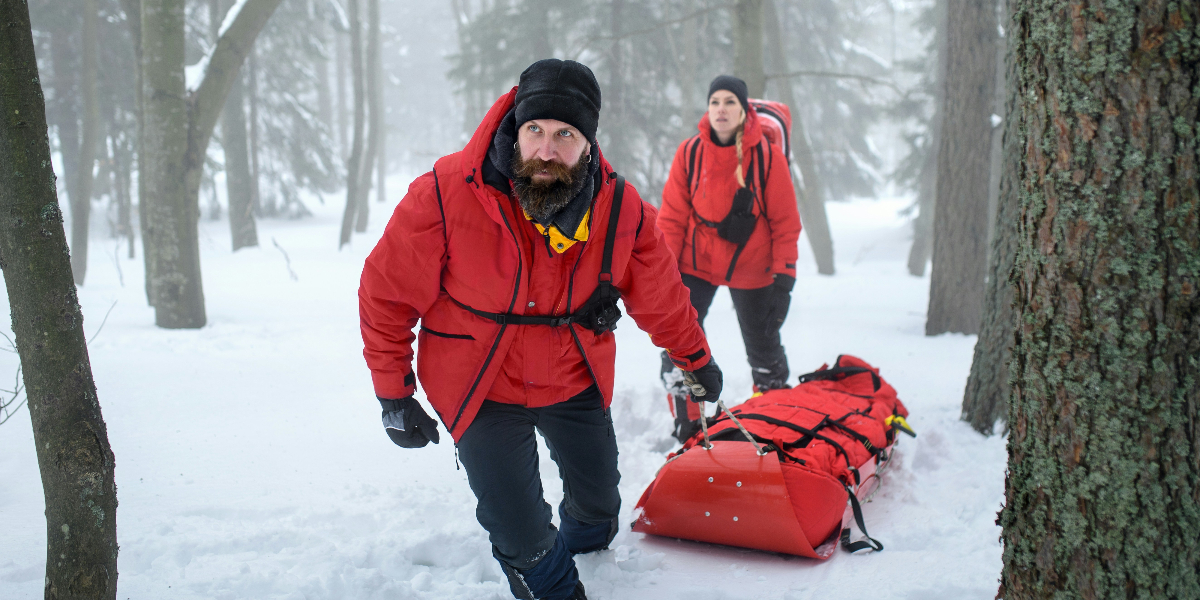
Rangers don’t rush because rangers stay. What distinguishes them from other first responders is that the wilderness setting requires rangers to remain with their rescues for extended periods of time. Where lifeguards or firefighters extract victims and hand them off to EMTs, who then hand them off to hospitals, rangers find victims in the backcountry, stabilize them, and then walk or carry them out of the woods. The process can take hours, even days.
I asked Ranger Liz what advice she had for people lost in the wilderness. “Sit down,” she said. “If you no longer have clarity, stop doing everything, and just sit down. Unless you’re about to get crushed by an avalanche, don’t move again until you are thinking clearly. Sit down, sit down, sit down.”
The lesson for caregiving is this: Don’t let the emergency set the pace of your response.
The cognitive costs of caregiving are real. Sustained watchfulness literally slows blood flow to the brain. Decades of research have found that cognitive acuity declines rapidly when workload is high, and the worker is frustrated, worried, or has limited control over the pace and content of her labor. Caring kin, like me, report exactly these conditions.
Caregiving often takes longer than you think. So, once you’re out of the path of the most immediate avalanche, sit down. When some cognitive capacity returns, think about how you want to respond to the crisis, who you want to be during the process of care and healing, and what skills, resources, and boundaries you’ll need for the days and nights to come. Moving deliberately will help you stay healthy and whole, which will keep you showing up to care for others.
2. Gather your training, tools, and team.
To stay as long as they are needed, forest rangers rely on training, tools, and their team.
Rangers are required to, at minimum, perform as swift water technicians, rope technicians, wilderness first responders, wildland firefighters, law enforcement officers, environmental educators, and natural resource stewards. Every ranger spends six months at the academy learning criminal procedure law, penal law, state land protection, and undergoing sometimes brutal physical conditioning. Their extensive training is what allows them to act instinctively and effectively when emergencies arise.
“Focus on preparedness and adaptability without weighing yourself down with things you don’t need.”
I learned from rangers to carry the ten essentials whenever I am hiking or bushwhacking: map and compass, sun protection, non-cotton layers, a headlamp with extra batteries, two ways to start a fire, two ways to treat water, a repair kit, nutrient-dense food, a compact tarp or tent footprint, and a well-stocked first aid kit (mine weighs two and a half pounds). The trick in caregiving, as in the woods, is to focus on preparedness and adaptability without weighing yourself down with things you don’t need.
Rangers rarely work alone. It takes at least four to carry an injured hiker on a litter. After taking care of themselves, taking care of their team is every ranger’s priority—even before attending to the patient. Kin can’t care unprepared and alone, either. Gather your training, tools, and team before the emergency arrives.
3. Heroes aren’t born; they’re made.
We speak of care as an attitude of the heart, but care is a muscle. You have to practice, to build capacity and competence.
Aquatic safety experts urge the general public not to go in the water to save a drowning person if you don’t have training and a flotation device. “Reach, row, throw, but don’t go,” they say. A drowning rescue is so dangerous to an untrained bystander that there’s a name for losing your life while attempting it: aquatic-victim-instead-of-rescuer syndrome, or AVIR.
AVIR occurs when the courage of would-be rescuers outstrips their competence, and the results can be tragic. Research on 225 drowning incidents in China found that death rates were higher for rescuers than original drowning victims. Research into 88 AVIR incidents in Turkey found that for 47 original drowning victims who were saved, 114 would-be-rescuers drowned.
Bystanders do perform rescues successfully, even when there is great risk to their own safety, in the water and in the wilds of violent victimization. Too often, faced with an emergency and failing care infrastructure, caring kin endanger themselves trying to protect the people they love. It’s a stupid thing to do. It is often the only option. And sometimes, it works.
Heroes aren’t born; they’re made. According to lifesaving experts Richard C. Franklin and John H. Pearn, the way to prevent AVIR is to equip everyone, before tragedy strikes, with the training and tools they need to perform heroic acts. As Franklin says, “Very, very, very few trained lifeguards drown.”
4. Start with one victim, end with one victim.
Sizing up and stabilizing the scene of an accident or disaster before tending to victims keeps rescuers alive and effective. It protects everyone involved from further harm.
So, stop, look around, and take stock of hazards. Is there frigid water? Falling rock? Is bad weather approaching? Most importantly, are other people at risk? Are you at risk? A rescue that starts with one victim should end with only one victim.
“The cost of caring for kin is enormous.”
But that’s not how care infrastructure works in the United States. Rather than being trained and paid to provide skilled labor, family members and other kin are exploited by a system that asks them to do the work of trained professionals without preparation or support. Hospitals send patients home quicker and sicker. Mental healthcare capacity is inadequate and shrinking. Survivors of violent crime have to fight for the space and resources they need to heal in a criminal justice and legal system that prioritizes punishment.
The cost of caring for kin is enormous. Caregivers report poorer physical health than their non-caregiving counterparts—including impaired immunity, impaired healing, and increased risk of hypertension, heart disease, and death. We work part-time, take leaves of absence, or stop working entirely. We save less, have less for retirement, and pay thousands of dollars out of pocket for care expenses. Caregivers report increased memory loss, frequent confusion, emotional strain, mental distress, anxiety, and depression.
A 2015 study found that 60 days after a family member’s admission to the ICU, 23 percent of their primary caregivers met the clinical criteria for PTSD. The authors concluded, “From a psychologic perspective, to have a critically ill relative hospitalized in the ICU equals the experience of enduring and surviving an earthquake.”
PTSD is not contagious; it passed from J. to me via institutional failures and political choices, not blood or breath or DNA. Once the attacks happened, his illness was probably unavoidable, though earlier and better-coordinated care might have helped contain the psychological impacts of the violence. But my symptoms were entirely predictable and preventable.
5. Caregivers deserve a map.
We’re told that care is noble. Transformative. Priceless. A spiritual journey. Caring kin are hidden heroes. Selfless champions. We are also told there is no blueprint for the journey to come.
“You are entering a new and unknown country, with an unfamiliar language and no map,” noted the journalist Allan Little, who cared for his wife after a traumatic brain injury. But there are 13 million people diagnosed with PTSD in the United States right now. There are 59 million of us caring for adult kin. Hundreds of millions have already visited this “new and unknown country”—and millions more are headed there now.
Why, then, is there no map?
“Too often, caring kin find themselves trying to fill gaping holes in the social safety net.”
Everyone’s experience is different. Violent crime or natural disaster or military deployment or sexual assault is a unique, life-shifting experience for anyone. But these things are common, not rare. Normal, not exceptional. We can—and must—plan for their effects.
Examples and waypoints already exist. The Department of Veterans Affairs’ Program of Comprehensive Assistance for Family Caregivers offers training, health care, and stipends for family members of seriously wounded veterans. Disability communities have long crafted care collectives to provide shifts of support for activities of daily living outside the state and the market. Trauma Recovery Centers provide therapy, psychiatric services, care coordination, and personalized wraparound services for free in more than 50 locations nationwide. Some even provide exactly the same services to primary victims of violent crime and to secondary survivors and caregivers.
Too often, caring kin find themselves trying to fill gaping holes in the social safety net, unprepared and on our own. We carry and drag our loved ones down out of the wilderness, down from the peaks of trauma, slogging through rock scree and bogs, only to reach the highway and find no ambulance, no hospital.
If we genuinely value care, we must create more robust support for survivors of violence and their caregivers. We have to make a better map, together.
Enjoy our full library of Book Bites—read by the authors!—in the Next Big Idea App: