












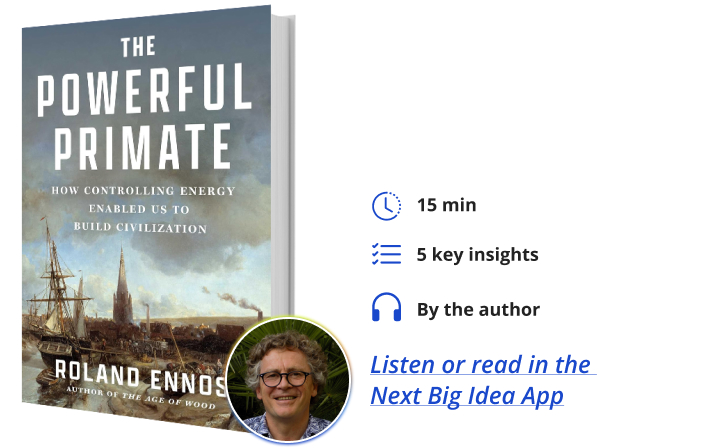
Below, Roland Ennos shares five key insights from his new book, The Powerful Primate: How Controlling Energy Enabled Us to Build Civilization.
Roland is a visiting professor in Biological Sciences at the University of Hull. He is the author of several successful textbooks, as well as author of the popular book Trees, published by the Natural History Museum. His other books include The Age of Wood and The Science of Spin.
What’s the big idea?
Human history is best understood as a continuous escalation of physical power through tools, engineering, and energy use. Though this evolution enabled us to dominate the planet, it has pushed civilization onto an unsustainable path that may require a return to lower-energy ways of living.
1. Our early ancestors survived because of their physical prowess.
We usually think of ourselves as weak creatures who have risen to prominence because of our intellectual and social skills. But in some ways, we are the most physically powerful animals on the planet—so much so that we are feared by even the fiercest of animals.
As soon as early hominids stood upright, they were able to use muscles from all over their body to produce rapid, powerful movements of their arms. And they could hold onto and control simple tools such as sticks and stones in the powerful grip of their hands, enabling them to hit harder, throw further, and cut deeper than any other animal. Early hominids were strong enough to look after themselves on the African plains.
2. We conquered the globe because of our engineering prowess.
Humans weren’t restricted to living in the African savannahs. We learned how to master any environment by developing a wide range of effective, powerful tools. We developed spears, slings, spear throwers, bows, and arrows that enabled us to kill animals at ever greater distances. We developed increasingly sophisticated hammers and knives to process our food. We developed axes and adzes, which we used to fell trees and work wood.
“It was thanks to our engineering prowess that humans spread across all five continents.”
By ten thousand years ago, hunter-gatherers could carry out an almost unlimited range of tasks. They could kill and butcher a huge range of animals and collect and process a wide variety of plants. They could make various tools, construct boats, and build houses. They even learned how to make clothes and build fires to keep themselves warm and cook their food. It was thanks to our engineering prowess that humans spread across all five continents.
3. Cereal farming stimulated engineering.
Despite what we have been told, cereal farming is not the best way to feed ourselves. In many warm, wet parts of the globe, people fed themselves far more easily by becoming horticulturalists, planting and harvesting root crops such as potatoes, yams, and manioc, and fruit such as bananas and squashes.
Cereal farming emerged in drier climates where only short-lived grasses could grow, and where it was harder to make a living. To survive, cereal farmers had to develop a whole new range of tools, materials, and machinery to cultivate, harvest, and process their crops. They developed ploughs to cultivate the land, kilns to make cooking vessels, metals to make axes and knives, querns to grind grain, and machines to irrigate their land. And they learned how to harness power from draft animals, water, and the wind to drive them.
These technologies enabled old-world cereal farmers to construct wheeled vehicles, build ships, and forge the swords and guns that created powerful empires. Ultimately, these inventions enabled a few Spanish adventurers to sail to the New World, conquer its horticultural inhabitants, and impose their inferior form of agriculture on them.
4. The Industrial Age was powered by horticulture and fossil fuels.
Despite its supposed importance, the Italian Renaissance had little effect on progress. Instead, industrialization, which originated in Protestant Northwest Europe, was spurred by the development of market gardening in the Netherlands and mixed farming in England. These fed a growing, wealthier population.
Further progress was powered by exploiting deposits of fossil fuel: peat in the Netherlands and coal in England. The English patent system then sped up technical innovation in the textile, mining, and iron industries to dramatically raise their productivity and kick off the factory system. In the 19th century, the development of wrought iron, high-pressure steam engines, and the hydraulic press further revolutionized manufacturing and transportation, enabling Britain to become the workshop of the world.
“Despite its supposed importance, the Italian Renaissance had little effect on progress.”
Coal finally made large cities habitable as its power was transmitted across town in the form of gas, water, and electricity, while oil finally spread the revolution into the countryside and up into the sky (thanks to the development of lightweight internal combustion engines). In the last 60 years, two new technologies—hydraulics and electronics—have enabled us to power our unprecedented standard of living, without us needing to lift a finger.
5. Our civilization depends on an unsustainable rise in consumption.
At each stage of our civilization, we have solved our problems by harnessing more energy. We have built increasingly powerful machines and created more and more goods. And we have used energy-intensive machinery and chemicals to return to the inefficient cultivation of cereals.
As we use more energy and build more goods, we create more pollution and use more resources, causing problems that can only be solved by using yet more energy and yet more raw materials. Consequently, our farming uses so much land, and our industry uses so many resources and so much energy, that we are in danger of destroying our planet. We can only survive if we return to the simpler, lower-powered way of life that used to sustain the large populations of the New World civilizations: gardening.
Enjoy our full library of Book Bites—read by the authors!—in the Next Big Idea App: