










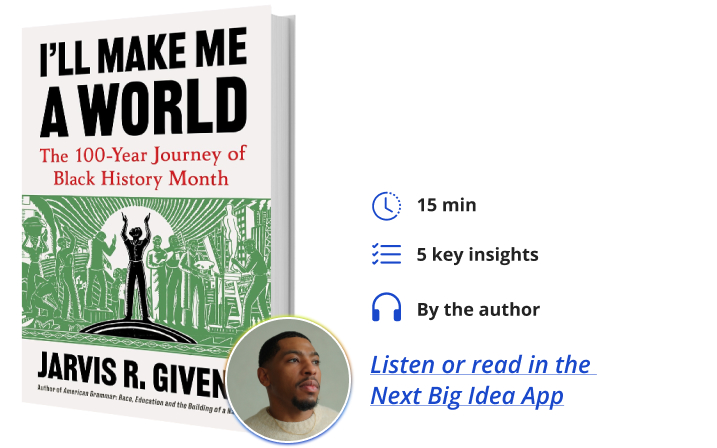
Below, Jarvis Givens shares five key insights from his new book, I’ll Make Me a World: The 100-Year Journey of Black History Month.
Jarvis is a professor of Education and African & African American Studies at Harvard University. He is also the co-founding faculty director of the Black Teacher Archive at Harvard, as well as the Leverhulme Visiting Professor at University College London’s Institute of the Americas.
What’s the big idea?
Black History Month is not simply a commemorative calendar event. It is the outcome of a battle over historical authority, beginning with Negro History Week in 1926 and shaped by African American communities determined to claim history as a source of truth, dignity, and power.
1. Black history is central to American history, but not reducible to it.
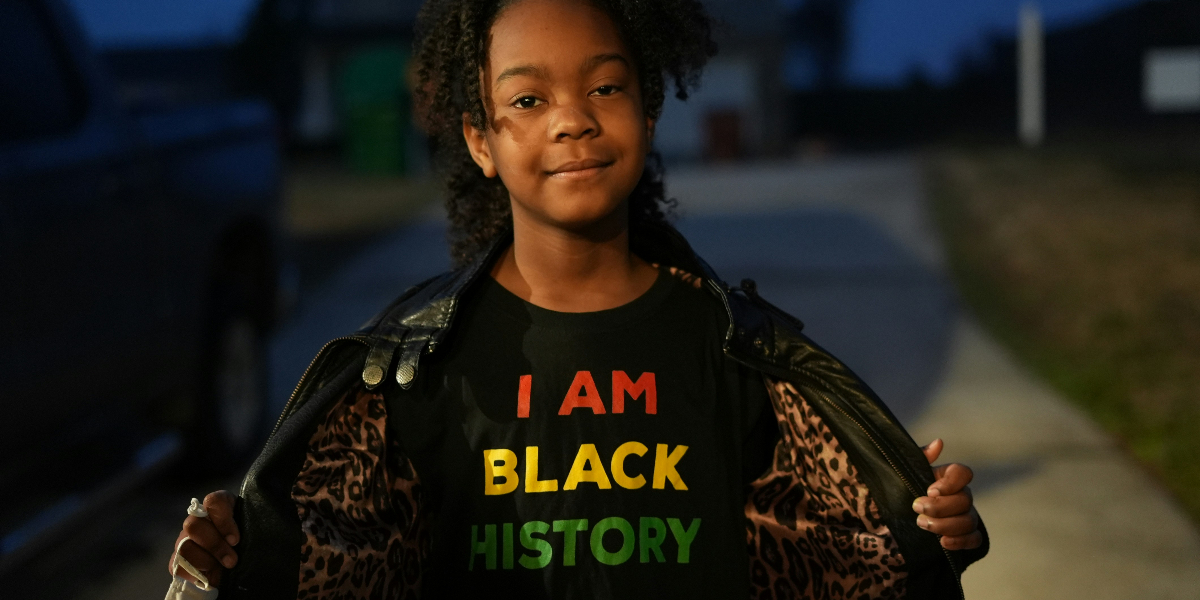
Every February, our nation commemorates Black history and culture, and every February, some segments of the population critique the idea of Black History Month by saying that “Black history is American History” and should not be separated from other parts of our nation’s past. My response is that Black history is a critical part of American history, but not reducible to it.
African Americans played critical roles in every stage of our nation’s development, and generations of scholarship have demonstrated this. There is no way to seriously study the economic, social, or cultural history of the United States without seriously considering the Black presence in this country. However, while this is true, scholars of Black history have also had to contend with some specific challenges and historical questions in their quest to preserve and create knowledge about the Black past.
For instance, scholars like Carter G. Woodson, the famed educator who founded Negro History Week in 1926, had to confront centuries-old myths that Black people (in the U.S. and beyond) had no history and culture, or at least none worthy of respect. Woodson’s professors at the University of Chicago and Harvard University perpetuated such lies during his time there between 1907 and 1912, requiring scholars of Black history to develop this field of study despite antagonistic ideas from the broader historical profession.
Furthermore, African Americans conceived of Black history as an academic project that dispelled lies and documented the experiences of Black people in the U.S., but they also understood African American history to be deeply connected to histories of Black people on the African continent and across the African Diaspora. They recognized how historical myths about Black people in the U.S. were always connected to distortions of African descended people in other parts of the world. These are two of many reasons why I consider the claim that “Black History is American History” to be misguided, especially when used as a critique of Black History Month. It overlooks key intellectual concerns of Black History in the past and present.
2. Black History Month extends from traditions dating back to the time of slavery.
Black History Month has been sustained by intellectual traditions that trace back to the oral and written narratives of enslaved people, as well as Black commemorative holidays organized by African American communities that began prior to the Civil War. Black people have always had something to say about the past.
During the time of slavery, they wrote and published accounts of their individual lives, like Harriet Jacobs’ Incidents in the Life of a Slave Girl, and at times they produced historical accounts of their race in books, like fugitive slave James W. C. Pennington’s A Text Book of the Origins and History, &c. &c. of the Colored People. They also created serial publications, such as Freedom’s Journal, the first Black-owned and operated newspaper.
“There is no way to seriously study the economic, social, or cultural history of the United States without seriously considering the Black presence in this country.”
During the antebellum period, African American communities also observed events like Freedom Day Celebrations, where they celebrated the dates of slavery’s abolition in the British West Indies and the abolition of slavery in the state of New York. Black abolitionists in Boston observed Crispus Attucks Day on March 5, beginning in the 1850s, insisting that the nation needed to remember that a Black man was the first to be sacrificed in the fight for American Independence. African Americans used these holidays not just as a time to mark the calendar, but also as an effort to encourage communities to remember critical aspects of their shared past and to continue struggling against enduring forms of injustice shaped by that past. Negro History Week, then Black History Month, was directly informed by these traditions.
3. Valuing Black lives in the past is also about valuing Black lives in the present and future.
Black history was always about more than mere facts, dates, and details about past events. Black scholars recognized how antiblack historical narratives, as well as racist practices of erasing and silencing Black histories, were used to justify violence imposed on Black people in the present and future. This was the larger political concern of Black history.
For instance, Black History Month’s founder, Carter G. Woodson, wrote in 1933, that “There would be no lynching if it did not start in the schoolroom.” Thus, scholars who created the early movements to study, preserve, and teach Black history aimed to document the truth about Black life and culture as an effort to discredit racist ideas that once legitimized slavery, and which continued to organize Jim Crow society and antiblack colonialism in the African Diaspora.
Scholars of Black history insisted that Black lives in the past were worthy of study and expressed deep insights about the human condition, and by doing so, they were also valuing Black lives in the present and future. They were insisting that Black people, like all people, have histories, cultures, and traditions that can be traced back, and that Black lives could facilitate deeper understandings about the meaning of justice, freedom, and beauty in our shared world. This was a central part of the politics of Black history—it set out to offer a more inclusive account of the human past to bolster demands for more inclusion, justice, and fairness in the present and future.
4. Critical interpretations of Black history must include Black histories of the everyday.
Given current and past attacks against Black history, there has been a tendency to resist claims that Black people have no history or culture worthy of study by focusing on monumental men and women, or individuals of rare achievement. Some have focused on pre-colonial African kingdoms and their contributions to human civilization, or they have focused on a small number of easily recognizable figures in more recent centuries, such as Martin Luther King, Jr., Harriet Tubman, Benjamin Banneker, Rosa Parks, and President Barack Obama. Such historical exemplars have been used to prove that Black people can exhibit inspiring acts of heroism and effective leadership, and that they, too, possess the potential for great intellectual achievement.
Yet, while these things are certainly true, it is important to emphasize that Black history is, and has always been, about more than just striking back and discrediting the naysayers. What’s more, to fully account for Black histories and cultures requires a deep study of everyday aspects of Black life in order to gain more nuanced insights about the lives lived by Black people in the past, to gain a deeper understanding of how ordinary people struggled and worked to live meaningful lives despite oppressive social conditions.
“It is important to emphasize that Black history is, and has always been, about more than just striking back and discrediting the naysayers.”
When working to popularize the study of Black history, Carter G. Woodson did not look exclusively to the most famous African Americans or to precolonial African kings and queens—though he certainly had a deep appreciation of such stories of monumental achievement. His most enduring motivation came from the lives and lessons of illiterate African American men with whom he worked alongside in the coal mines of West Virginia; from the stories of his formerly enslaved mother and the lessons he learned from her brothers, who were Woodson’s first teachers in a one-room schoolhouse. He was inspired by those whom he referred to as “the workadays” and “undistinguished Negroes” even as he celebrated the lives of Frederick Douglass and Harriet Tubman.
What’s more, it is only because of the labor and organizing traditions of everyday Black people that Negro History Week successfully spread across the U.S, eventually evolving into Black History Month in 1976. It will require the work of everyday Black people to ensure that this tradition is sustained in the years and decades to come.
5. Power shapes historical memory.
As we witness a resurgence of attacks on Black history in the aftermath of presidential executive orders and state laws that criminalize teaching about race, it is important that we recognize that such attacks are just the tip of the iceberg. To fully assess this moment, communities must be supported in recognizing that this fight extends from a long legacy of powerful elites dictating what counts as legitimate history, who gets recognized as legitimate interpreters of history, and which historical sources are reliable representations of past lives and events.
This battle is taking shape on multiple fronts: it is being waged through the defunding of historical projects focused on preserving Black historical collections and narratives, and it is also being waged through coordinated efforts to decrease access to higher education for students from historically marginalized communities—the very scholars who are most likely to study and produce critical knowledge about the past.
“Black History Month is an ideal time for cultivating historical consciousness in communities and across the nation.”
As we move into the next era of Black History Month, it is important that this relationship between power and historical memory be made more transparent. I was reminded of this while working with a group of African American high school students in an out-of-school program focused on Black history. After a discussion about archival research and the making of historical narratives, these students expressed concern that they had never been invited to think about what happens behind-the-scenes of the historical enterprise—never allowed to think critically about the making of historical narratives. The truth about Black history is that its form emerges from the substance of Black lives lived in the past, but also through the labor of memory workers struggling to preserve and narrate the details of said lives. Knowing such details about the making of Black history is critical for the development of a mature historical consciousness among individuals and communities.
Every generation bears the responsibility of cultivating memory workers who will continue to recover, rewrite, and seek new depths of understanding about the Black past and to tell the truth about it; and the cultivation of such laborers is urgent, precisely because the threat of erasure is so fiercely repetitive. This is how we protect not only critical knowledge about the Black past, but also secure the future of Black history. Black History Month is an ideal time for cultivating such historical consciousness in communities and across the nation.
Enjoy our full library of Book Bites—read by the authors!—in the Next Big Idea App: