










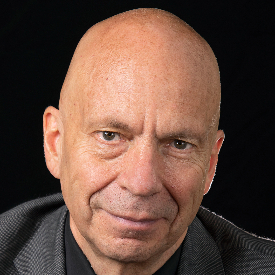
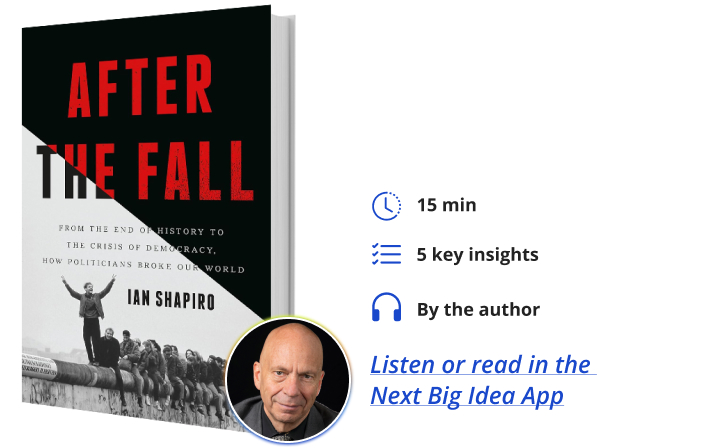
Below, Ian Shapiro shares three key insights from his new book, After the Fall: From the End of History to the Crisis of Democracy, How Politicians Broke Our World.
Ian is Sterling Professor of Political Science and Global Affairs at Yale University. He is a fellow of the American Academy of Arts and Science and the American Philosophical Society, and a member of the Council on Foreign Relations.
What’s the big idea?
Today’s instability was produced less by sudden extremist disruptions than by decades of failures, shortsightedness, and missed opportunities by mainstream political leaders after 1989.
Listen to the audio version of this Book Bite—read by Ian himself—in the Next Big Idea App, or buy the book.
1. Donald Trump did not destroy the rules-based international order.
Commentators across the political spectrum are excoriating Trump for destroying the rules-based order. His actions in Venezuela and Iran, his threats against Greenland, Cuba, and even Canada certainly paid little heed. But the critics failed to appreciate that Trump’s predecessors had fatally undermined that order long before he came along.
Indeed, their actions facilitated someone with Trump’s unilateralist agenda coming to power and then implementing that agenda. George Herbert Walker Bush had acted with admirable restraint to reinforce the rules-based order when Saddam Hussein invaded Kuwait in August 1990. Bush created the template for what he labeled a New World Order. He secured authorization from the UN Security Council to assemble a diverse international coalition to expel Iraq from Kuwait. And Bush was careful not to exceed the terms of that authorization when neoconservatives and others urged him to topple the Iraqi regime and begin a project of refashioning the political landscape of the Middle East. The principle that animated Bush’s effort stopped the bully without becoming one might indeed have become the basis for the international community’s response to aggression in the post-Cold War period, if his successors had followed in his footsteps. Alas, it was not to be.
In 1999, Bill Clinton led a NATO operation to bomb the Serbs in Kosovo without Security Council authorization—even though no NATO country was threatened—it earned him condemnation from Russia, China, and across the Global South. George W. Bush prosecuted his Global War on Terror with coalitions of the willing, most notably when he toppled the Iraqi regime without Security Council authorization in 2003, creating a failed state that became the terrain on which ISIS subsequently flourished. Barack Obama led a NATO operation to topple Gaddafi’s regime in Libya in 2011, again, when no NATO country was threatened. NATO went beyond anything the Security Council had authorized, producing another failed state that persists to this day, and an arms bazaar across North Africa that fueled conflicts from Mali to Syria.
By the time Donald Trump came along with his unilateralism in 2025, he was pushing against a door that had been open for a long time. Some will say that Trump’s actions are orders of magnitude more extreme than those of Clinton, Bush, and Obama. While this is true, it calls to mind Ernest Hemingway’s line about how he went bankrupt: first gradually, then suddenly. Worse than what they did was what they failed to do: buttress and entrench the first President Bush’s precedent into the norms and rules of international conduct.
2. The old Cold War did not have to be replaced by a new one.
When the Cold War ended, it was very much an open question as to what would replace the decade-long standoff that existed between the West and the Soviet bloc. Many commentators recognized that it was a rare opportunity for a fundamental restructuring of those relations.
Richard Nixon made a compelling case that the important precedent to bear in mind was the actions taken by the victorious powers after World War II. He had in mind the Marshall Plan, named for George Marshall, Harry Truman’s Secretary of State at the end of World War II.
Marshall had been motivated by a desire to avoid repeating the mistakes made after World War I, when the victorious powers imposed punitive sanctions on the defeated Germany, which aided and abetted the rise of Hitler. Marshall said, “No, we don’t want to go down that path again.” And led the effort to make massive investments in the defeated Germany and Japan and to fold them into the post-war international security arrangements and economic arrangements that were shaping the revival of the Western economies after the war.
It had widely been recognized as a huge success, and this was the precedent that Nixon said should guide the victorious powers at the end of the Cold War. He advocated massive investments in the new Russia to help it become a successful, diversified economy that would support democratic institutions and to press hard to achieve security arrangements with the defeated Soviet Union, not least because of the nuclear weapons that they possessed.
“It had widely been recognized as a huge success, and this was the precedent that Nixon said should guide the victorious powers at the end of the Cold War.”
And there were willing interlocutors on the other side. Throughout the 1990s, Boris Yeltsin made it clear that he wanted Russia to join the new NATO. He wanted economic integration with the West, and he desperately needed Western investment in his economy to assist with the transition and fend off the reactionaries who were pushing to stop the transformation of the old Soviet Union into a thriving market economy.
Sadly, Clinton brushed aside his entreaties to join NATO and infuriated him by adding the Czech Republic, Hungary, and Poland to NATO in 1999. Clinton left Yeltsin twisting on the vine economically by dribbling out aid as Russia lurched from crisis to crisis, that eventually required an IMF bailout in 1998.
By the time Yeltsin left office, he had been permanently alienated, but the new leader of Russia, Vladimir Putin, was looking for a reset when he came into office at the beginning of the millennium. He too talked about economic integration with the West. He too talked about joining NATO for the first three years of his premiership until George W. Bush’s invasion of Iraq made this almost impossible because it was so unpopular in Russia. This began the process of Putin’s alienation.
That continued as discussions of NATO expansion proceeded—particularly the overtures to Georgia and Ukraine that NATO leaders put on the table in 2007—precipitating, eventually, Putin’s invasion of Georgia in 2008 and his total alienation from the West. Of course, it’s possible that Putin would have become the ultra-nationalistic authoritarian leader that he has ended up being anyway, but nothing the West did took advantage of the possibilities to explore better options that might have taken the world to a different place than the one we find ourselves in.
3. Mainstream political parties contributed to the rise of the extremist right-wing populism.
They did this by embracing policies that produced economic growth whose benefits made the rich much richer, while most voters experienced decades of wage stagnation, job insecurity, and diminished prospects for themselves and their children. They did this because they came to believe in Margaret Thatcher’s infamous words that “There is no alternative.”
Thatcher meant that there was no alternative to privatizing public sectors, deregulating markets, and embracing free trade—the set of policies that came to be known as neoliberalism. The traditional alternative of deploying industrial planning and Keynesian fiscal and monetary policies had been declared obsolete for apparently failing to vanquish the stagflation of the 1970s.
Thatcher and Ronald Reagan mainstreamed the neoliberals who had been hanging around in right-wing think tanks for decades, giving them access to the corridors of power. Left parties found themselves on the defensive, particularly after the collapse of communism rendered the neoliberal model hegemonic. They embraced it, with the zeal of converts, as the only path to power.
“Thatcher and Ronald Reagan mainstreamed the neoliberals who had been hanging around in right-wing think tanks for decades, giving them access to the corridors of power.”
The message was that everyone had better suck it up and get with the program, but the 2008 financial crisis shattered the hegemony. Blindsided political and financial elites were panicked into grabbing the Keynesian tools that they had decried for decades, borrowing hundreds of billions of dollars to save bankrupt financial institutions and stave off worldwide depression. But they did it hypocritically, protecting the financial elites who had caused the crisis and even paying their millions in bonuses while continuing to impose austerity on everyone else in accordance with neoliberal dogma. Financial markets rebounded, and elites prospered, but most people continued to flounder as jobs kept disappearing offshore and increasingly to technology.
Right-wing populists like Donald Trump, Marine Le Pen, Nigel Farage, Giorgia Meloni, and Geert Wilders seized the chance to mobilize millions of voters by attacking the elite hypocrisy, decimating mainstream parties, and threatening a revival of anti-system politics that hadn’t been seen since the 1930s.
All of this could have been avoided if mainstream politicians had used their leverage during the 2008 financial crisis and its aftermath. They should have insisted that the price for saving Wall Street was saving Main Street as well. This would have meant major investments in 21st-century infrastructure and educating the workforce for the new tech economy in ways that produce economic growth whose benefits are widely shared. That is what they still must do if they want to regain the support of the tens of millions of voters who have deserted them for the destructive agendas of the right-wing populists.
Enjoy our full library of Book Bites—read by the authors!—in the Next Big Idea App: