






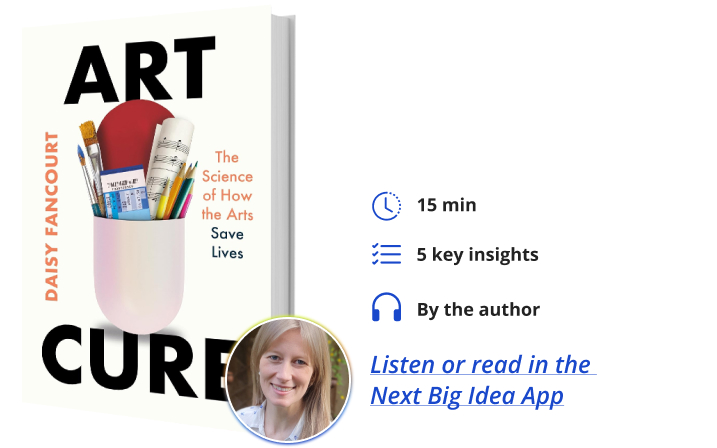
Below, Daisy Fancourt shares five key insights from her new book, Art Cure: The Science of How the Arts Save Lives.
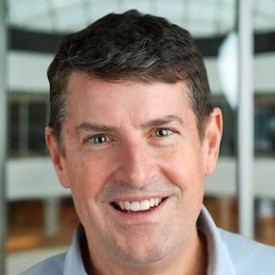
Daisy is Professor of Psychobiology and Epidemiology at University College London, where she heads the Social Biobehavioral Research Group. She is also the Director of the World Health Organization Collaborating Centre on Arts and Health. Daisy has published over 300 scientific papers and won over a dozen academic prizes.
What’s the big idea?
The arts are not a luxury; they are essential. Everyone can fine tune their arts experiences to target specific aspects of health and wellbeing. Art, alongside diet, sleep, exercise, and nature, is the forgotten fifth pillar of health.
1. Arts engagement has remarkable health benefits.
Did you know that regularly going to the theatre, live music events, or museums and galleries could nearly halve your risk of developing depression over the next 10 years? And, if you already have depression, combining arts therapies with antidepressants could double your improvements.
When we engage in the arts, we give our brains what they want to be happy: we activate the same pleasure and reward networks that are activated by food, sex, and drugs—which release happy hormones, like dopamine. And we also give our brains what they need: dancing, singing, crafting, and writing help us fulfill core psychological needs like autonomy, control, a sense of mastery, and a way to regulate emotions.
We are born artistic, and in our early years, the arts shape the architecture of the entire brain, nurturing core cognitive skills like language and fundamentally altering the size and functioning of different brain regions. The arts build the brain’s resilience against the ravages of diseases like dementia, helping us preserve our cognition. Art activates brain regions involved in diverse functions such as movement and even builds new neural pathways around brain injuries.
Zooming out to look more widely at the body, there is no physiological system art does not affect. When we breathe deeply during activities like singing, we strengthen our respiratory muscles. When we dance, we have decreases in blood pressure, glucose levels, and stiffness in our arteries. Arts engagement even improves immune activity and affects the expression of our genes, helping us stay biologically younger, physically fit, and functioning free from disease for longer.
“There is no physiological system art does not affect.”
If children engage in art workshops, choirs, book clubs, dance classes, drama groups, or bands, they’re less likely to be lonely or develop behavioral problems—like committing crimes or abusing substances. This is because the arts build vital life skills such as self-control, self-esteem, empathy, and motivation. The arts also keep us more socially connected and less sedentary, all of which affect our future health.
The arts, however, are not a panacea. In fact, there are examples of the arts doing more harm than good, from being used as a means of torture to a way of wielding power within society. But these are exceptions. It’s no exaggeration to say the arts could save your life. From preventing suicides to increasing life expectancy, the arts really can be the difference between life and death.
2. The arts are an amazing medical tool.
Just playing recorded music while people are having surgical procedures under local anesthesia halves the amount of anti-anxiety medications they need. And playing music prior to general anesthetics leads to patients needing 10mg less morphine after their surgery. These are major findings, given that we are witnessing an ongoing opioid crisis. Routine surgeries are a common route for people to become dependent on opioids. But we could help reduce the quantities of drugs needed by providing people with music in the surgical areas of hospitals.
Also, I’ve worked with some incredible programs that use the arts to help people with motor problems, from Parkinson’s disease to strokes to cerebral palsy. One of my favorites is a program that works with children with one-sided paralysis, also known as hemiplegia. The recommended treatment is hours of hand exercises. But magicians and occupational therapists in England have turned these hand exercises into magic tricks. So children can now attend magic camps where they practice their hand exercises and learn to be young magicians. Studies show that within just two weeks, the children have a 30 percent improvement in how much they use their affected hand and are performing 93 percent of daily tasks with both hands. Their brains even respond more efficiently when they use the hand affected by the hemiplegia.
“The arts really can be the difference between life and death.”
Indulge me in one more example: I’m sure you’ve heard of or known somebody who developed Alzheimer’s Disease. And even though they couldn’t remember their own relatives, they could still hum along to their favorite songs. This is because there is a specific region of the brain responsible for our long-term musical memory, and it’s one of the last regions to be affected by Alzheimer’s. Music really can be one of the last things people remember. As they remember the music, they typically also remember other memories associated with that music, reconnecting them to their past selves.
The arts can have two roles in medicine. Sometimes they are a more effective treatment. At other times, they provide an adjunct to medical treatments that helps us focus not just on what is the matter with us, but on what matters to us.
3. As individuals, we are not valuing the arts enough in our lives.
Can you imagine if a drug had the same catalogue of benefits as the arts? We would be telling everyone about it, fighting to get our hands on it, paying premium prices, and taking it religiously every day. Unfortunately, the reality is quite different.
How many minutes did you spend actively engaging in the arts yesterday? By “actively,” I mean that you weren’t multitasking. When we asked this of a representative sample of U.S. adults, 95 percent said zero. If your figure was higher than this, you technically could be congratulating yourself. But…is that number sufficient? Are you truly valuing the myriad of health benefits?
If we compare arts engagement to other health behaviors across high-income countries, 57 percent eat vegetables every day, and 40 percent engage in 150 minutes of physical activity per week. I’m not convinced that the arts are so much less enjoyable than eating broad beans or sweating in the gym. Rather, we have two problems:
- Most people are unaware of how valuable the arts are to our health.
- We as societies are really devaluing the arts.
4. We as societies are really devaluing the arts.
If you look back a few centuries, everyone around the world told stories, sang, and danced as a natural part of everyday life. But we have taken this ubiquitous human behavior and commodified it—turned it into a luxury. The engagement we do have is increasingly passive, like playlists we plug into and zone out from. And every time we face periods of austerity, funding for the arts is the first thing to go.
We haven’t considered the health ramifications of these decisions. For the last few years, I’ve been collaborating with my government in the UK on new economic modeling. Every year in the UK, the general health benefits of engaging in the arts for working-age adults alone are estimated to be worth over £18 billion. I am itching to get my hands on the data to run the same analyses in the U.S. because every pound we cut in investment in the arts has consequences for health and healthcare systems.
We should be worrying about the impact of not having regular arts engagement. Arts deprivation is linked with increased risk of depression, dementia, chronic pain, harmful behaviors, physical decline, and premature mortality. And by failing to ensure equal access to the arts, we’re exacerbating health inequalities.
“We should be worrying about the impact of not having regular arts engagement.”
But I’m optimistic. Every health behavior we’re now familiar with has had a “seatbelt moment”: a time when societies suddenly woke up and realized how important that behavior is to our health. Diet started getting its due attention in the 1970s, exercise in the 1980s, seatbelts in cars in the 1990s, and smoking bans around the millennium. I believe the seatbelt moment for the arts is now.
5. Think about art as you think about food.
Crash diets don’t work. So don’t go out and cram creativity into every crevice of the day. Your goal is regular, sustainable engagement. Work out the equivalent of getting your five-a-day for vegetables. Maybe that’s 10 minutes of art before you start work, or picking up some crafts each evening before bed.
Diversity is key. We all know we should eat as many plants as we can, and the same goes for art. Each art activity offers different health benefits, so don’t get stuck on just one art form. Remember to experiment with new ones. Also, just like you might have a rule for how often you treat yourself to eating out, plan regular arts treats, like tickets to a show or an arts class. And don’t forget to be a mindful chef. No more plugging into headphones and zoning out; if you’re listening to music, really listen to it! If you’re going to a gallery, put your phone on silent.
Arts can be one of the most mesmerizing, awe-inspiring, sense-tingling, meaningful, and enjoyable experiences in our lives. We should all be making more time in our lives for art, allowing ourselves to feel exhilarated, intoxicated, and elated. Art is fundamentally, measurably good for us.
Enjoy our full library of Book Bites—read by the authors!—in the Next Big Idea App: