










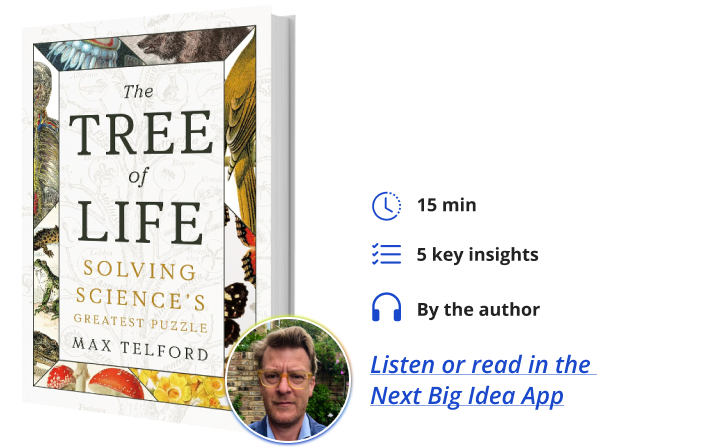
Below, Max Telford shares five key insights from his new book, The Tree of Life: Solving Science’s Greatest Puzzle.
Max is an award-winning evolutionary biologist and the Jodrell Professor of Zoology and Comparative Anatomy at University College London.
What’s the big idea?
All life on Earth belongs to a single ancient family tree, and its branching structure records both how new species arise and how traits evolve over deep time. By reading this tree correctly—seeing past evolutionary look-alikes—we can use it as a time machine to trace our shared origins and reconstruct the long path that led from the first life to humans.
1. There is one tree of life.
There is a single family tree of life that relates every member of every species alive on Earth today. No matter how alien some species may seem, we really are related to all of them.
It’s easy enough to see that we are related to the creatures that look most like us—chimpanzees, for example. Common ancestry explains the incredible similarities. Our many shared characteristics also tell us that we and chimpanzees share a common ancestor that lived relatively recently—about 10 million years ago. We also share quite a lot with all the other primates, although not quite as much as we do with chimps. The common ancestor that links us to monkeys lived further back in time, perhaps 30 million years ago.
We can keep on tracing our ancestry back in time to meet older and older ancestors that link us to increasingly different species. Eventually, when we reach back about 550 million years into the past, we meet the ancient ancestor that links us to all the other animals, from jellyfish and corals to butterflies and snails. We are very different from jellyfish, but humans and jellyfish still share some fundamental things: bodies made from many tiny cells, and systems such as muscular, nervous, and digestive. It’s still possible to imagine our common origin.
Two billion years back, we’re related to fungi, green plants, and a whole host of tiny single-celled creatures. We can still find things we share with these aliens, most notably the fact we all have cells with chromosomes in a nucleus.
The final, longest leg of our journey takes us four billion years into the past where we meet the ancestor that we share with all of life on Earth. At first glance, it is hard to see what we could possibly have in common with a bacterium. But there are many parts of being alive—complicated things like the DNA double helix, the ways our cells divide, how our cells make energy—that are essentially identical in every living thing. These shared aspects of being alive have proved to be so intricate and unexpected that it is impossible to imagine that they have been invented twice.
If these complex aspects of being alive have a single origin, then everything alive today that has these features must have inherited them from the same ancient source. These shared basic features of all life are irrefutable evidence of just one origin of life.
2. The tree of life describes the birth of new species and the evolution of new forms.
The shape of the tree of life—with its trunk, huge lower boughs, followed by smaller and smaller branches and twigs—describes two different parts of evolution.
First, it shows us how different species are related. The lowest split on the tree represents the ancient event where the ancestor of all life, a single species, divided into two separate species. The two large groups of species that trace their ancestries back to these first two branches are the most distantly related.
“These shared basic features of all life are irrefutable evidence of just one origin of life.”
As time passed, each of these two oldest branches went on to split again and again to form more and more species. Each moment when one species divides to make two is shown on the tree by a split and the appearance of new branches.
The second thing we can read on the tree is how species change. As soon as two species have separated, they are free to evolve in their own separate directions thanks to the process of natural selection. This change is represented by the upward growth of the branches—the more a species has changed, the longer its branches. As our distant ancestors changed by evolving new characteristics (a backbone, specialized limbs, or a clever brain), each new invention became handed down to their descendants.
The rather helpful outcome of this process is that each branch can be recognized by the inventions that the ancestor passed on to its descendants. The first vertebrate passed on its new backbone to all its descendants, and now we can use this feature to recognize all the species that belong to the vertebrate branch. We can recognize mammals by their fur and milk, and plants by their green leaves, and so on.
3. Sometimes evolution fools us.
The inventions that allow us to recognize which species are related to one another are the raw material we use to work out the shape of the tree of life. We have gathered masses of useful information over the past couple of centuries: anything from the shapes and colors of different species, details of their physiology, and (for animals at least) the minutiae of how they develop from a fertilized egg into a fully formed adult. Most important of all, for the last 50-or-so years, we have invented ways to use similarities and differences in genes to work out relationships.
With all this data, it might seem odd that we are still struggling to work out the shape of the tree of life. Our difficulty lies in a part of biology called convergent evolution: different branches of the tree of life coming up with the same solution when faced with the same evolutionary challenge.
“Convergent evolution is very common and is one of the biggest challenges we face when mapping the family tree of life.”
There are countless examples of convergent evolution, but my favorite comes from swallows and swifts. I am not an expert on birds. Until very recently, I assumed the similar-looking swallows and swifts were close relatives. They live similar lives; their fast, acrobatic flight is almost constant as they catch insects on the wing. They are beautifully designed for this, with light, streamlined bodies, slender, backward-curving wings, and a wide, gaping beak.
But they are not closely related. Details of their skeletons and comparisons of their DNA have shown that swifts are more closely related to hummingbirds than to swallows. And swallows are closer to owls than they are to swifts.
My mistake was caused by convergent evolution. From very different starting points, both swallows and swifts started to feed on flying insects. And one excellent way to catch this elusive and tiny prey was to evolve a light, slender, maneuverable body; wings backswept like a fighter jet for fast flight; and a big mouth to maximize the catch. Both swifts and swallows have stumbled on what is essentially the same solution to the problem of catching insects on the wing. It is this convergent evolution that made them look so similar and that fooled me. Convergent evolution is very common and is one of the biggest challenges we face when mapping the family tree of life.
4. The tree of life is very big and very old.
A family tree is a great way to picture the evolution of life’s dazzling diversity. But in some ways, it is utterly inadequate. A mature oak tree standing forty meters tall can be covered in as many as a million leaves. But to picture an oak tree big enough to carry a leaf for all the species alive today (which one recent estimate puts as high as a trillion species), we would have to imagine standing in the shade of an oak towering 40 kilometers above us, halfway to space.
The age of life on Earth is hard to picture. The very oldest part of the human historical record goes back about six thousand years—before the pyramids, before Stonehenge—to the first use of writing. But the ancestor we share with chimpanzees, our very closest relatives, lived ten million years ago. To meet this very closest of our many ancestors, we need to travel back in time roughly two thousand times further than the whole span of human history.
If we want to attempt picturing the time frame of evolution, we need to put it in another context. I like to use the familiar proportions of the human body, where the 4.5 billion years of Earth’s existence are represented by the height of a human; the moment of the Earth’s first formation lies at the feet; the events of today are found at the crown of the head.
“If we want to attempt picturing the time frame of evolution, we need to put it in another context.”
On this human time scale, the first appearance of life would be found at the level of the shin. The first animals don’t appear until we reach the bottom of the chin. The first animal with four legs (the ancestor of all amphibians, reptiles, birds, and mammals) is found at the tip of the nose. The first primates don’t appear until high in the hairline. This human timescale shows that most of the history of life on Earth contained no animals at all. Humans only feature in the very last few frames of the movie.
5. The tree of life is a time machine.
Arguably, the most valuable thing that comes from knowing the relationships between all species of life is the ability to travel back in time to meet our ancestors. To travel back in time to discover when each character first appeared, we simply need to ask which other species we share it with.
Let’s look at humans, for example. Some of the most basic bits of human biology are found across the tree of life, from humans to bacteria to plants. DNA is a feature of all of life, and this tells us that DNA must also have existed in the very first organism alive on Earth. This is the ancestor that all of life on Earth inherited DNA from. This way of thinking has just allowed us to travel four billion years into the past to know something about a tiny species we will never be able to see in the flesh.
Other parts of what adds up to make us human are restricted to smaller groups of organisms: the backbone is found in all the vertebrates, but not in insects or mollusks. This tells us that a backbone was an invention of the vertebrate ancestor, a creature that lived about 500 million years ago. Fur and milk are found in all mammals, but not in reptiles or birds. This tells us that fur and milk first appeared 100 million years ago in the ancestor of mammals.
We have been able to do this time travel by knowing just two things: what characteristics different species have and how these species are related. This amazing trick can be used to reconstruct the characteristics of any ancestor. It’s the secret we can use to follow our own evolutionary story from humble beginnings at the bottom of an ocean to an ape who can wonder about his origins.
Enjoy our full library of Book Bites—read by the authors!—in the Next Big Idea App: