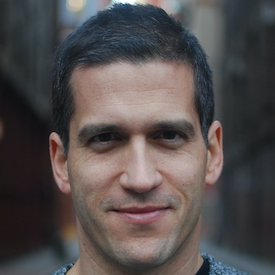












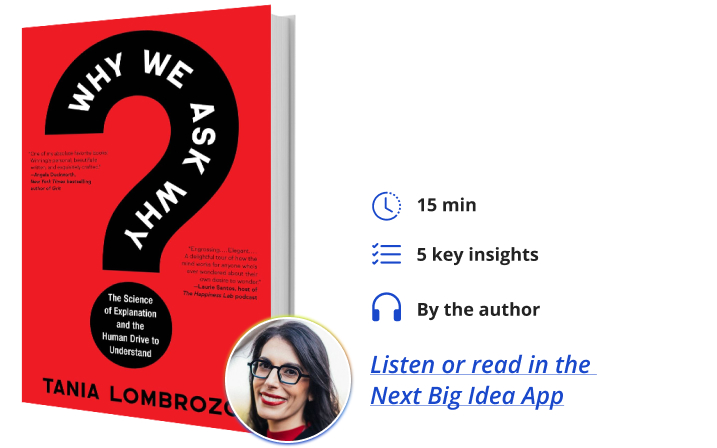
Below, Tania Lombrozo shares five key insights from her new book, Why We Ask Why: The Science of Explanation and the Human Drive to Understand.
Tania is a professor of psychology at Princeton University, where her research focuses on the cognitive science of explanation and belief.
What’s the Big Idea?
Explanations do more than help us understand the world. They shape what we believe, how we learn, and the decisions we make. By recognizing the ways explanations can both illuminate and mislead, we can become more curious, think more critically, and make better choices about the future.
Listen to the audio version of this Book Bite—read by Tania herself—in the Next Big Idea App, or buy the book.
1. Explaining is a superpower.
Most of us appreciate the close relationship between explanation and learning. When we want to learn something new, we seek an explanation—reaching out to someone we know, reading a book, searching the internet, or asking a chatbot. But one of the most remarkable things about explaining is that we can sometimes learn just from explaining to ourselves.
It’s a phenomenon called the self-explanation effect, first documented in educational settings. Researchers found that when students explained new material to themselves, they not only learned it better, but could also generalize it more effectively to new problems. In the course of trying to explain something to ourselves, we can gain new insights or recognize our gaps in understanding. When we appreciate what we do and don’t know, we’re in a better position to direct our own learning.
2. Cultivate your curiosity.
Curiosity is one of the most powerful forces in learning, and it’s often what triggers a search for explanations. But what happens when curiosity is satisfied? Is that an end to learning?
Strikingly, the answer is no. Research in my lab has found that when people receive a satisfying explanation in response to a question, that actually stimulates further curiosity. They’re more likely to be curious about the answers to follow-up questions. Good explanations are engines for learning because they encourage a desire to learn more. Even young children show a similar pattern in their infamous chains of why-questions: when a caregiver responds with a genuine explanation—more than “just because”—the child is more likely to move on to a follow-up question.
“Good explanations are engines for learning because they encourage a desire to learn more.”
We’ve also found that curiosity is contagious. When people are curious about the answer to a question, we’re more likely to be curious ourselves. One of the best ways to cultivate our curiosity is to surround ourselves with good explanations and curious peers.
3. We fall prey to explanatory illusions.
With a visual illusion, something about our perceptual experience misleads us about what is and isn’t true. Explanatory illusions are cases where our explanatory experience—our sense of what is or isn’t a good explanation—misleads us regarding what’s true.
For example, we might find a simple explanation more satisfying than a complex one, leading us to perceive the world as simpler than it truly is. Research has identified a variety of other features of explanations that can shift our judgments of whether an explanation is good or bad, even when those features aren’t reliable indicators of truth. This is a problem because we rely on explanations as a basis for our reasoning and decisions. If we fall prey to explanatory illusions, that’s an obstacle to using our explanatory superpowers and cultivating our curiosity to its full potential.
Fortunately, we can protect ourselves. The first step is knowledge: learning about our explanatory illusions so we’re in a better position to spot them in action. The second step is to practice strategies like explaining to ourselves, gathering additional data, and considering alternative explanations.
4. Explanations are more than facts.
We tend to talk about explanations as if they’re objective entities out in the world, just waiting to be discovered. But that’s not the right way to think about them.
Consider an example. A child does poorly on the science component of a standardized test, and someone asks why. What counts as a good explanation is going to depend, first, on what exactly they’re trying to explain. Are they wondering why the child did poorly on the science component, rather than doing well? Or are they wondering why the child did poorly on the science component, in particular, rather than the math or English component? Even once we’ve specified exactly what we’re explaining, there will be a host of possible answers. Most likely the child’s performance resulted from the confluence of many factors: they didn’t study enough, the test was hard, the teacher didn’t explain a key concept well, they didn’t sleep enough the night before, they became anxious about running out of time during the test, and on and on.
“Even once we’ve specified exactly what we’re explaining, there will be a host of possible answers.”
When we explain, we pick out just one of all the factors that played some role in what we’re trying to account for. Explaining is an active process: we make countless decisions about what to explain and how to go about it, depending on our context and our goals. And those decisions have important consequences for how we think about the world.
5. Explanations decide the future.
Suppose you explain a child’s poor performance on a science test by highlighting how little they studied. That places the blame on them and points to a clear correction for the future: study more. Suppose instead you explain it by pointing out the teacher’s inadequate instruction. That shifts blame to the teacher and suggests a different course of action—perhaps the teacher can explain key concepts better next time.
When we explain, we don’t just describe the past. We paint a particular picture of what the world is like, with implications for our evaluations and our actions. Explanations don’t just guide our learning; they shape our orientation to the past and the future. Understanding the science of explanation won’t just help you become a better producer and consumer of explanations. It might just change the way you navigate the world.
Enjoy our full library of Book Bites—read by the authors!—in the Next Big Idea App: