











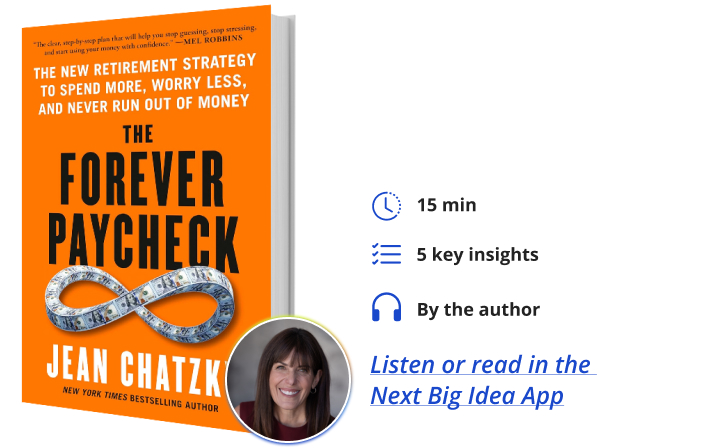
Below, Jean Chatzky shares five key insights from her new book, The Forever Paycheck: The New Retirement Strategy to Spend More, Worry Less, and Never Run Out of Money.
Jean is the founder of HerMoney Media and host of the HerMoney podcast. You may also recognize her from NBC’s Today Show, where she spent 25 years on air as Financial Editor.
What’s the Big Idea?
We spend decades learning how to save for retirement, but almost no time learning how to spend once we get there. Turning part of your savings into a reliable paycheck can replace fear with confidence, giving you both the security and the permission to enjoy the money you worked so hard to build.
Listen to the audio version of this Book Bite—read by Jean herself—in the Next Big Idea App, or buy the book.
1. The pension disappeared, and nothing replaced it.
When you think about how previous generations retired, the answer was easy: you worked for a company, stayed loyal, then the company gave you a pension when you retired, and the pension paid you every month for the rest of your life. You didn’t have to think about it—it just showed up, right on schedule, like a paycheck. That, in combination with Social Security, was enough to live comfortably.
That world is gone. About 40 years ago, we started shifting away from pensions and into 401(k)s and other accounts like them. That took the responsibility for funding retirement off the books of companies and placed it on individuals instead.
Over the years, 401(k)s became really good tools for accumulating savings. This was especially true after 2006, when the Pension Protection Act cleared the way for employers to automatically enroll you in plans, automatically bump up your contributions each year until you were maxing out, and default your investments into target date funds that made sure you were taking an appropriate amount of risk for someone your age. These systems were designed to protect people from their own worst investing instincts. And they dramatically improved our odds of building real savings.
Unfortunately, no one ever bothered to look at—or create tools for—the flip side of the equation: What happens when retirement comes, earning ends, and you have to make the money you have last the rest of your life? I’ll tell you what happens: Fear takes hold. Fear that the money will run out before you run out of time.
61 percent of Americans are more afraid of running out of money in retirement than dying. 84 percent of Gen Xers are “concerned or terrified” about having no more paychecks in retirement.
2. Saving and spending are two different ball games.
Saving is straightforward. Your 401(k) balance goes up, and you feel good about your contributions. You likely never even see the money if it comes directly out of your paycheck, so you’re not missing it. Spending in retirement is much more complicated. No formula tells you, “This is the safe amount to spend this month.” The result is that many retirees are simply not spending. One study that looked at people 20 years into retirement found they had only spent 12 percent of their money, on average.
“Many retirees are simply not spending.”
Researchers at Cornell University found that people treat certain things as precious—a good bottle of wine, a nice box of chocolate, gift cards for spas and special restaurants—and hold onto them for so long, waiting for the right moment, that they literally end up spoiling or expiring. People are more afraid of using something too soon than never using it at all. Retirement savings work the same way. Once that balance feels hard-won and irreplaceable, pulling money out doesn’t feel like spending it. It feels like losing it. So they don’t.
I watched this behavior in my own mother. She was 63 when my father died. He left her with a modest pension, Social Security, a paid-off apartment, a nice long-term care policy, and a retirement account. For the next 20 years, I watched as she happily spent the pension, Social Security, and the interest on the retirement assets. But she wouldn’t touch the principal itself. This was despite the fact that she had three grown kids telling her to spend because we didn’t need her money. When she died a couple of years ago, she no longer had the same balance in her retirement account…she actually had a little more.
She, like many people, was comfortable spending the money that she knew was going to show up every month. But her assets? She was going to leave her hands off. Researchers have seen this behavior time and again. One study looked at people with the same amount of assets, but half had their money in pensions that produced a paycheck. The other half had their money in retirement accounts. The people with pensions typically spent double the money. They were living better, happier, with the same amount of money overall.
3. You don’t need a massive nest egg to build a Forever Paycheck.
Two misconceptions:
- When people hear “guaranteed income for life,” they assume it’s only for people with millions saved. It’s not.
- A Forever Paycheck means you need to take all of the money you’ve saved and invested and convert it into income that has to last the rest of your life. Nope, you only need to convert some of it—typically a quarter to a third.
You want the portion you convert to a paycheck, when combined with Social Security, to be enough to cover all of your needs and most important wants for the rest of your life. Since you’re only peeling off some of your savings for a guaranteed paycheck, you still keep cash on hand for emergencies, and a significant amount of money growing in stocks, so it can help you keep pace with inflation over a retirement that could easily last 30 years or more.
Risk in retirement is different than risk during your working years. When you still have a long runway before you need the money, you can typically afford to take more investment risk; there’s time for the market to recover if it dips. Once you’re actually drawing down your nest egg, you have to manage risk differently because a shortfall in your income means less of the things you want and maybe even less of those that you need.
There are two ways to get a paycheck that lasts the rest of your life: You can buy one or build one. You build one by using investments or you can buy one with insurance. Which one suits you is dependent on your personality. If you’re a little more risk-averse and want guarantees that the income will last for life, an annuity (insurance) is the better bet. If you are afraid of missing out on future market gains, then you may be better off with investments.
“Which one suits you is dependent on your personality.”
I used to be anti-annuity. I’d spent 15 years at personal finance magazines where they were basically a dirty word. But after doing all of this research, I have chosen to annuitize a chunk of my own portfolio to provide an income that will fund my Forever Paycheck.
4. A steady paycheck can add years to your life.
Guaranteed income improves your health. People with a reliable income stream in retirement report lower rates of disability and better health outcomes than people with the same amount of money sitting in an account they’re managing on their own.
Financial stress is chronic stress. It disrupts sleep, raises cortisol, and keeps your nervous system on alert. A paycheck (even a modest one) tells your body that you’re safe.
Part of it is timing. A paycheck gives you a do-over every month; if you spend on something you regret, more is already on the way. A balance in a retirement account doesn’t work like that. Watching a number go down feels like losing that money forever.
I like getting a paycheck. I’ve liked it since I was 15 and got my very first one; there’s something about watching money land in your account reliably that just feels good. I don’t think that feeling goes away once you stop working.
“Watching a number go down feels like losing that money forever.”
In a recent survey, 60 percent of retirees said their assets had grown since they stopped working. But when they were asked how it felt to draw down their own savings, the words that kept coming back were uncertain, anxious, and vulnerable. Only about a quarter said they felt comfortable with spending. That’s because there are really two separate questions in retirement: can I afford to spend this, and am I comfortable spending this? The answers aren’t always the same, but by adding a steady paycheck, you can quell some of that anxiety.
5. The real risk is never spending the money you’ve worked so hard to save.
We talk endlessly about the fear of outliving your money. We almost never talk about the opposite failure: dying with most of it still sitting in your account, having spent decades not enjoying the life you saved for. This is my mom’s story. I believe she lived well. But could she have lived better? Yes. She was disciplined almost to a fault, and it meant 20 years of not fully spending what she and my father worked for.
Once you have the Forever Paycheck in place, you get to shift into dealing with life as it actually happens. I’m a longtime Nora Ephron fan, and I’ll admit that tweaking is one of my favorite verbs. There’s a scene in You’ve Got Mail where Tom Hanks, trying to woo an unsuspecting Meg Ryan, says he’s “in the middle of a project that needs…tweaking.” The word stuck with me. You don’t have to start from scratch or wipe the slate clean every time something changes. With a paycheck covering the basics, you can simply nudge yourself back toward your goals.
The real tragedy isn’t running out of money in retirement. It’s doing everything right for 30 or 40 years, and then being too afraid to enjoy what you built once you stop working.
Enjoy our full library of Book Bites—read by the authors!—in the Next Big Idea App: