











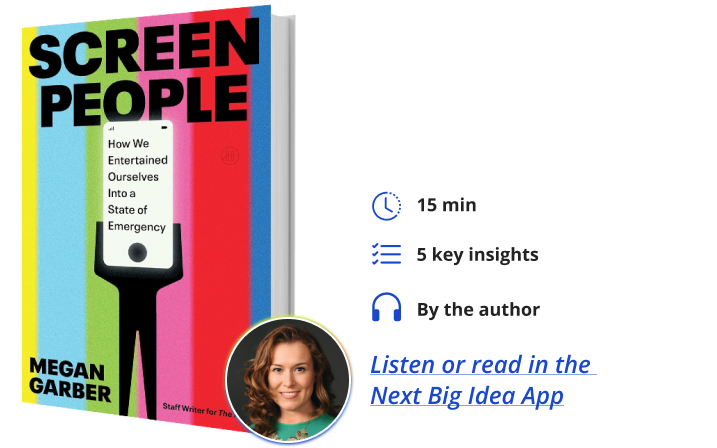
Below, Megan Garber shares five key insights from her new book, Screen People: How We Entertained Ourselves into a State of Emergency.
Megan is a staff writer at The Atlantic who writes about culture. She previously worked as a reporter for the Nieman Journalism Lab, as well as a critic for the Columbia Journalism Review.
What’s the big idea?
The internet is transforming human identity, relationships, and society in profound ways, and we still have the power to decide what kind of world it creates.
Listen to the audio version of this Book Bite—read by Megan herself—in the Next Big Idea App, or buy the book.
1. The internet is rapidly changing what it means to be human.
In recent years, the word “human” has become something of a cliche. Goods are marketed as “human-powered,” and we compliment people by saying things like “what a great human.” That language reflects the reality—and the anxiety—of life in these early days of the digital age. The internet can sometimes seem like an endless CAPTCHA test, always asking us to prove that we are, in fact, humans (rather than, say, a product of AI). And language that literally humanizes people is acknowledging the broad consequences of that demand. “Human,” in digital spaces and more broadly, is no longer a given. It’s becoming one possibility among many.
Someone who anticipated that shift was Marshall McLuhan, the Canadian theorist best known for his idea that “the medium is the message.” For McLuhan, communications technologies like TV and newspapers—what he would call mediums—are different from other kinds of technologies. They might seem like things that we use and control; they might seem like straightforward conveyors of what today we’d call content. But—and this is the message part—mediums shape the content, too. And along the way, they shape the humans who consume it.
McLuhan introduced his theories in the 1960s, when the medium that was transforming life was television. He was talking about screens, but ones that operated, essentially, in one direction: TVs broadcast moving images and audiences consumed them.
But the screens of the internet work much, much differently. They’re not one-way propositions. They are interactive. Think of a service like Zoom, which turns “see and be seen” into a technological proposition. Two-way screens, in general, remake us as two-way people. On them, we’re both humans and pieces of media, three-dimensional bodies and two-dimensional images—we’re whos and whats at once. The duality is basic, in one way—it’s just how screens work—but they’re also deeply consequential. After all, in the world at large, “objectification” is widely recognized as a violation: as an insult, as a problem. In the world of screens, though, objectification is just a fact of physics. Objectification is the internet’s price of admission.
“Two-way screens, in general, remake us as two-way people.”
And screen-based objectification is becoming ever more common and ever more systematized. As the internet edges ever closer to becoming a way of life, screens are expanding from what they’ve been for so long—things people watch—into things people inhabit. They are places where a growing number of humans work, meet, learn, date, fight, laugh, and live their lives. Screens are technologies that are also, in a very real sense, human environments. And, every day, we’re doing what all creatures do when they contend with new environments: We’re adapting to them. And often, whether we mean to or not, we’re conceding to them.
2. “Main character energy” is becoming a cultural crisis.
A few years ago, the clothing chain H&M launched an ad campaign based on the idea that the store’s clothes would allow the people who wore them to become “the main character of each day.” The campaign was nicely prescient. Main characters—the exhibitors of “main character energy”—are everywhere these days. It’s common now for people to talk about their own character arcs, about “the writers” who allegedly script out world events, about people who have “lost the plot,” and people who have been “canceled.”
Such language isn’t fully new. Americans have traditionally admired people who are “larger than life” and seem cinematic. Sociologists have long talked about performance as a framework for understanding everyday social interactions. But the internet is bringing a new literalism to those ideas—in large part because its screens are stages that never end. On screens, we watch the spectacles, and we are the spectacles. We become each other’s critics. We become each other’s fun. All the world’s a stage, that longstanding metaphor, is becoming more like a mandate.
The consequences of that shift are expanding to nearly every facet of life, online and off. Screens, because they double as inescapable mirrors, are making self-consciousness ever more standardized. And many people now talk about daily life as a source of endless performance anxiety. They talk about the “fear of being perceived.” TikTokers have coined terms like “cocooning” and “bedrotting” to describe not just being at home but, specifically, staying home as a soothing alternative to the demands of public exposure.
Their reticence is revealing. When all the world’s a stage, all the world is also a set. Smartphones, on top of everything else, are movie studios in miniature, carried around in people’s pockets. They mean that anyone with a phone can become a cinematographer, producer, and content creator. Anyone can find themselves as the star—or the extra, or the scenery—in someone else’s show, whether they’ve consented to the spotlight or not.
We have everyday people becoming everyday celebrities. Celebrity elevates people, but it also tends to demean them, and sometimes even dehumanize them. Historically, celebrities have been people who function a lot like fictions: They’ve been what the artist Andy Warhol once called “half people.” Celebrity is becoming more accessible, or you might even say more democratized. But that also means that more people run the risk of getting cut down to size.
3. On screens, those most basic of facts—people—can come to seem like fictions.
In a social media post he sent in 2022, Donald Trump posed a question: “Why are people so mean?” he asked. It was a good question. And “main character” energy is one answer: Screens can muddle the distinction between real people and fictional ones. They can also make it easier than ever to wound people we’ve never met.
“Screens can muddle the distinction between real people and fictional ones.”
Screens do more than objectify people. They also distance people from one another. And physical distance has a way of becoming moral distance, too. Think how much easier it would be to speak badly of someone behind their back than to criticize them to their face.
Media theorists talk about the “online disinhibition effect”: the basic idea that some people behave differently in digital spaces than they would in physical ones. One explanation they offer for the discrepancy is that online environments can seem unreal to people in ways that IRL environments simply don’t. That explanation can extend to the people who populate those environments—especially when those real, human people are coexisting with bots and the pseudo-“people” generated by artificial intelligence. “Is that person real?” was once a question asked primarily by bigots. On the internet, though—and as a basic matter of digital hygiene—it’s a question we need to keep asking.
4. The internet is revolutionary, but it is not unprecedented.
In 17th-century England, King James ordered his royal printers to create new editions of the King James Bible. They dutifully completed their assignment, only later to realize that in the editions they had just mass-produced, the Ten Commandments were missing a word. “Thou shalt not commit adultery” read as “Thou shalt commit adultery.” The typo, best I can tell, did not give rise to a spate of cheating scandals in early modern England. But the misprinted text—which would later be called the “Wicked Bible”—encouraged a different form of infidelity.
Before the printing press came along, Bibles were created by scribes. They were works of craftsmanship that could take months, sometimes even years, to produce. Bibles were rare and expensive, making the Church and its clergy the Bible’s gatekeepers. They presented its teachings to laypeople as both the law of the land and the mystic gift of an infallible deity—with text that was meant not to be questioned but simply obeyed.
But then that text got typos. The Word of God became the words of God—and the words, sometimes, conflicted. The early days of the printing press were also the early days of market capitalism. The two developments were deeply interconnected. And the Wicked Bible, however singular it was in its errors, had a lot of company. Its misprint was one of many that occurred as printers raced to get God’s words to market. The sloppiness had broad implications, especially because Christianity back then was so much more than a religion. It was politics. It was culture. It was life’s organizing principle. The Bible had been the source code for all of that. But the misprints suggested that the code could have bugs.
“The early days of the printing press were also the early days of market capitalism.”
That was destabilizing for people of the time. But it might feel quite familiar, too. The printing press brought transformations that anticipated the ones we’re navigating today: new forms of democratization, new forms of literacy, new forms of art and expression and knowledge—the old gatekeepers falling, and new ones clamoring to rise in their place. Our version of that can be even more unsteadying because it is also deeply personal. The printing press changed how people saw the world. The internet is changing how people see one another.
5. “The algorithm” is not destiny.
The science fiction writer Arthur C. Clarke once observed that “any sufficiently advanced technology is indistinguishable from magic.” He meant the line as a nod to technology’s power. Today, the line might read more as a warning. The internet is machinery that can seem like magic, precisely because it often doesn’t seem like machinery at all.
Yes, its screens are objects made of metal and glass, and, yes, the worlds within those screens are designed by people who are guided by extremely analog incentives—money, status, and power—but many of the ways we talk about screens (as environments) downplay those realities. The internet as “ether,” for example, its information stored in the “cloud,” its workings decided by “the algorithm,” that formless entity that affects everyone and answers to no one. It’s easy to treat the internet as just another technology, indistinguishable from magic. But the treatment is counterproductive and simply incorrect. The internet is not a mystical force. It is not a foregone conclusion. It is machinery. Magical thinking may soothe us, but it won’t save us.
The internet was created by people in the hope that the endless connection it afforded would help us be more human and more humane. Every day, we’re testing whether those early ideals can still be realized. We’re making small choices that, taken together and over time, will shape what it means to be human on, and in, our screens. We owe it to ourselves, and the people who will follow us, to choose wisely.
Enjoy our full library of Book Bites—read by the authors!—in the Next Big Idea App: