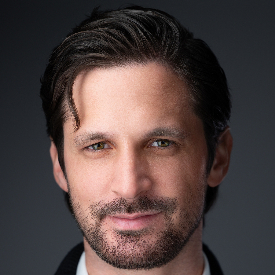










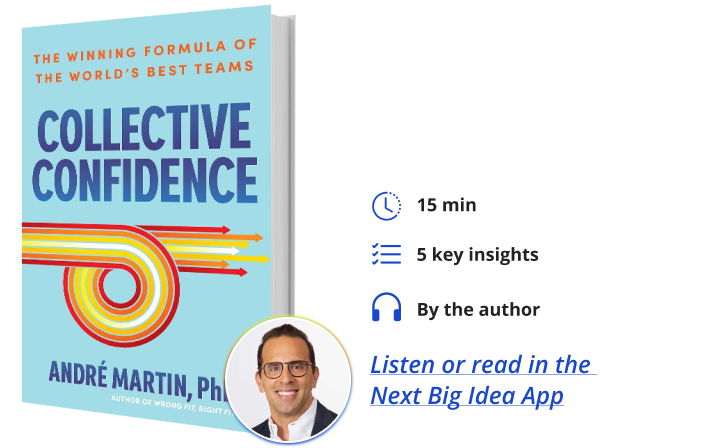
Below, Dr. André Martin shares five key insights from his new book, Collective Confidence: The Winning Formula of the World’s Best Teams.
André is an organizational psychologist. He has spent his career building and coaching teams—first inside Mars, Target, Google, and Nike, and now with founders, executive teams, and athletes.
What’s the Big Idea?
Our present moment calls for better, more confident teams. You cannot motivate your way to confidence. Everyone needs to know why they matter. Brilliance must be borrowed so we can see success as possible. And leadership works best when everyone holds a piece of it.
Listen to the audio version of this Book Bite—read by André himself—in the Next Big Idea App, or buy the book.
1. The team is the only unit of performance that matters.
In August of 2017, Hurricane Harvey flooded Houston. Official rescue systems were overwhelmed within hours, so ordinary people hitched up their fishing boats and went to work. They became known as the Cajun Navy. No hierarchy, no script, nobody in charge. They split the city into sectors, tracked water levels, and reached trapped families through Facebook groups and walkie-talkie apps; within days, they pulled an estimated 8,000 people from flooded homes.
No one trained them for that. They shared a belief that together they could figure it out.
Leading these days is hard. The Surgeon General has called loneliness a public epidemic, with one in five employees feeling lonely on a daily basis. Change is coming at us at a magnitude, pace, and relentlessness never before seen. And in early 2025, a survey of executives found 84 percent of companies feel underprepared for the disruptions headed their way.
Thriving alone has become almost impossible. The team is the only unit of performance that matters now. I saw this firsthand at Google when the pandemic hit. The team I led took our entire onboarding program virtual almost overnight. No executive had that playbook. The group built one in the middle of the chaos.
Collective confidence is shown to be one of the strongest predictors of future performance. When the next disruption arrives, your job is not to have the answers. Your job is to have already built a team that believes it has the capability to find answers together.
2. You cannot motivate your way to confidence.
Midway through a rigorous inspection of the USS Honolulu, a weapons system issue came up. Then equipment damage compounded it. The inspectors had every reason to fail the crew before the exam was finished.
The crew rallied. They worked on the problem and demonstrated capabilities the inspectors had written off. At the end, the lead inspector told them, “We’ve done a number of these exams over lots of years, and this was the best we’ve ever seen.”
“Confidence spreads like a virus and compounds like interest.”
Admiral John Richardson, who commanded that submarine, told me that story. In his mind, that moment was curated over the entirety of the year leading up to it, one sailor at a time. Whenever a new sailor came aboard, Master Chief Bill Kramer sat him down and gave him the truth in two halves. First half: this is going to be hard. You’ll stand watches and do scut work while you’re unqualified. Second half: you will have help. You will have mentors. And after a year of grinding, you’ll earn your dolphins, and everything changes.
Richardson and Kramer also went hunting for small wins. The ship spent holidays on a four-hour cleanup—Thanksgiving and Christmas included. They ended it and spread the work across regular duty days. Kramer’s line: “Those were big wins because they were little wins.”
By inspection day, that crew was full of people who had already proven to themselves they could handle hard things. That team’s belief was assembled out of individuals who both believed in themselves and in each other. Confidence spreads like a virus and compounds like interest.
3. Everyone needs to know why they matter.
Every August, 70,000 people build a temporary city in the Nevada desert for Burning Man. Inside that city, thousands of adults line up to adopt stuffed animals. That’s Camp Corny.
It started in 2014 when Paul “Disco” Troiano carried a single stuffed unicorn on a stick around the playa. “When I would hand it to someone, they’d start dancing with it, and it just made them so happy,” he told me. Fifty animals the next year, then 100. Now, it’s 3,000 a year.
The real magic isn’t the stuffed animals. It’s what happens to the people who show up to help without pay, equity, or any clear monetary benefit. They do it because the collective matters. Investment bankers become bar bosses. Pharmacists become party bosses. A craftsman who never thought of himself as creative and a software developer who had never touched fire effects team up to build a 25-foot fire-shooting unicorn arch.
“Contributory confidence is knowing that your skills, effort, and ideas matter to a specific group.”
Troiano’s rule: if you see something that needs doing, you’re now in charge of it.
In my research, this was one of the most powerful predictors of collective confidence, and one of the least studied. I call it contributory confidence. Individual confidence is about your own ability. Contributory confidence is knowing that your skills, effort, and ideas matter to a specific group. Many employees can recite their job description. Far fewer can tell you why they are vital on their specific team. So tell them, and be specific: here’s what only you bring, and here’s what we would lose without it. Five minutes, and people carry it for years.
4. Borrowed brilliance raises the bar.
In 2006, Jeff Conroy had a problem. As showrunner for Deadliest Catch, season two meant six crab boats in the Bering Sea, a two-person camera crew on each one, 30-foot waves, and no second takes. His shooters were ex-military guys, nature documentarians, and extreme sports junkies. Almost none had been to film school.
So he built one. Before the season, he brought everybody to Dutch Harbor, Alaska for a week. They watched the previous season’s footage together—the beautiful shots and the botched ones. No ego, no finger-pointing. One operator’s clever angle inside a crab pot became everyone’s. One operator’s missed moment became everyone’s lesson.
Then out at sea, a cameraman named Doug Stanley was thrown against the deck by a rogue wave, cracked his ribs, and kept filming. Every crew on every boat heard about it. The sentence in their heads changed from “this is impossible” to “if he can do that, we can at least try this.”
Your team does not have to earn every ounce of confidence the hard way. They can borrow it. Run your own film school: get people together to look at real work before the pressure is on. Look outside your industry too. Mark Rampolla built Zico Coconut Water with a team of eight by studying Vitaminwater, Red Bull, and Starbucks. “We became students of success,” he told me. Excellence leaves clues.
5. Make everyone the boss of something.
In 2009, two Berkeley seniors heard a professor mention that gourmet mushrooms grow on used coffee grounds. Out of a class of hundreds, Nikhil Arora and Alejandro Velez were the only two who emailed to learn more. They grew their first crop of mushrooms in buckets in Alejandro’s fraternity house, then turned down their offers in consulting and banking. Neither was the boss. Decisions got made together. When a crop failed, or an investor passed, one stepped up while the other caught his breath.
“Give every person on your team one thing that is theirs, where they can make the call, and you back it.”
I’ve been alongside Nikhil and Alejo as a coach and a friend since those early days, and I’ve watched them step forward for each other and step back for each other so often that it became unconscious—a language with no words, just movement. I once asked Nikhil how they handled disagreement. He said, “When Alejo says something differently, my first thought isn’t ‘How do I convince him.’ It’s ‘What am I missing?’”
In March of 2026, almost 20 years in—selling in Walmart, Target, Home Depot, and Amazon—Back to the Roots had a record month. Not because they finally cracked the code on something, but because they never stopped doing the things that built the company.
Give every person on your team one thing that is theirs, where they can make the call, and you back it. Then borrow Nikhil’s question: the next time someone disagrees with you, ask “What am I missing?” before you decide how to answer.
Enjoy our full library of Book Bites—read by the authors!—in the Next Big Idea App: