










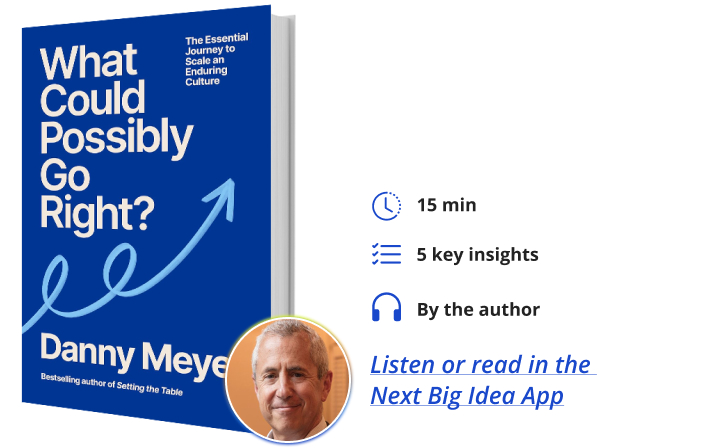
Below, Danny Meyer shares five key insights from his new book, What Could Possibly Go Right?: The Essential Journey to Scale an Enduring Culture.
Danny is a renowned restaurateur, entrepreneur, and founder of Union Square Hospitality Group and Shake Shack. He is widely recognized for his pioneering approach to hospitality and his belief that putting people first is the key to building great businesses.
What’s the Big Idea?
The best businesses do more than earn customers. They earn a place in people’s hearts by embracing change, refusing to settle for good enough, and making people’s lives genuinely better.
Listen to the audio version of this Book Bite—read by Danny himself—in the Next Big Idea App, or buy the book.
1. What could possibly go right?
I begin each day by asking myself this question because the really good stuff happens when I imagine the best possible outcome. Now, not everything goes right in life. But watch a really good card player and you’ll see that somehow they manage to win, even when they get the worst cards dealt to them. And that’s because even with a bad hand of cards, they start by saying, “Hmm, what would it take to actually make this work?”
2. Culture and growth are not in opposition.
For many, many years, people would ask me, “How are you going to maintain your culture even with all the growth that you’re undertaking?” And I couldn’t answer them. Until finally, I had a wonderful aha moment: What if we could use our growth to advance our culture?
Culture is like a shark. It cannot stay still. It doesn’t want to stay still. And in fact, it must be moving forward if it’s going to grow and survive.
3. Change your grip.
I was the number five player on my high school tennis team. I was pretty good, but never quite good enough to get to number four, number three, and certainly not number two or one. But my coach gave me an important piece of advice. He said, “Look, you’re good enough right now. You’ve made the team, but if you really want to excel and improve your game, you’re going to have to change your grip.” And so he turned the tennis racket maybe a quarter of an inch in my hand. My hold on the racket felt so awkward. The next five balls I hit sailed over the fence. The next five after that went right into the net. He said, “Look, stick with this thing and you’ll get more velocity. You’ll get more top spin.”
“In business, I’ve learned to constantly be changing my grip.”
But I chose to revert. I reverted to the grip that made me an okay player because it was uncomfortable to do what I needed to do to take it to the next level. I think about that a lot in business. In business, I’ve learned to constantly be changing my grip. Whatever got me here is not going to get me there, and though it’s uncomfortable to make those changes, it’s a key to outstanding leadership.
4. Don’t effing settle (DFS).
Great companies rarely collapse overnight. Instead, they decline slowly through small compromises, lowered standards, or tolerated misses. Soon, average begins to feel normal and normal is not essential. In my company culture, we bring the DFS model to everything from the hiring process to daily routines. We ask, “Is it good enough? Is the person a good enough hire? Is the way we’re doing things good enough to take us to the next level?”
A DFS mentality reminds everyone in the organization that there is nothing positive about settling in terms of getting us to the next level. As a matter of fact, complacency—doing things in an average way—is the worst possible thing you can do for the culture of your business because you’re going to stop attracting the best performers, and then your best performers are going to start to feel demoralized because you’ve surrounded them with sub-performers.
5. Essentiality.
My goal is to create businesses that become essential in people’s lives. I’d like every single thing we do to make people’s lives better to the point that they think, “My life improved because that place existed.” And, God forbid, if the place went out of business, people would actually feel a sense of sadness or diminishment.
Think about the handful of songs in your life that always make you feel good every single time you hear them. The songs that make you think, “I can’t even imagine my life if that song had never been written.” That’s what we want to do with restaurants. It is amazing when any company does that with any product.
“My goal is to create businesses that become essential in people’s lives.”
Think about the way non-essential things weigh down our lives. You can turn on Netflix and there are way more movies and way more TV series than you can possibly consume in a lifetime. Wouldn’t you love it if you could just curate the ones that were actually essential? That’s what we try to do when we create a business, and I think that is a worthy goal.
Before the internet, the number one thing we tried to earn as a business was mindshare. We wanted people to know we existed. But then, our game became: how can we earn heartshare? How can we earn a place in people’s hearts so that they fall in love with what we do? If you earn heartshare over and over, that is the pathway to essentiality.
Enjoy our full library of Book Bites—read by the authors!—in the Next Big Idea App: