










Below, Scott Solomon shares five key insights from his new book, Becoming Martian: How Living in Space Will Change Our Bodies and Minds.
Scott is an evolutionary biologist, professor, and science communicator. He teaches at Rice University and is also a Research Associate at the Smithsonian Institution’s National Museum of Natural History.
What’s the big idea?
Our species is already building its presence in space, and opportunities for more of us to venture beyond Earth’s orbit will only expand. We need to be ready for how living on the Moon or Mars could fundamentally change what it means to be human.
1. We are on the cusp of a golden age of space exploration.
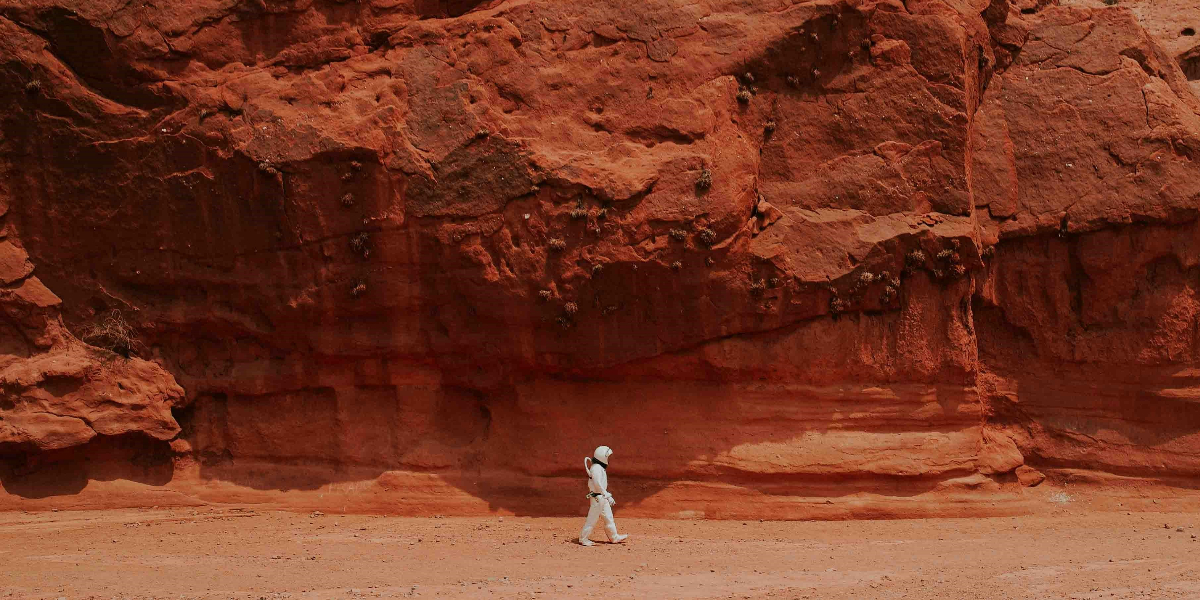
Already, many more people are getting to travel to space, and over the next few years, the number is expected to skyrocket. Plans are underway to build bases on the moon and, perhaps, even permanent human settlements on Mars. But what happens to us when we go to space?
We’ve learned a lot over the last six decades about how the conditions of space, such as lower gravity and higher radiation levels, affect our bodies and minds. There’s even an entire field called space medicine that is all about keeping people alive and well when they go to space.
We know that astronauts need to exercise regularly in space to prevent their muscles from getting too weak and their bones from becoming too brittle. We know that astronauts often have problems with their vision, which is thought to be related to how fluids in our bodies shift around in low gravity, potentially affecting the sensitive photoreceptor cells in our eyes.
2. Being on the Moon or Mars will be different.
Most of what we know about what happens to us in space comes from studies of astronauts orbiting fairly close to the Earth in space stations or other spacecraft. The conditions there are different from what people will experience on the Moon or on a planet like Mars.
For one thing, there’s more gravity. Astronauts in low-Earth orbit are weightless, essentially experiencing zero gravity. On the Moon or Mars, there is partial gravity. The Moon has one-eighth the gravity of Earth, and Mars has one-third.
“No one has ever experienced Martian gravity except in brief simulations.”
Only 12 people have been on the surface of the Moon, but they only spent a few days there. And NASA only collected a little bit of data about how their bodies reacted. No one has ever experienced Martian gravity except in brief simulations.
Another thing that’s different about being on the Moon or Mars is that people there will have much more radiation exposure than astronauts in low-Earth orbit. That’s because Earth has a protective magnetic field that shields us from much of the harmful radiation in outer space, and it is large enough that the International Space Station is still within its protective umbrella.
3. Growing up Martian.
If we decide to create human settlements on Mars, where people live their entire lives and raise families, we need to consider what would happen to those children. We aren’t even sure that pregnancy and childbirth will be safe in Mars’s lower gravity, but assuming they are, what would it be like to be a kid on Mars?
One potential problem is that as we grow, our bones and muscles develop based on how much we use them. That’s the reason weightlifting makes you stronger. But your skeleton is also built in response to how much bone your body needs. Kids growing up in one-third gravity may not develop bones as hard and strong as they would if they grew up on Earth. That means that a child born on Mars might not be able to handle coming to Earth. They would weigh three times as much and would be very prone to bone fractures.
Another challenge for children born on Mars is that their immune systems would be developing without the rich microbial diversity here on Earth. Since the time we are born, our bodies are constantly encountering bacteria, viruses, and other microbes, and our immune systems learn how to fight them off. On Mars, the only microbes will be the ones we bring with us, either intentionally or unintentionally. That will be a tiny fraction of what we have on Earth. A person who was born on Mars would not have natural defenses against even the most harmless microbes we breathe in every day. Coming to Earth might be a very dangerous thing for a Martian.
4. Leaving Earth will change us.
Here on Earth, any species that ends up on an island often evolves into something different. Ever since Charles Darwin visited the Galapagos Islands, biologists have treated islands as living laboratories for understanding how organisms change when they end up isolated in a place that is different from their original home. Planets are much like islands, and any species—including ours—that ends up in such a place is likely to experience evolutionary changes with each new generation.
“All the conditions for rapid evolutionary change would be present in a human space settlement.”
We often think of evolution as a slow process, but it doesn’t have to be. All the conditions for rapid evolutionary change would be present in a human space settlement. Radiation exposure means a higher rate of genetic mutations—the raw material for natural selection. And if moving between planets is rare because it’s dangerous or risky, then that would speed up the rate at which Martians would adapt to the unique conditions on their planet.
5. Our future in space is already happening.
In a sense, we are already a spacefaring species. Humans have been traveling into space since 1961. Since 2000, there has been a continuous human presence in space aboard the International Space Station. We use space technology every day, often without even realizing it. Every time you use GPS, you receive that information from satellites orbiting our planet. Our phones connect directly with satellites, too. In the next few decades, we are likely to increase our foothold in space, both through our technology and by sending people farther into space than we have before.
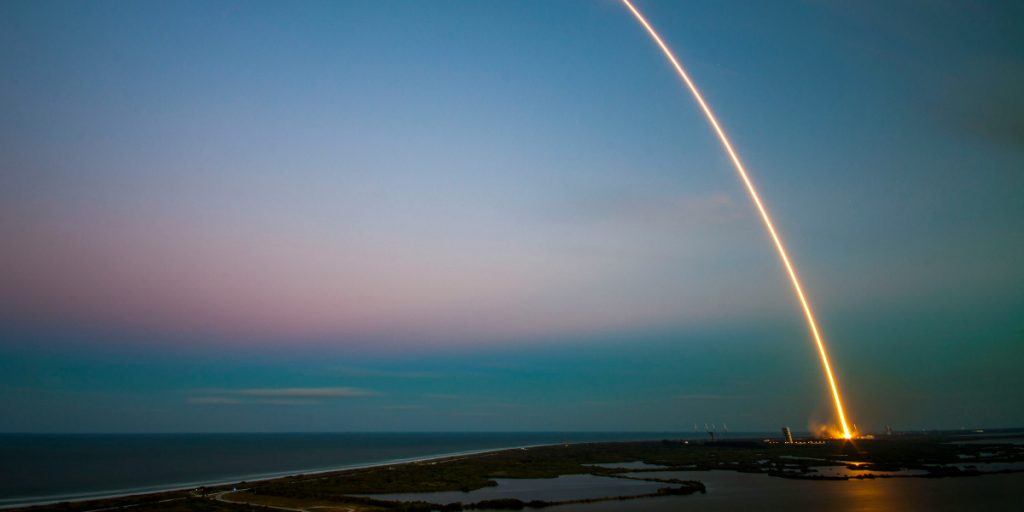
I’ve been fortunate to get to know many of the people involved in humanity’s expansion beyond planet Earth. Many of them are super smart, kind, and fascinating people. I got to watch the launch of the world’s largest rocket, go inside a galactic cosmic-ray simulator, join a team guiding a Mars rover, and visit a space microbiology laboratory. I’m not sure that I’m ready to buy a ticket to visit the Moon or Mars myself just yet, but I wouldn’t be surprised if that becomes possible in my lifetime. I think we still have a lot to learn before we’re ready to start raising families on other planets. But when that day comes, it is going to be quite an adventure.
Enjoy our full library of Book Bites—read by the authors!—in the Next Big Idea App: