












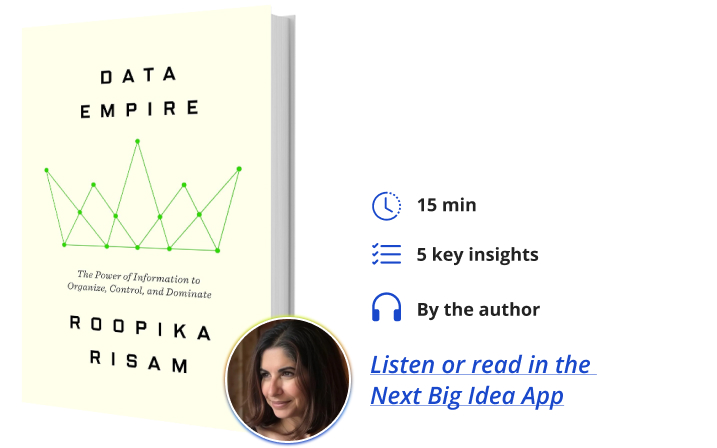
Below, Roopika Risam shares five key insights from her new book, Data Empire: The Power of Information to Organize, Control, and Dominate.
Roopika is a professor of Digital Humanities and Social Engagement at Dartmouth College. Her research explores how histories of race, empire, and technology shape the modern world.
What’s the Big Idea?
Data isn’t a byproduct of modern technology. It’s one of humanity’s oldest tools for governing ourselves. Every system we build reflects choices about who is seen, who is ignored, and who holds power.
Listen to the audio version of this Book Bite—read by Roopika herself—in the Next Big Idea App, or buy the book.
1. Data built civilization.
Most people think data began with computers. In reality, data is one of humanity’s oldest technologies. Nearly five thousand years ago, someone named Kushim carefully recorded deliveries of barley on a clay tablet in ancient Mesopotamia. Kushim wasn’t a king or a priest. He was an accountant—and he is the first person with a name in recorded history.
Usually, we imagine history beginning with rulers, battles, or monuments. Instead, the first named person is someone doing paperwork. Kushim was tracking grain because survival in the ancient world depended on it. Cities needed to know who had contributed food, how much was stored, and how it would be redistributed. Without records like these, large settlements simply couldn’t function.
We tend to think of data as something abstract or digital. But from the very beginning, data was about solving a practical problem: how to coordinate thousands of people who no longer know one another personally? The answer was creating records that could outlast human memory. And that meant inventing new ways to record information.
We often think writing emerged so people could tell stories or preserve great works of literature. But some of humanity’s earliest surviving documents didn’t contain poetry or philosophy. They were inventories, receipts, and tax records. Writing emerged because growing societies needed reliable ways to keep track of grain, land, labor, and trade.
Once people could record information outside the human mind, they could coordinate increasingly complex forms of cooperation. Those records made it possible to collect taxes, manage trade, and govern growing cities. Data helped make civilization possible. Computers transformed the speed and scale of data. But they didn’t invent it.
2. To count is to govern.
One of the most important political decisions any society makes is deciding what to count.
After invading England in 1066, William the Conqueror ordered a massive survey of nearly every village, field, animal, and household in his kingdom. The result became known as the Domesday Book. It wasn’t created out of historical curiosity. It was a tool for taxation, administration, and control.
That pattern repeats throughout history. Colonial governments counted populations. Property records determined land ownership. Tax rolls established obligations. Every system of recordkeeping makes some people visible and others invisible.
“One of the most important political decisions any society makes is deciding what to count.”
The British Empire took this logic to an extraordinary scale in colonial India. Officials counted people, mapped land, classified castes, recorded religions, and cataloged languages. Those records didn’t simply describe Indian society. They reshaped it. Categories like caste that had once been fluid became fixed in bureaucratic forms, influencing political representation, access to resources, and even how communities came to understand themselves.
Counting changes the world it measures. Data has never simply described society. It has helped govern it.
3. Crises create data revolutions.
Many of the databases we rely on today were born during moments of crisis.
During the Great Depression, the United States realized it couldn’t solve unemployment because it didn’t even know how many people were unemployed. New surveys and statistical methods became essential for understanding the economy.
A few years later, the creation of Social Security required the federal government to identify and keep track of millions of Americans over the course of their entire working lives. That challenge demanded entirely new administrative systems.
World War II accelerated those developments even further. Governments developed new ways to coordinate troops, supplies, and logistics across continents. During the Cold War, they expanded those capacities again to model nuclear conflict, forecast economic trends, and support scientific research.
Again and again, crises transformed how societies gathered information—and how governments exercised power. The information age wasn’t simply the product of technological innovation. It was also built through political responses to extraordinary moments.
“Crises transformed how societies gathered information—and how governments exercised power.”
We often talk about technological change as though it unfolds naturally. History tells a different story. The biggest leaps in our information infrastructures often happened because societies confronted problems they couldn’t solve with the tools they already had. Technology mattered, but so did politics, public investment, and collective decisions about what information governments needed in order to act. The data technologies being used today are products of those choices, not simply the inevitable result of scientific progress.
4. Data is not objective.
When we discover bias in a tool like ChatGPT, it’s tempting to think the problem began with the algorithm. But AI is built on data, and data carries history.
Take the Dewey Decimal System. In 1876, a young librarian named Melvil Dewey set out to organize all human knowledge into a single classification system. It became one of the most successful information systems ever created and is still used in libraries around the world.
The categories looked like objective numbers, but they reflected Dewey’s own worldview. Christianity occupied seventy detailed classifications, while other religions were compressed into a single catch-all category. Western philosophy and science received expansive treatment, while Indigenous knowledge and many non-Western traditions were pushed to the margins.
Every system of classification reflects human choices about what matters and how the world should be organized. Artificial intelligence works the same way. Before an AI system can recognize patterns, it depends on categories, labels, and datasets that people have created. AI inherits centuries of human decisions about how to organize knowledge and classify the world.
5. The new data empire is corporate.
Every empire has had its signature technology. All roads led to Rome. The British Empire had the telegraph. Today’s empires run on data.
For most of history, governments built and controlled the information infrastructures that organized public life. Today, many governments depend on private corporations to store public records, provide cloud computing, develop artificial intelligence, and build the digital infrastructure behind everything from healthcare to education to national security.
Governments increasingly rely on companies like Amazon, Google, Microsoft, OpenAI, Anthropic, and Palantir to perform functions that were once carried out primarily by the state. In many countries, public institutions can no longer function without technologies designed and maintained by private corporations.
“The future of democracy depends on who controls the data infrastructure behind it.”
That represents one of the biggest political shifts of our time. You often hear that technology companies are the new empires because they extract data the way earlier empires extracted land, minerals, or other natural resources. But corporations aren’t simply collecting enormous amounts of data. They are increasingly building, owning, and operating the technologies that nations use to exercise political power. As countries outsource more of their core administrative functions to private companies, public authority becomes increasingly entangled with corporate power.
The defining question of our moment isn’t simply how much data is being collected. It’s who controls it, who profits from it, and who is accountable when tech companies have a direct hand in governing us. The future of democracy depends on who controls the data infrastructure behind it.
History reminds us that none of this was inevitable. It is the result of people making political choices. And if people built these systems, people could change them. That means holding political leaders accountable for their choices about which companies gather our data, who regulates them, whose interests they serve, and what kind of digital future we want to build.
Enjoy our full library of Book Bites—read by the authors!—in the Next Big Idea App: