












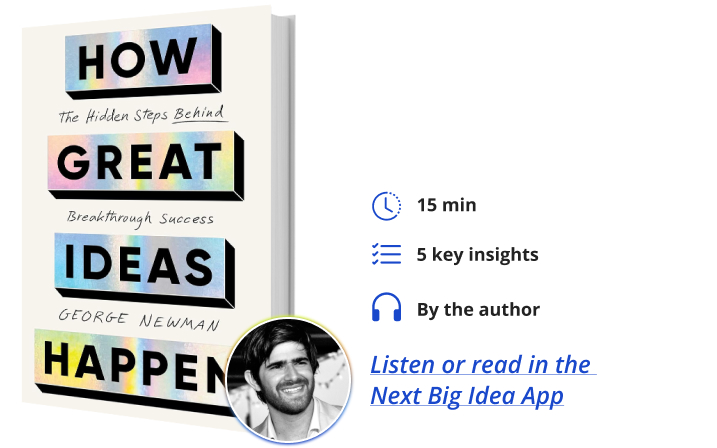
Below, George Newman shares five key insights from his new book, How Great Ideas Happen: The Hidden Steps Behind Breakthrough Success.
George is an associate professor at the Rotman School of Management at the University of Toronto, and he has spent his career trying to unravel the mysteries of what creativity is and where it comes from. His research has been featured in the New York Times, The Economist, BBC, Scientific American, Forbes, The Wall Street Journal, and The Washington Post.
What’s the big idea?
Most of us think great ideas are conjured from within—some mysterious well of genius possessed by a special few. But if you listen closely to history’s most celebrated creators, you’ll hear something completely different. They describe their greatest work not as something they conjured or invented, but as something they found. Not creation, but discovery.
1. The five percent novelty rule.
There’s a famous story about Post-It Notes. In 1968, a chemist named Spencer Silver was trying to create a super-strong adhesive that could be used to make airplanes. Instead, he wound up discovering pretty much the exact opposite: a glue that was barely strong enough to hold paper together—though it could be used again and again without losing its stickiness.
For years, Silver brainstormed different products. His first big idea was a sticky bulletin board. That went nowhere. The next idea, which came from his colleague Art Fry, was a reusable bookmark. That also flopped. Finally, after almost a decade of brainstorming, Silver landed on Post-It Notes, and the rest is history.
Silver’s story is often told as one of grit and perseverance. And, no doubt, stick-to-itiveness is an important part of creativity. But when you think about it, the sticky bulletin board, reusable bookmarks, and Post-Its were essentially three different versions of the same basic idea: paper + Silver’s adhesive. Yet, only one was a major hit.
Often, when we think about what makes certain ideas great, there’s a tendency to focus on the differences—how much a breakthrough idea towers above the rest. But rather than focusing on what differentiates great ideas, I want you to instead think about the similarities—how close those breakthrough ideas are to many others just like them.
Just like in the story of Post-Its, for every great idea we can point to in history, there were dozens, maybe even hundreds of ideas that were just like it—nearly identical versions of the same thing that failed to catch on because they lacked a small, but crucial element. For example, when John Lennon originally wrote the Beatles song “Please, Please Me,” it was a slow ballad. George Martin suggested the group try speeding it up. Would the Beatles not have been The Beatles without a small tempo change? It seems almost impossible to imagine, and yet, history is filled with examples that suggest exactly that. How many breakthrough ideas are sitting in someone’s drawer right now, just one small adjustment away from changing the world?
Great ideas aren’t about inventing something radically new. They’re about finding the missing adjustment, tweak, or change that unlocks an idea and makes it your own. We often get this backward. In my own research on creativity, I have found that when people set out to do something “creative” they often focus too much on trying to be original and different from everyone else. In one study, we had home chefs create sandwiches for a food truck. We found that our chefs thought that the more original they made their recipe, the more attractive it would be to others. But when we presented those sandwiches to customers, we found the opposite: the more original the chefs tried to be, the less willing customers were to try their sandwiches. Those chefs had forgotten the most important ingredient of all: making their food taste good.
“How many breakthrough ideas are sitting in someone’s drawer right now, just one small adjustment away from changing the world?”
We also analyzed multiple seasons the show Top Chef and found the same thing. When contestants explicitly said they were trying to be original and different from everyone else, they were more than twice as likely to have the worst-rated dish and get eliminated. So, stop trying to reinvent the wheel. Just make it spin a little differently.
The recipe for a great idea is surprisingly simple: Make the main dish conventional, something familiar and known. Then add something special—a spice or twist—making it new, exciting, and your own.
2. Be a problem finder.
Okay, so you need to find that missing five percent. But how? One of my favorite studies on creativity comes from one of my favorite psychologists, Mihaly Csikszentmihalyi. He spent years investigating what distinguished truly creative individuals, and he found that the most creative people weren’t just good at solving problems. They were exceptional at finding them.
In one study, Csikszentmihalyi and his colleague, Jacob Getzels, recruited a group of art students studying at the prestigious Art Institute of Chicago. One by one, each of the artists was led into a studio furnished with two tables. On one table was a collection of objects that artists might typically use to create a still life. On the other table were drawing supplies, including paper, pencils, and charcoal.
The instructions were straightforward: Choose some objects from the first table, arrange them in any manner you like, then create a drawing. The artists were free to take as much time as they wanted, start over if they needed, and to stop only when they were satisfied with the outcome.
Most of the artists quickly got to work. But some artists did something different. They spent time handling the objects, feeling their weight, studying them from different angles. Looking at the negative space that formed in between them. They were searching for something—a problem worth solving, or a question worth asking.
Then Csikszentmihalyi waited—for 18 years. When he followed up with the artists nearly two decades later, the ones who talked about drive or ambition were not the ones who were successful. Nor was it the ones who opined generally on the importance of seeking “beauty,” or “order,” or “harmony.” It wasn’t the artists who seemed confident, nor was it the ones who had worked out a deep, philosophical approach to their artistic practice. Instead, it was the problem finders, the artists who approached the drawing task without any preconceived notions and allowed the shape and structure of their still life to emerge from the situation itself.
“When we pay close attention to our surroundings, new opportunities and challenges begin to reveal themselves.”
When it comes to finding the missing element that unlocks a breakthrough idea, it is essential to adopt the mindset of a problem finder. When we pay close attention to our surroundings, new opportunities and challenges begin to reveal themselves. Our task then is to learn to recognize these signals—to see that creativity isn’t about forcing solutions but about uncovering what an idea needs.
Finding a great idea takes a lot of work, trial and error, and even a bit of luck. But there’s also a lot that you can do to increase your chances of finding something great. Notice where there are problems, tensions, or places of resonance. Author Margaret Atwood doesn’t just sit in a cabin waiting for inspiration. She digs through archives, historical records, and newspaper clippings to find the inspiration for her stories. Creativity isn’t magic. It’s about looking outward and remaining attentive to the world around you.
3. Push past the creative cliff.
Once you’ve found your problem, it’s time to dig. And here’s where most people sabotage themselves. Researchers Brian Lucas and Loran Nordgren asked people to brainstorm ideas for five minutes—things like how a charity could increase donations. Before starting, they asked participants to predict their productivity: How many ideas do you think you’ll come up with in the first minute? How many in the second minute? And so on.
People expected the first two minutes to be productive, followed by a sharp drop-off. Raffle, bake sale, door-to-door solicitations—really, how many fundraising ideas could there be?
But when people actually brainstormed, something fascinating happened. The first minute was strong. The second minute was even better. But then, instead of falling off a cliff, participants just kept generating more and more ideas. The third minute was more productive than the second. The fourth and fifth were even more productive. And what’s more, when other people rated the ideas, they scored the ideas from the latter half of the session as more promising than the early ideas.
We call this the creative cliff illusion. People think they’ll run out of ideas, but the opposite is true. Just when you think you’ve exhausted every possibility, that’s probably when your process is really starting to heat up.
Look at some of the most successful creators in history. Thomas Edison held more than a thousand patents, including duds like cement furniture and a creepy talking doll. James Dyson built over five thousand prototypes before finalizing his vacuum design. When Dua Lipa recorded Radical Optimism, she wrote 97 songs—only 11 made the final cut.
When you think you’re done brainstorming, keep digging. Generate a hundred or 500 names for your business, not just ten. Schedule multiple brainstorming sessions over several days, not just one. When it comes to generating ideas, more is more.
4. Great ideas are worth waiting for.
If you’re generating hundreds of ideas, how do you know which ones are worth pursuing? There’s a wonderful anecdote about Albert Einstein that captures this perfectly.
Years after developing his theory of relativity, Einstein was discussing his creative process with his friend and psychologist Max Wertheimer. Einstein explained that before his big breakthrough, he’d been bothered by something. Not confused, not stuck—bothered. There was a tension he couldn’t resolve, a gap between what he observed and what the current theories predicted. That discomfort, that sense of something not feeling right, was the spark that eventually led to one of the greatest scientific breakthroughs in history.
“We become significantly better at evaluating our own ideas with a little time and space.”
The research shows that we can be surprisingly bad at knowing when we’ve struck gold. One reason is that great ideas—especially when we first think of them—can feel abstract and even a bit uncomfortable. A second reason is that we can become overly attached to an idea simply because we were the one who thought of it. I’ve found that people actually have a great deal of difficulty evaluating the quality of their own ideas, in part because of the sudden rush of excitement we get when thinking of a new idea.
One solution is simply to wait. We become significantly better at evaluating our own ideas with a little time and space. Another solution is to invite others in—other people can provide a much more accurate assessment of an idea’s promise precisely because they are less attached to it.
Great ideas are worth waiting for. Studies of entrepreneurs have shown that the very first kernel of an idea can predict a product’s success just as much as the final product itself. Ideas contain structure; they suggest what comes next. As Andrew Stanton from Pixar once said, “You’re digging away, and you don’t know what dinosaur you’re uncovering. But once you start getting a glimpse of it, you know how better to dig.”
So don’t rush past discomfort. Lean into it. Bring others in. The ideas that bother you, that feel awkward or strange—those might be exactly what you’re looking for.
5. Think about what you can take away.
Now comes the hard part: deciding what to keep and what to discard. In 1984, Paul Simon was in a funk. His marriage to Carrie Fisher had ended, and his previous albums were commercial disappointments. Then a friend gave him an unmarked cassette of street music from South Africa. Simon listened to it nonstop. By summer’s end, he knew he had to go to Johannesburg.
Simon spent two weeks in South African recording studios, essentially jamming with local musicians, generating as much material as possible. Then he returned to the U.S. and spent an entire year editing. He selected engaging segments, pieced them together, overdubbed, and transformed those free-form sessions into songs. The editing was so extensive that Simon pioneered the use of digital audio workstations in studio recording. The result was Graceland, which many consider Paul Simon’s greatest work. But here’s what’s crucial: Simon wasn’t looking for what he could add. He was looking for what he could take away.
This goes against our instincts. Psychologist Gabrielle Adams showed that when improving a piece of writing, rather than removing the redundancies, most people add more material. In another study with visual designs, people almost never removed elements—they just kept adding.
“Often, the biggest breakthroughs are revealed when we can strip away everything that’s not needed.”
It’s easy think about creativity like building a tower. You want to stack everything you’ve done, showcase all your effort. But your audience isn’t in the tower business. They’re in the raft-inspection business. They’re looking for holes, for weak spots that will sink the project.
So, when you’re refining your idea, think about floating a raft. Remove anything that doesn’t directly serve your core purpose. Often, the biggest breakthroughs are revealed when we can strip away everything that’s not needed.
Creativity isn’t a mysterious gift possessed by a chosen few. It’s a process of discovery that anyone can learn. Stop waiting for genius to strike. Start exploring, imitating, and problem-finding. Push past the cliff when you want to quit. Trust the discomfort of promising ideas. Great ideas are often hiding in plain sight—you just need to know where to look and what to strip away. The tools of discovery are available to all of us. You just have to be willing to dig.
Enjoy our full library of Book Bites—read by the authors!—in the Next Big Idea App: