











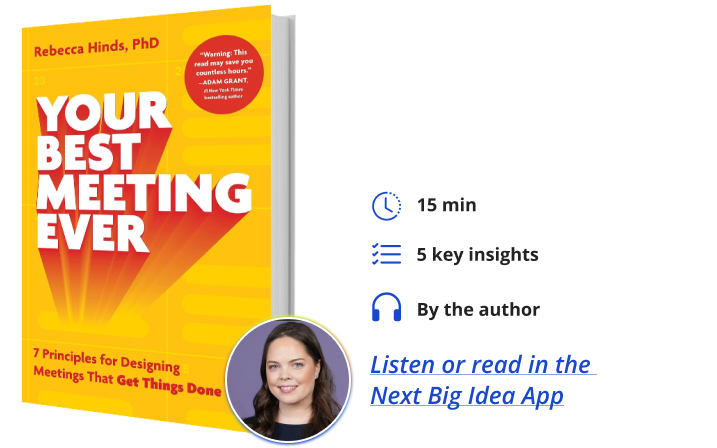
Below, Rebecca Hinds shares five key insights from her new book, Your Best Meeting Ever: 7 Principles for Designing Meetings That Get Things Done.
Rebecca is a leading expert on organizational behavior and the future of work. Her research is consistently featured in publications like Harvard Business Review, the New York Times, The Wall Street Journal, Forbes, and Wired.
What’s the big idea?
If you’re tired of watching your organization suffer under the weight of bad, broken, bloated meetings, there are proven ways to replace that slow-motion dumpster fire with calendars that actually move work forward. By treating meetings like a product, you can design the best meetings ever.
1. Treat your meetings like a product.
Meetings are your organization’s most important product. They’re where decisions are made, priorities are set, and culture is built. Yet meetings are the least designed, least tested, and least optimized product in your organization. In the U.S. alone, they burn well over $1.4 trillion a year—more than five percent of GDP.
You would never ship a physical product to customers without thoughtful design, testing, iteration, and user feedback. But organizations ship meetings exactly this way every single day.
Meetings need design. If you haven’t done the hard work of designing the meeting, you don’t deserve to hold it. And if meetings are a product, then we should design them using the same principles that make products great.
2. Clear your meeting debt.
Just like products collect technical debt, meetings collect their own version: meeting debt. A recurring meeting lands on your calendar and often becomes immortal. No one remembers who created it, why it exists, or what it’s supposed to do. But everyone still shows up and goes through the motions. Week after week. Month after month.
Eventually, the debt piles so high that the only real solution is to declare a Meeting Doomsday: a 48-hour calendar cleanse where you wipe recurring meetings off your calendar and rebuild from scratch. In the Meeting Doomsdays that I have run, participants reclaimed up to 11 hours per person, per month. Meeting Doomsdays work for two key reasons:
- They snap you out of the status quo. Traditional meeting audits (evaluating one meeting at a time) keep you defending the clutter already squatting on your calendar. A Doomsday jolts you out of autopilot and into the deliberate, effortful mode of thinking Daniel Kahneman called System 2 thinking.
- They tap into the IKEA effect. Research shows we value things more when we build them ourselves, whether it’s an IKEA desk or a newly rebuilt calendar. When people redesign their own calendar, they value it more. They protect it. And they stop letting unnecessary meetings sneak back in.
Doomsdays only work if they’re done with real intention. Do them poorly, and the old habits come roaring back. But done well, they become one of the most powerful ways to reboot not just your calendar, but your entire meeting culture.
3. Become a meeting minimalist.
A Meeting Doomsday is a radical way to clear meeting debt. But a one-time purge isn’t enough.
You need ongoing discipline to keep your calendar lean.
The best products in the world are minimalist. Think about Google or ChatGPT: one search bar, one prompt bar, no fluff, no clutter, no nonsense. Meetings should work the same way.
But minimalism isn’t human nature. As my colleagues Bob Sutton and Leidy Klotz have shown, humans have a built-in bias toward addition—what they call “addition sickness.” When we hit a challenge—or the faintest whiff of uncertainty—our instinct is addition. Add a meeting. Add more attendees. Add more minutes to the meeting length. Add more agenda items.
“Research shows that standing meetings run about 25 percent shorter than sitting ones.”
The good news is that research also shows that when people are primed for subtraction, addition sickness can be short-circuited. People start thinking like minimalist product designers. In meetings, becoming a minimalist means applying that mindset to four dimensions: the agenda, the duration, the attendees, and the frequency.
Let’s take duration. Meetings suffer from Parkinson’s Law: work expands to fill whatever time you give it. Give a meeting 60 minutes, and it will almost always use the full 60. If you want shorter, sharper meetings, you have to actively defend against the natural creep of filler, fluff, and rambling. One way to do that? Standing meetings. Research shows that standing meetings run about 25 percent shorter than sitting ones. Nobody wants to drag things out when their knees are fighting gravity.
But it’s not just about saving time. Standing rewires how we collaborate in meetings. Research shows that people become less territorial. When we sit, it’s my chair, my slice of the table, my turf. The room is divided into tiny plots of land. But when we stand, the space becomes shared, and so do our conversations and ideas. It becomes less about turf and more about teamwork.
4. Apply systems thinking.
We love to blame meetings for everything that’s broken about work. But meetings usually aren’t the root problem. They’re the symptom of a deeper issue: a broken communication system.
Think about Apple. They don’t design products in isolation. Every piece fits into a larger ecosystem—hardware, software, services, user experience—all reinforcing one another. Meetings should work the same way: as part of a communication system, not random acts of scheduling.
During the pandemic, the time people spent in dysfunctional meetings got worse, even as organizations adopted more digital tools than ever—tools that should have reduced the need for meetings. Why? Organizations added tools but didn’t give people guidance on how to use them.
When people don’t know what deserves an email, a document, a Slack thread, or an async update, they default to meetings. And they do it for two reasons.
“Meetings usually aren’t the root problem.”
First, meetings are highly visible. You can’t see someone’s thinking. You can’t see someone’s judgment. You can’t see someone making good decisions. But you can see someone in a meeting. A packed calendar broadcasts importance. So, meetings become theater: a performance of productivity that often produces nothing.
Second, meetings hijack attention. You can ignore an email. Skim a document later. Snooze a Slack message. But meetings are public. It’s anchored to a specific time slot. It claims physical territory on your calendar. And psychologically, that creates a social contract. You feel like you owe someone your attendance. Meetings become the fastest, bluntest, most reliable way to hijack someone’s attention.
Before you can fix your meetings, you have to fix the system around them. Start with the 4D Test. A meeting should only exist if the purpose is to:
- Decide
- Debate
- Discuss
- Develop (yourself or your team)
Everything else (status updates, broadcasts, one-way briefings) fails the 4D Test. That’s systems thinking.
5. Innovate with technology.
No technology is more transformative, or more dangerously seductive, than AI. Here are two ways to use AI to make your meetings better, not just shinier:
- Calculate airtime. One of the strongest predictors of team performance is balanced airtime. When airtime gets lopsided, it distorts our perception of the people in the room. Researchers call this the babble hypothesis: the more someone talks, the more we perceive them as a leader, even if they are just spewing nonsense. AI can counter that. It can flag who’s dominating the mic, surface who’s getting steamrolled, and nudge the conversation back to one that isn’t warped by the loudest voice.
- Play devil’s advocate. One of the biggest traps in meetings is groupthink. We’re conditioned to believe brainstorming works best in groups, but research shows that people generate more ideas, and better ones, when they think alone first. Early research shows that AI can help counteract that. It can introduce alternative angles, challenge assumptions, and disrupt the gravitational pull toward consensus. AI doesn’t even need to be right to be useful.
Enjoy our full library of Book Bites—read by the authors!—in the Next Big Idea App: