









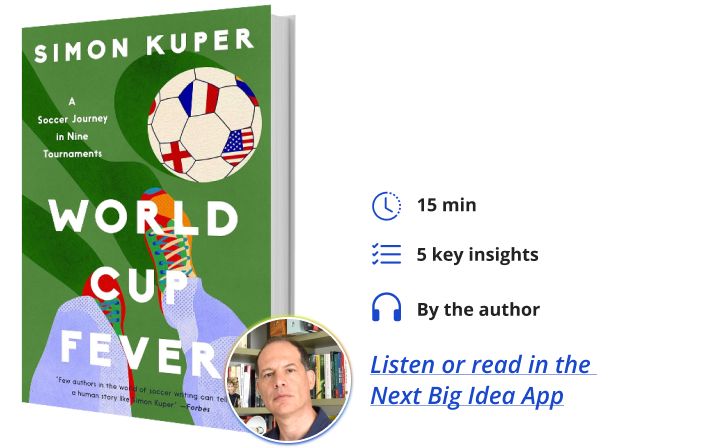
Below, Simon Kuper shares five key insights from his new book, World Cup Fever: A Soccer Journey in Nine Tournaments.
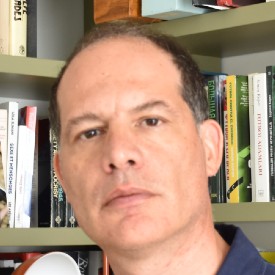
Simon is a journalist for the Financial Times and has written for The Observer, The Times (London), and The Guardian. He also writes regularly for Dutch newspapers. He has attended every World Cup since 1990.
What’s the big idea?
The World Cup is less a soccer tournament than a global ritual. Its games may be inferior to club soccer, but its emotional and national significance is unmatched.
Listen to the audio version of this Book Bite—read by Simon himself—in the Next Big Idea App, or buy the book.
1. The World Cup grew out of World War I.
Jules Rimet is the Frenchman who created the World Cup. Almost nothing about his life has been recounted in English, but I live in France and I found the few French sources about him. I even cycled out to his grave in the Parisian suburbs.
The key experience in Rimet’s life was fighting in World War I. He spent the entire four years at the front, so it’s a near-miracle that he survived. I found one remarkable photo of him from 1916, in which he is sitting in a trench, surrounded by seven black infantrymen. These must have been some of the West African men who fought for France in the Great War. The war may have been Rimet’s only lifetime encounter—but presumably quite an intimate one—with Africans.
Rimet was a brave soldier, who won the Croix de Guerre medal for bravery three times. He came home, became president of the new French national soccer federation, and in 1921 was elected president of FIFA.
He barely mentioned the Great War after 1918, but it seems to have remade his worldview forever. Like many French ex-soldiers, Rimet had returned from war obsessed with peace. Football was supposed to bring people together. His mission in the 1920s was to realize FIFA’s original dream and set up a World Cup. Finally, in May 1928, the FIFA congress in Amsterdam voted to create a competition open to all football nations. By “all,” FIFA meant only Europe and the Americas. Non-white peoples were mere colonial subjects who didn’t count. But the French and Germans, the chief combatants of World War I, played at the first World Cup in 1930.
2. Dictatorial leaders have always embraced the World Cup, with the blessing of FIFA.
In 1934, the second World Cup was staged in Benito Mussolini’s fascist Italy. Rimet did his best to get on with his Fascist hosts, though it wasn’t always easy. He wrote that he often had “the impression during the World Cup that the real president of the international football federation was Mussolini.” When the two men sat side by side during matches in Rome, the dictator watched play “with sustained attention, without distractions,” showing no interest in the Frenchman’s attempts at chit-chat. Mussolini had commissioned a huge bronze winner’s trophy that dwarfed the actual World Cup. Luckily, wrote Rimet, the Italians beat Czechoslovakia in the final and kept the thing, “as we would not have known how to carry it away.”
“Mussolini had commissioned a huge bronze winner’s trophy that dwarfed the actual World Cup.”
Ever since then, FIFA has been happy to embrace brutal regimes, from Argentina’s military junta of the 1970s through Vladimir Putin and the Saudi crown prince Mohammed bin Salman. It was baked in from the start. This summer, a would-be autocrat, Donald Trump, is going to try making himself the main character of the World Cup—with FIFA’s blessing.
3. Western Europe rules World Cups.
It’s the global game, but it’s still dominated by a region that has only about five percent of the world’s population. Teams from Western Europe have won four out of the last five men’s World Cups. Even better, continental European countries hogged thirteen of the
fifteen places on the medals podium this period—meaning that they finished first, second, or third.
In the last 20 years, only one team from outside the region has been able to compete with the best Western Europeans: Leo Messi’s Argentina. Even when Morocco became the first ever African team to make the semifinals, in Qatar in 2022, about half its team were people of Moroccan origin who had been born and raised in western Europe—players like Achraf Hakimi, who grew up the son of Moroccan parents in Madrid. Even a massive non-European country like the U.S. can’t compete. Think of the U.S. team’s thumping in Qatar by Holland—a country of just 18 million people, but still much better at soccer.
What explains Western Europe’s dominance? Well, having grown up playing soccer in the region myself (in the Netherlands), I think it’s that Western Europeans understand better than Americans, Africans, or anyone else how to play soccer. It’s a game, as the great Dutchman Johan Cruyff said, that you play with your head. Soccer is a kind of dance in space. You’re making decisions all the time: where should I stand? Who should I pass to? Western European kids learn from age six how to make those decisions. One day, the rest of the world will catch up, but it hasn’t happened yet.
4. The quality of soccer at World Cups is poor.
It’s the most-watched tournament in any sport, and when I was a kid in the 70s and 80s, the soccer was better than in any league in the world. When I started watching, there were only 16 teams, and you’d see brilliant players from Brazil or an African country that you’d never heard of before.
But soccer has changed. Nowadays, the world’s best players are scouted early and brought to Western Europe, where they all play in the English Premier League or the Champions League. That means the best club teams are brilliant. Teams like Arsenal or Real Madrid play together every week, and so they’re much better than any team you’ll see at a World Cup.
“People don’t watch World Cups for the quality.”
Fans who are used to watching the Premier League and the Champions League are going to be dismayed by some of the games at this World Cup. The tournament will expand this year from 32 to 48 teams, and a lot of them simply wouldn’t survive in the Premier League.
Think of games like Cape Verde-Saudi Arabia in LA, or Iran-New Zealand in Houston. I’ve sat at a lot of games at past World Cups, wondering, “Why is anyone watching this?” But this time, it will be worse. But understand this: people don’t watch World Cups for the quality.
5. In many countries, the World Cup is the biggest shared national moment.
We live in an era when people are becoming isolated from each other. Most of the time, everyone is on their own screen, watching their own content. Ever more people live alone. Ever more Americans say they have no, or almost no, friends.
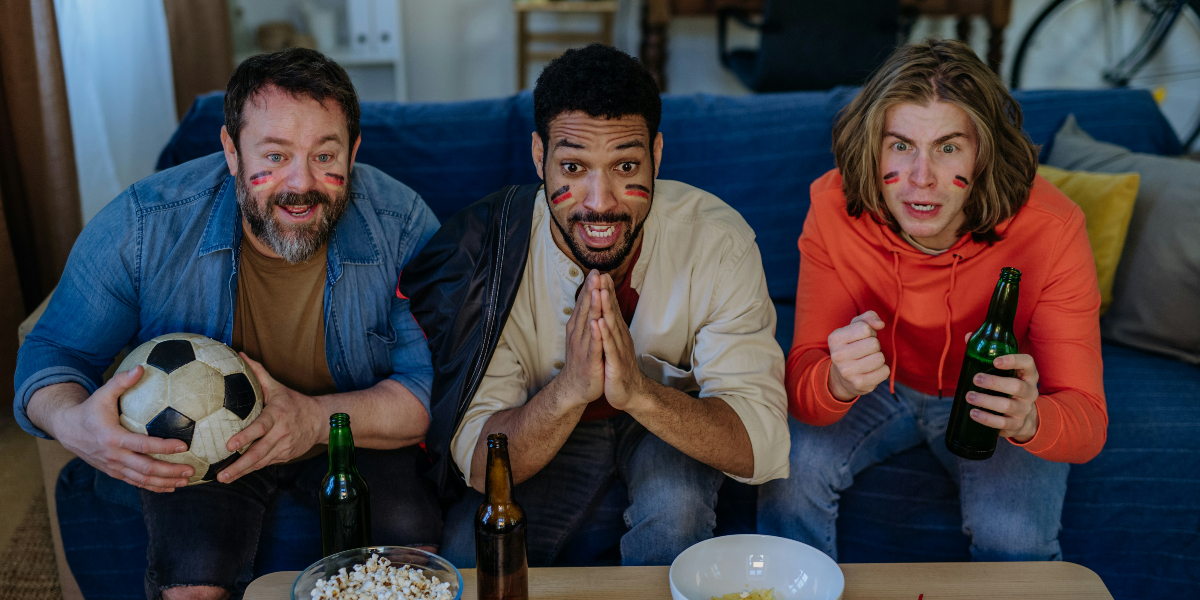
When the World Cup comes along, it unites countries. In a European, African, or South American country that’s playing a World Cup match, life comes to a stop. Offices in Brazil shut down when Brazil is playing. Everyone gathers with friends or family to watch. When they watch their team, they feel that it embodies their country. Those eleven young guys in plastic shirts are Brazil, or England, or whatever. They become the nation made flesh.
There’s no shared national moment like it. The next day, everyone talks about it at school, at work, and on social media. Lonely people are drawn into the national conversation. Everyone feels part of something. There’s strong evidence that suicides fall in a country that’s playing a World Cup. Even decades later, everyone can still remember a goal or a blunder from a game at a World Cup. It’s not the best tournament in sport. It’s just the most meaningful.
Enjoy our full library of Book Bites—read by the authors!—in the Next Big Idea App: