











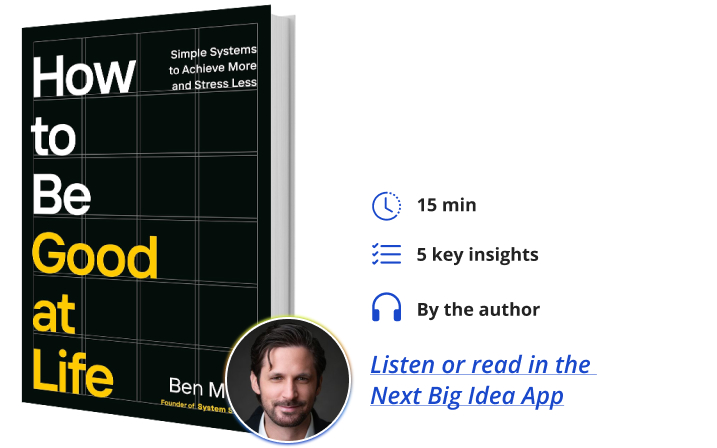
Below, Ben Meer shares five key insights from his new book, How to Be Good at Life: Simple Systems to Achieve More and Stress Less.
Ben is the creator of System Sunday, a weekly newsletter on productivity and life design read by more than 250,000 people. He is an executive coach to founders and CEOs, and previously worked as a management consultant at Ernst & Young.
What’s the Big Idea?
We tend to assume that when something in our life isn’t working, the answer is to try harder. Be more disciplined. Have more willpower. But very often, the better answer is to change the systems around us.
Listen to the audio version of this Book Bite—read by Ben himself—in the Next Big Idea App, or buy the book.
1. Modern life is too complex for habits alone.
Life has always been hard, just in different ways. For previous generations, much of the burden was physical. Maybe your grandfather really did walk five miles to school. Now, much of the burden is cognitive. The modern world has increased convenience, but it’s also increased complexity. We gained access to nearly infinite information while our cognitive capacity stayed finite. That’s why life today can feel like running a small company you were never taught to manage.
Personal finances, family schedules, endless admin—it’s more moving parts than any brain was built to handle. One of the main solutions we’ve been given for dealing with all this complexity is habits. And habits are genuinely powerful—research suggests that around 40 percent of what we do each day is habitual, which is a huge help. But that also means the majority of what we do isn’t habitual, and a lot of it never will be.
Some of our biggest creative projects, our most important strategic work, and our relationship dynamics can’t become habits. They either have too many steps or happen too infrequently to ever become automatic. And yet people get down on themselves because they’ve been told that everything should eventually click on autopilot.
“Life today can feel like running a small company you were never taught to manage.”
Habits are just one tool in a broader systems toolkit. They’re great for certain problems, but other tools are better for others. A checklist, for instance, is perfect when you don’t want to forget something important. A project plan with milestones and deadlines works beautifully when you’re renovating a kitchen or trying to land a new job. You can’t habit your way through that kind of complexity.
We don’t need to give up on habits. We just need to expand our systems toolkit, because when you have more tools available, you can navigate complexity with greater ease.
2. Fix the right thing, fix almost anything.
When something goes wrong, it can be tempting to reach for a surface-level solution instead of fixing the root cause.
In the 1990s, the marble at the Lincoln Memorial was wearing away faster than anyone expected. The obvious culprit was bird droppings. The monument was constantly scrubbed, which wore the marble down even faster. The proposed solution was metal spikes to deter the birds.
But a biologist named Donald Messersmith wasn’t satisfied with a surface-level fix. One evening, he stood at the base of the monument, looked up, and asked one of the most powerful questions you can ask when something isn’t working: Why? Then he kept asking:
- Why is the marble deteriorating? Too much cleaning.
- Why so much cleaning? Bird droppings.
- Why are the birds there? They’re eating spiders.
- Why are the spiders there? They’re eating midges.
- Why are the midges there? They swarm at dusk, drawn by the floodlights.
The solution was to turn the lights on an hour after peak midge activity. Fewer midges meant fewer spiders. Fewer spiders meant fewer birds. Fewer birds meant less cleaning and less erosion. All without a single ugly metal spike.
That’s the power of getting to the root cause. But in our own lives, we often do the opposite. We buy more storage bins instead of getting rid of things we don’t need. We delete the same emails every morning instead of unsubscribing once. If the same problem keeps coming back, that’s your cue to keep asking why until you reach something you can actually redesign. While everyone else is scrubbing bird poop, you’ll be finding the lights.
3. Build the playbook with DRIVE.
Once you’ve identified the right problem, how do you build a system to solve it?
High-performing companies, championship teams, and prolific creators tend to follow the same pattern. They set a goal, then build a system that makes achieving it more likely. I eventually formalized that process into a five-step framework called DRIVE.
The easiest way to explain it is with something I went through myself. I decided I wanted to run a half-marathon, despite having spent most of my life convinced that running was legalized torture.
- D: Define. Get clear on the goal, and diagnose what could stop you. My goal was to finish a half-marathon. The obvious risks were getting injured or letting work crowd out my training.
- R: Reverse Engineer. A half-marathon is 13.1 miles, so I worked backward from race day, gradually increasing my distance.
- I: Implement. This is where the plan becomes real. Instead of relying on motivation, I had a training plan scheduled into my calendar. Motivation is especially unreliable when life gets busy.
- V: Validate. Create a feedback loop. I tracked my runs to see whether the training was actually working.
- E: Evolve. Use that feedback to improve the system. My energy kept crashing near the end of long runs, so I adjusted my fueling—eating more carbs beforehand and bringing energy gels with me.
When I started, I was running so slowly that power-walking grandmas with ankle weights were blowing past me. But week by week, I got better. Eventually, I finished the half-marathon on a hilly course in Asheville in a time I was really proud of.
That’s what a good system does. You don’t have to be great when you start. You need a process that helps you improve. Life gives us problems. It doesn’t always give us a playbook. DRIVE is a way to build one.
4. Make life easier one Sunday at a time.
I used to get the Sunday scaries. Sunday afternoon would roll around, and every meeting, deadline, errand, and loose end waiting for me during the week ahead would overwhelm me. What I eventually realized was that a lot of that anxiety was simply my brain asking for a plan.
So I began carving out 30 to 60 minutes on Sunday to set myself up for the week ahead. I would get clear on my priorities and schedule them on my calendar. This protects time for what matters and lets me spot friction before the week begins. Maybe Tuesday has four hours of back-to-back meetings, so I add some buffer for a bathroom break. Or I notice I’m double-booked and can fix it ahead of time.
A half-hour investment on Sunday can make the next 167 and a half hours of the week run a lot more smoothly. But there’s another part of System Sunday that is even more powerful: use some of that time to install one system that makes your life easier going forward. Maybe you set up a password manager so you can stop resetting passwords. Maybe you automate a bill. Maybe you create a recurring reminder for birthdays.
“A half-hour investment on Sunday can make the next 167 and a half hours of the week run a lot more smoothly.”
Imagine that once a week, you remove one recurring frustration, automate one repeated task, or make one good behavior easier. After a month, you have four improvements working for you. After a year, you have dozens. Rather than trying to redesign your whole life this weekend, pick one thing. Make it easier. Then come back next week and do it again.
5. Design beats discipline.
If life feels harder than it should in a particular area, try getting curious about the underlying structure. As physician Paul Batalden put it, every system is perfectly designed to get the results it gets. So if something isn’t working, interrogate the system rather than blame yourself.
Say you’re exhausted all the time. The character-trait interpretation is that you’re bad at sleeping. The systems interpretation might look like: I keep my phone on my nightstand, and it’s causing me to scroll an extra 45 minutes, and that’s cutting into my sleep. Once you see that, you can change it. Maybe you charge your phone in a separate room and buy an old-fashioned alarm clock. What you saw as a character flaw became a design opportunity.
Instead of beating yourself up, get curious about the structure underneath the outcome. Seeing the system allows you to redesign it.
Enjoy our full library of Book Bites—read by the authors!—in the Next Big Idea App: