











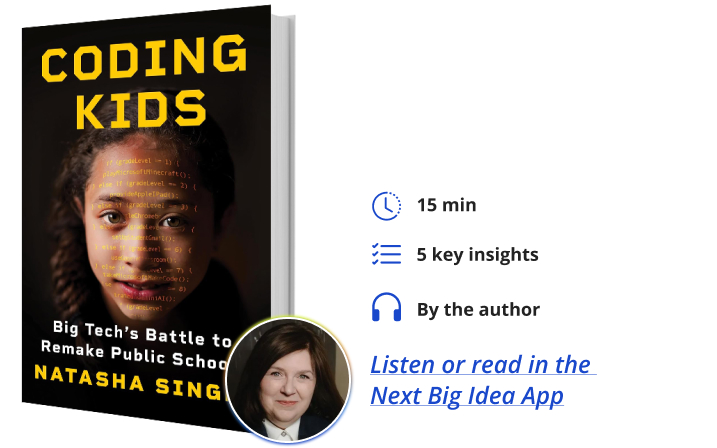
Below, Natasha Singer shares five key insights from her new book, Coding Kids: Big Tech’s Battle to Remake Public Schools.
Natasha is a technology reporter at the New York Times, where she covers technology in schools, tech education, and how emerging technologies like AI affect children and teenagers.
What’s the Big Idea?
Big Tech is using schools to cultivate its next generation of customers. Instead of teaching kids how to use the latest technology, we should be teaching them to question the power of the companies behind it.
Listen to the audio version of this Book Bite—read by Natasha herself—in the Next Big Idea App, or buy the book.
1. We have collective amnesia about tech in schools.
Over the years, tech companies like Google and Microsoft have used familiar arguments to urge schools that adopting the latest technology is in students’ best interests. Their pitch often went something like this: If you give every student their own laptop or Chromebook or iPad—or if you just teach every child computer programming—then education will improve for everybody and kids will learn valuable career skills.
But many of these classroom tech initiatives did not live up to their hype. In fact, UNESCO reports that there’s little evidence that educational technology has meaningfully improved student outcomes. Yet now, some of the same Big Tech companies that sold schools on Chromebooks and coding are recycling those arguments to push AI chatbots into classrooms. This feels like collective amnesia. Before rushing to embrace AI, schools need to learn from the mistakes of past classroom tech initiatives.
2. Silicon Valley’s enormous influence in schools is anomalous.
Consumer tech giants provide essential scaffolding for education: laptops and tablets, operating systems and device-tracking software, apps for writing essays, messaging platforms that connect students and teachers, and much more. Some companies have used their position as classroom tech providers as a springboard to influence how and what schoolchildren learn.
Today, a handful of tech giants influence nearly every step of the education supply chain. They finance national polls and research reports to help make products like AI chatbots priorities for school districts. They advocate for new laws that require schools to teach industry-aligned subjects. They sit on the committees that help shape learning standards for public school students at every grade level. They supply or sponsor teacher training and provide free course materials for students.
“A handful of tech giants influence nearly every step of the education supply chain.”
This playbook allows Big Tech to shape the American education system in ways that serve their own interests. Apple offers a free Advanced Placement Computer Science curriculum that teaches high schoolers to code in Swift, the programming language used to develop iPhone apps. Microsoft offers a competing curriculum, called AP Computer Science with Minecraft Education, built around Microsoft’s popular Minecraft game.
On the surface, these corporate-branded computing courses may sound innocuous. But there is no Exxon-Mobile AP Environmental Science course, Raytheon AP Physics course, or Purdue Pharma AP Biology course.
3. Big Tech is repurposing the Big Pharma playbook.
In my previous job, reporting on the pharmaceutical industry, I covered how drug and medical device makers influence medical education and patient treatment. For decades, sales representatives for drug companies like Pfizer and Merck visited major hospitals and provided free lunches for medical students and doctors. Over lunch, the pharma reps would give talks about the wonders of their latest drugs. When medical researchers studied these marketing tactics, they found that even doctors who had only attended just one free lunch costing less than $20 were more likely to prescribe the expensive drugs being promoted.
Drug companies have pulled back on some of these tactics, but the tech industry is now applying Big Pharma’s strategy to public schools. The key difference is that Big Tech’s influence in schools has raised fewer alarms. Many patients would be uncomfortable if their healthcare providers started branding themselves as, say, Viagra-Certified Physicians or Ozempic Nurses or Lipitor Hematologists. Yet there are plenty of Google Gemini Certified Teachers and Apple Distinguished Educators who have been trained by tech companies. And hardly anyone questions it.
4. The tech industry crusade for AI chatbots in schools prioritizes product use.
Tech giants are fiercely competing to turn consumer chatbots into classroom staples for both students and teachers. Some industry-funded nonprofit groups are also urging schools to prepare students for the future by teaching subjects like AI literacy and AI readiness. But in my view, the industry-backed AI education movement is prioritizing product use, like teaching kids how to prompt chatbots, over durable critical thinking skills.
“It assumes chatbot supremacy is inevitable, unstoppable, and something we should want.”
The problem is that much of this Future-Ready Kid campaign frames AI training and AI literacy as the new central axis and mission of education. It assumes chatbot supremacy is inevitable, unstoppable, and something we should want. Its underlying message is that we must rush to adapt kids to new technologies, and to whatever future Big Tech has in store for humanity.
The new AI preparedness drive also seems to subvert one of public schools’ key missions: teaching students to think independently and question assumptions. And it can squelch students’ voices by failing to ask them what kind of future they imagine and want.
5. Broader tech education is the remedy.
Fortunately, a new generation of teachers are taking a broader approach to tech education. Some are calling it “tech literacy” or “AI literacy,” but I’m calling it “tech civics.”
In recent years, parents across the political spectrum, governors, and state lawmakers have called for more civics education in public schools. Civics teaches kids about the power of government and their own power as citizens. Tech civics is an offshoot of that idea. It’s about understanding the power of trillion-dollar companies, whose wealth and influence eclipse that of most nations, and encouraging kids to question how these tech giants and their products affect us.
What are your rights and how much power do you have as an individual in an ecosystem where tech giants are rewriting the rules we live by? I’ve visited schools where educators are teaching a deeper, more inquisitive tech curriculum to equip students to navigate the machine-driven world they’ll graduate into.
Enjoy our full library of Book Bites—read by the authors!—in the Next Big Idea App: