












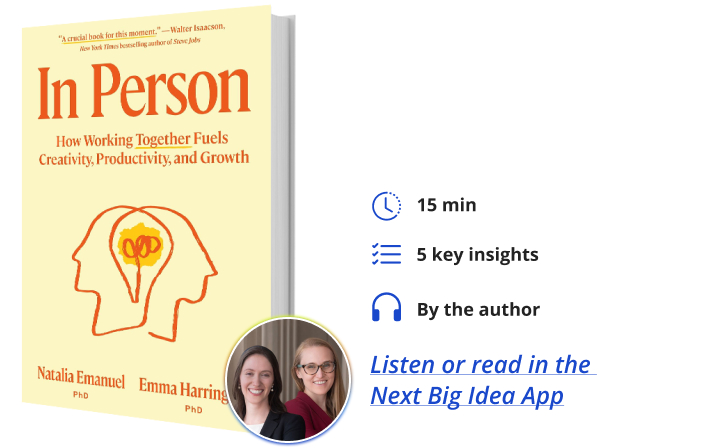
Below, Natalia Emanuel and Emma Harrington share five key insights from their new book, In Person: How Working Together Fuels Creativity, Productivity, and Growth.
Natalia and Emma are economists whose research explores how remote and in-person work affect productivity, collaboration, and the well-being of employees and employers. Natalia is a research economist at the NY Federal Reserve Bank, and Emma is a professor of economics at the University of Virginia.
What’s the Big Idea?
The debate over remote versus in-person work misses the point. What matters is not where people work, but how they work together. The best workplaces make room for the focus and flexibility of remote work while bringing people together for what is better face-to-face.
Listen to the audio version of this Book Bite—read by Natalia and Emma—in the Next Big Idea App, or buy the book.
1. Collisions foster creativity.
In the 1990s, Pixar’s campus featured unremarkable office buildings. A busy road separated the buildings, and on one side worked the writers, on the other the animators. This did not make connection between the two departments easy. But Steve Jobs, then the CEO of Pixar, wanted lots of connection. So he purchased a 15-acre plot with plenty of room to house all employees.
Even with everyone sharing a building, Jobs knew people would need an incentive to get up from their desks, out of their little bubbles, and into conversation with one another. His incentive of choice was the bathroom. Pixar’s new headquarters would have one set of bathrooms—all in a central place. That way, people would have to wind through the building multiple times a day.
Jobs’ rationale was simple: the point of the office was to create arbitrary collisions. The more you bump into people, the more you will be exposed to different perspectives. Different perspectives lead to creative breakthroughs. Those breakthroughs lead to better work for everyone.
Since the 1990s, there has been a big shift in technology. We now have Slack and iMessage, Teams and Zoom. Everyone is just a ping away. It would seem that Jobs’ arbitrary collisions are almost inevitable. But data suggest the opposite. Even though we could reach out to anyone digitally, we don’t. When researchers from Microsoft looked at internal communication patterns around the shift to remote work, they found that losing in-person connection caused digital networks to shrink and become siloed.
Perhaps that’s why Jobs said, “There’s a temptation in our networked age to think that ideas can be developed by email and iChat. That’s crazy.” Often our best technology for communication is our oldest: talking face-to-face.
2. Get a gold medal in synchronized thinking.
When you talk to someone, you might catch yourself mirroring their body language. You cross your arms when they do. Twirl your pen when they start fiddling with theirs. Or wrinkle your forehead when they raise their brow. Amazingly, the same sort of choreography happens in our brains. When part of their brains light up, your neurons fire in lockstep.
Neuroscientists call this phenomenon neural synchrony. Neural synchrony is tremendously powerful: it precedes learning, heralds feelings of connection, and leads to creative ideas.
“When you talk to someone, you might catch yourself mirroring their body language.”
Unfortunately, when people talk over Zoom, 90 percent of that neural synchrony falls away. One reason is that Zoom makes true eye contact impossible. If I look at the camera and give you eye contact, I can’t see your eyes on the screen, and vice versa. Likewise, you can’t see people’s body language: the tapping foot or clenched fist. More fundamentally, Zoom cannot transmit touch: we miss the casual handshake that releases oxytocin, a bonding chemical normally associated with new parents but released with even the briefest interactions.
Losing the hallmarks of face-to-face connection has tangible consequences. People come up with 14 percent fewer creative ideas on Zoom. They exchange 18 percent less written feedback on teammates’ work. And they feel appreciably less connected to their colleagues.
3. AI is making the human parts of work more important.
Remote work is best for concrete, solo tasks. Research indicates that remote work helps people cross a few more items off their to-do list, but those tasks include the parts of work where AI excels. By contrast, AI is less adept at the most human parts of work: establishing rapport, building trust, resolving conflict, creating alignment, or coming up with the next path forward. These are also the parts of work where remote employees feel the distance. The loss of neural synchrony is salient when remote employees try to build connections and bridge disagreements. They miss the creative collisions that help generate the next idea.
Perhaps unsurprisingly, recent data on the labor market indicate that the companies on the forefront of AI deployment have stopped posting as many remote roles. In the end, AI makes fully remote work less tenable.
From this vantage point, it might seem like the answer is just to work in-person all the time, but that’s the wrong approach. Getting butts in seats every day often misses the point.
4. Don’t work remotely from the office.
Return-to-office mandates often come with dreaded dashboards showing who badged into the building that day. Higher-ups can see team-by-team or employee-by-employee metrics on office attendance. They can see whose butt got in a seat.
But workers complain that they’re commuting in just to take Zoom calls with a different background. Some have teammates who are fully remote or in different cities. Others have gotten so used to the convenience of Zoom that their teams don’t bother booking rooms for meetings. The result is the same: employees spend their days working remotely from inside the office.
This is a colossal waste of time and energy. When people are in the office, the purpose is to be face-to-face with colleagues, clients, and collaborators. It’s getting our brains in sync at a literal level. What we want to measure is not butts-in-seats. It is:
- Did you have an interesting conversation?
- Did you learn something about a colleague?
- Did you see something from a different perspective?
These conversations are the reason to commute. A coordinated hybrid policy, where people come into the same space at the same time, eats an arbitrary five-day mandate for breakfast.
5. Remote work is not one-size-fits-all.
Workplaces need to choose the right dose of in-person time and apply it correctly. One of our favorite in-office policies came from a startup founded years before the pandemic. The team was scattered across New England with many employees living multiple hours away from one another. Given this distance, they decided to meet in person just once a week.
During those times, they would do what is best done in-person: aligning on the next week’s tasks, strategizing, but also shmoozing, resolving disagreements, hanging out, passively building trust. In short, they used this time to get their brains in sync.
The rest of the week, they worked solo with each of their respective noses to the grindstone. They chugged away knowing that they would soon have time to unstick themselves from thorny problems and converge on next steps in person. Their in-person time revolved around what was best done face-to-face.
“When in-person work is at its best, it is an engine for growth, meaning, connection, and creativity.”
This policy worked for a few reasons. First, they were all experienced workers. They knew how to execute their tasks, and they also knew how to work with one another—many had worked face-to-face together at prior companies. Second, a weekly dose of ideating and relationship-building was sufficient to drive them forward. Third, the work they did easily lent itself to checks and reviews, lowering the stakes of any mistake.
Other companies whose workers are inexperienced, whose work revolves around connection and creativity, and where any mistake could be catastrophic may need more in-person time.
When in-person work is at its best, it is an engine for growth, meaning, connection, and creativity. Fundamentally, connecting in person is a way to make work more human.
Enjoy our full library of Book Bites—read by the authors!—in the Next Big Idea App: