










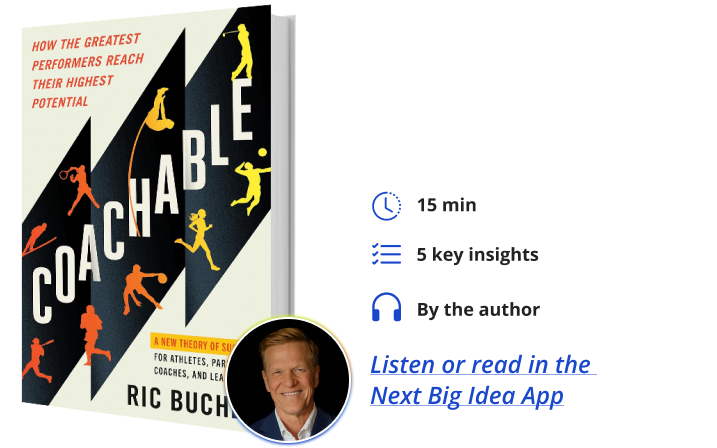
Below, Ric Bucher shares five key insights from his new book, Coachable: How the Greatest Performers Reach Their Highest Potential.
Ric is a longtime sportswriter and TV analyst for ESPN, TNT, and most recently Fox Sports. His writing has been recognized by the Pro Basketball Writers Association, and he has built an international podcast network, United We Cast, which includes his personal show, On the Ball with Ric Bucher.
What’s the big idea?
The path to realizing your full potential begins with refusing to let your strengths, weaknesses, successes, or setbacks define who you are. By cultivating faith, adaptability, and a broader perspective on life, you create the freedom to become more than you ever thought possible.
Listen to the audio version of this Book Bite—read by Ric himself—in the Next Big Idea App, or buy the book.
1. A fixed flaw can be a fountain of faith.
The world knows Stephen Wardell Curry as a four-time NBA champion and the official all-time leader in three-point shots made. Unofficially, he is also the master of miraculous “how did he do that?” shots from literally anywhere inside the painted lines—or even from outside the lines, during warm-ups. No one would have ever predicted any of that for a five-foot-nine high school sophomore with a shooting form that had the ball starting near his waist. Steph was surprisingly accurate, but his father, Dell, a former NBA sharpshooter, told him in no uncertain terms that if he wanted to play beyond high school, he would have to completely change how he shot the ball.
So, Stephen did. His entire summer was spent in the shadow of his backyard hoop, mastering a more fundamentally sound shot. It was an incredibly humbling process. Shooting from long range was what he did best, and now he was starting from scratch, standing a few feet from the hoop, trying to generate power to get the ball up and over the rim in a completely different way. It was at least a month before he could make shots consistently from beyond the paint.
Eventually, the new form took hold, and that hand-eye coordination that allowed him to score even with a funky form now gave him limitless range. The process also taught him a host of valuable lessons that he has subsequently applied to, well, everything else:
- It pays to listen to someone who has been where you want to go.
- Develop habits that allow you to grow, even if they don’t provide immediate results.
- Building something from scratch affords limitless confidence in your ability to build just about anything.
What we learn from attacking a weakness is as valuable, if not more so, than whatever we gain from reducing or eliminating that weakness. As Stephen said, “That summer, I had to have the confidence and faith that I was going to reach the result that I wanted while not knowing how long it was going to take. You don’t know what that roadmap actually looks like, what the experiences will be, how deep and dark it might get along the way. There’s faith that comes with going through that, working toward that intended outcome of who I want to be.”
2. Don’t let who you think you are get in the way of who you can be.
To avoid getting into fights with people threatened by his size and intimidating physique, Richard Jefferson learned to be a cutup, using humor to defuse volatile situations. Cracking wise became part of his persona. Even as he evolved into a professional athlete, he saw it not only as an inextricable part of who he was, but as a valuable tool for bonding with teammates and others.
Richard first realized the value of reinventing himself as a player in San Antonio. By then, his effectiveness as a ball-dominant scorer was beginning to wane. Head coach Gregg Popovich convinced him he had untapped potential as a defender and a catch-and-shoot perimeter threat. One summer, Richard spent countless hours with Popovich at the Spurs’ practice facility, often just the two of them, transforming both his skill set and his mindset. The experience didn’t lead to a championship in San Antonio, but Richard credits that transformation with helping him win one years later in Cleveland. Without it, he believes he would have been out of the league before he ever had the chance to lift the Larry O’Brien trophy.
When Richard entered broadcasting after his retirement, his humor and charisma made him a natural in front of the camera, much as his superior athleticism had made him a natural scorer when he reached the NBA. But a strength leaned on too heavily can become a liability. That was true both on the court and behind a microphone.
“A strength leaned on too heavily can become a liability.”
His desire to poke fun and be silly made television producers nervous that he might say something inappropriate or lead viewers not to take him less seriously. With his eye on climbing to the top of the profession, Richard adapted, developing a more measured and analytical approach. Now, he is part of ESPN’s number one NBA broadcast team.
Letting go of what we do best can create space to get good at something else. What he did best—being funny—didn’t change. He simply learned that he could do more and be more.
3. Never lose sight of your why.
Caroline Marks started surfing as a way to spend time with her brothers and earn their respect. However, she proved to be extraordinarily good at it right off the bat. As a natural people-pleaser, the high-fives and adulation from strangers, and the joy her brothers and parents felt at her success, were gratifying, too.
There’s a point, though, for anyone who rises to the top of their profession, when finishing on top becomes less an aspiration and more an expectation. When she went to the Tokyo Olympics, ranked the second-best female surfer in the world, and finished fourth, it was crushing. The celebrity that comes with success, especially in sports, particularly with women, can also introduce another dicey category of competition: physical appearance. She was a young girl evolving into a woman, competing in a bikini, mingling with fans on her way to and from the surf, and appearing on life-sized ads. Caroline found herself being judged for both her surfing and looks.
Pursuing a more svelte figure led to a decline in the core strength that had powered her sharp turns and unshakable balance on the board. It undoubtedly played a part in her performance in Tokyo. The weight loss also led to severe heart complications, all of which led to a sudden ambivalence about catching waves and making the most of them.
Fortunately for Caroline, while she might have lost sight of what surfing meant to her, her family did not. They convinced her to move back home, get off the pro tour and social media, and reconnect with them instead. After a few months, the itch to get in the ocean returned. A session with her brothers on a little wave near her parents’ Florida home rekindled her original why, which eventually led her to surf with the enthusiasm and free spirit that had captivated fans and contest judges alike. It also won her a World Surf League title and an Olympic gold medal.
4. Trust your instincts and find people who support them.
The reflex with the discovery of any young prodigy is to encourage them to make the most of their singular talent as soon as possible. For a female golfer, it means foregoing a college education and turning pro, especially if they’ve already tasted a certain amount of success as an amateur competing in pro-am tournaments.
Rose Zhang fit that profile to a T, but she recognized the limitations of defining herself simply as a golfer. What if a pro golf career didn’t work out? Or what if she got injured? What would be her purpose then? Who would she be? She preferred to think of herself not as a golfer, but as a smart young woman who happened to have a gift for playing golf. Despite the misgivings of friends and family, she enrolled at Stanford University to play golf and mature as a person.
“College was my time to grow, to make mistakes, to seek a new world and find new perspective on life,” Rose said, “To know who I really am.”
Anne Walker, the Stanford women’s golf coach, understood exactly why Rose was there and promised her: “When your line as a person crosses with your golf line on the graph and they meet, I’m going to kick you out the door,” she told Rose. “Because you, Rose, are more important than Rose the golfer.”
A fellow Stanford student, Beatriz Stix-Brunell, erased any doubt Rose might have had about her decision. Beatriz, 28, was also in her first year at Stanford after pursuing a ballet career with London’s Royal Ballet. In essence, Beatriz told Rose, “I had an amazing career, but I felt like I missed out. Golf will always be there. This won’t.”
Walker and Zhang agreed that her growth as a person was on par with who she was as a two-time national champion golfer. After her sophomore year, she joined the Ladies Professional Golf Association tour. Injuries plagued her first few years on the tour, so having a Stanford degree to pursue proved to be both a welcome distraction and a means of fulfillment during the times when she was unable to swing a club. She will graduate in June and is now hungry to commit 100 percent to becoming the best golfer she can be, because she has already proven to herself that she is fully capable of succeeding as someone else.
5. Tunnel vision is a black hole.
When Dirk Nowitzki was inducted into the Basketball Hall of Fame, he acknowledged each person who helped him achieve that recognition with a word that described their particular contribution. His longtime coach and mentor, Holger Geschwindner, was given the word innovation. And what exactly did Holger innovate? Wrong question. It’s not what, but who. And that was Dirk Nowitzki.
Holger told Dirk in one of their first meetings that if he wanted to be the best player in Germany—with his combination of size, spatial awareness, and work ethic—nothing could stop him. But if he wanted to set his sights higher, like the NBA, well, there were plenty of seven-footers with considerably more foot speed, strength, and leaping ability. He might be a unicorn in Germany, but he would need to become something no one had seen before to reach the NBA.
He had to find something that put those freakishly athletic seven-footers at a disadvantage. While there had been seven-foot-tall players capable of taking and making jump shots before Dirk, he mastered a way to make them with as much efficiency as his opponents did from close range.
“The principle was always the same: how to shoot with the minimum amount of effort and have the maximum margin of error,” Holger said.
To achieve that, the two of them perfected an array of non-traditional methods that felt natural and repeatable to Dirk. They trained off one foot, then the other, fading or spinning, or spinning and fading, and especially from beyond the three-point arc—a place big men previously did not frequent and almost never eyed the basket. Holger’s methods were revolutionary.
Holger believed in a holistic approach to coaching basketball and saw value in developing skills that simultaneously introduced a wider worldview. Hence, he had Dirk learn to play the saxophone to improve his manual dexterity. He had him learn fencing to develop his balance, reflexes, and hand-eye coordination. When a critic labeled Holger’s methods as nonsense, Holger christened his summer basketball camp The Institute of Applied Nonsense. A sports psychologist applauded Holger’s use of non-traditional athletic settings. Dirk would become the first foreign-born player to lead an NBA team to a championship in 2011, but that might never have happened without Holger’s insistence that basketball occupy its proper place in the grand scheme of life.
“Holger believed in a holistic approach to coaching basketball.”
In 2007, Dirk was named the NBA’s Most Valuable Player after leading the Dallas Mavericks to the best record in the Western Conference. Yet his triumph quickly turned to disappointment when the Mavericks were stunned in the first round of the playoffs by the eighth-seeded Golden State Warriors.
Rather than retreat to his home in Dallas or immediately return to the gym to work on weaknesses the Warriors had exposed, Dirk and Holger disappeared into the Australian outback for several weeks. Long stretches of road without seeing another person and nightly campfire conversations untouched by the news cycle helped put both the MVP award and the playoff loss into perspective.
“That trip really gave me a new perspective,” Dirk said. “I was looking forward again to a new season and new challenges.”
It would have been infinitely harder for Dirk to trust Holger if the latter hadn’t been able to explain the reasoning behind his unconventional methods—or if he lacked the flexibility to abandon ideas that Dirk found unhelpful. The seeds of Dirk’s confidence that he could overcome any setback, even one as devastating as winning league MVP only to be eliminated in the first round, were planted during their years of experimentation and mutual learning. Together, they learned to view setbacks, no matter how painful, as information to be used going forward.
That mindset helps explain why, despite playing under coaches far more accomplished than Holger, Dirk kept him as a mentor and trusted adviser throughout his entire career. Finding the right coach is important. Holding on to the right coach, through success and failure alike, may be even more important.
Enjoy our full library of Book Bites—read by the authors!—in the Next Big Idea App: