











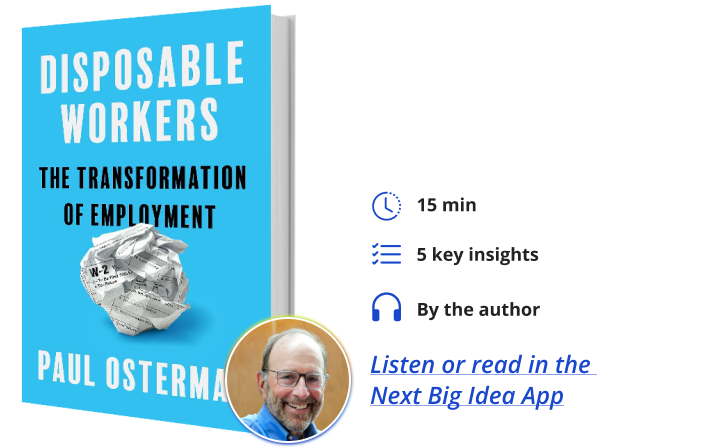
Below, Paul Osterman shares five key insights from his new book, Disposable Workers: The Transformation of Employment.
Paul is a Professor Emeritus of Human Resources and Management at the MIT Sloan School of Management.
What’s the Big Idea?
The rise of disposable work is allowing companies to gain flexibility and cut costs while shedding responsibility for their workers. We need guardrails to keep that flexibility from coming at the expense of workers and the public.
Listen to the audio version of this Book Bite—read by Paul himself—in the Next Big Idea App, or buy the book.
1. Firms do not want employees.
Employers want to get out from under the obligations they owe their workforce. Companies want bodies to do the work, but they increasingly don’t want those bodies to be employees.
Disposable workers are everywhere nowadays. The concierge who greets me when I leave my condo in the morning works for a contracting company, not the building. When I do an interview at a downtown office building, that building is being cleaned by contractors. The person indexing my new book is a freelancer. If I get into an accident, the nurse who might treat me in the emergency room is possibly a traveling contractor, not a hospital employee. If I sue the city because of a pothole led to that accident, the defense attorney may be a staff attorney hired for a single case, not on the partner track at the firm.
Disposable workers include contractors, freelancers, and what I call marginal workers: people who are technically on a firm’s payroll but whom the firm has no intention of placing on any kind of career ladder and wouldn’t much care about losing.
Why are companies doing this? Partly, it’s cost. They avoid paying benefits, and they can pit one staffing firm against another to drive prices—and wages—down. But management also wants flexibility. They want the ability to do what they want, when they want, without the constraints that come with a permanent workforce.
And the third element is a certain lack of respect for frontline employees. The consulting firm McKinsey issued a report claiming that 95 percent of a company’s value is produced by only five percent of its employees. That’s disrespect. When one major bank’s CEO attributed a round of layoffs to artificial intelligence, he referred to the workers he’d let go as “low value human capital.” That phrase tells you everything.
2. More than a third of American workers are disposable.
The disposable workforce includes people from various lines of work: Uber drivers, food delivery workers, staff attorneys, travel nurses. They don’t all look alike, and they’re often counted separately in official labor statistics, which makes the full picture easy to miss.
To get a real count, I conducted an original, nationally representative survey of well over 6,000 workers, asking detailed questions about the nature of their employment arrangements. The bottom line is that 35 percent of the American workforce are disposable workers. That is a very large number.
“The bottom line is that 35 percent of the American workforce are disposable workers.”
An important and sometimes overlooked portion of that figure is made up of marginal employees. Some are obvious cases, like adjunct faculty or staff attorneys on short-term contracts. But many part-time workers belong in this category too. Firms deliberately create part-time jobs because they know part-time workers have higher turnover than full-time workers. By engineering high-turnover positions, firms manufacture disposability, creating a workforce to which they owe no lasting employment commitment whatsoever.
3. The consequences reach well beyond paychecks.
One way to measure the real cost of disposability is to ask workers how satisfied they are with their current employment arrangements. Satisfaction is a good metric because it captures wages, working conditions, health and safety, and a range of other factors all at once.
Freelancers, on average, report higher satisfaction than standard employees. They say schedule flexibility is genuinely valuable to them. But contractors and marginal workers are considerably less satisfied than standard workers. They are also far less willing to put in extra effort for their employer. When asked about commitment and willingness to work harder, freelancers and standard employees both score high, but marginal workers and contractors score much lower. That disengagement has real consequences for organizational performance.
The consequences extend to the public as well. One important study compared hospitals that used contractors for cleaning with hospitals that used regular full-time employees for the same work. Infection rates were higher in the contractor hospitals. Contractors are not embedded in the hospital’s communication networks. They exist on the margins of the workforce, disconnected from the protocols and relationships that keep patients safe. The same pattern holds for industrial accidents: workplaces with high concentrations of disposable workers see higher injury rates.
4. AI is making it worse.
There’s a great deal of speculation about what artificial intelligence will do to employment. Before engaging with that question, it’s worth establishing that the rise of disposable work preceded the rise of AI. This shift began decades ago, driven by cost pressures and management preferences—not algorithms.
“AI introduces significant uncertainty for firms about their future staffing needs.”
That said, AI is relevant to where things are heading. AI introduces significant uncertainty for firms about their future staffing needs. They do not know how many workers they’ll need two years from now, or what skills those workers will require. In the face of that uncertainty, the incentive to rely on disposable workers grows stronger, because disposable workers are easy to let go when circumstances change.
It’s unclear whether AI will cause mass job elimination. It is the uncertainty of an AI-powered future that increases firms’ appetite for fewer obligations—and fewer obligations come with more disposability.
5. We need guardrails, not abolition.
Firms are profit-maximizing machines. That’s their primary objective, and within the current legal and regulatory environment, using disposable workers serves that objective very well. The solution, then, is not to abolish disposable work—that isn’t realistic, and for workers who genuinely prefer freelance arrangements, it wouldn’t even be desirable. The right analogy is sharks. Sharks are important to the ocean’s ecosystem. They serve a real function. But they will eat you if you let them. So we build barriers—not to eliminate sharks, but to limit their range.
What kinds of barriers work?
One powerful lever is clarifying who counts as an employee in the first place. Current federal law is a tangle of inconsistent statutes, and enforcement shifts with every administration and every judicial appointment. 33 states have adopted what’s called the “ABC test”—a simple, three-part definition of employee status. If adopted at the federal level, it would cut through much of that complexity and make enforcement more straightforward. This matters especially for gig workers: drivers, delivery workers, and freelancers whose legal status is perpetually contested.
“We build barriers—not to eliminate sharks, but to limit their range.”
For contractors and marginal workers who are already classified as employees, the challenge is different: it’s about raising the floor on job quality. Unions remain the most effective tool for that. Unionized building cleaners earn significantly more than their non-union counterparts, but only about six percent of private-sector workers are unionized, and that number shows little sign of growing.
So we need additional strategies. Workers themselves are organizing outside of traditional union structures. On both coasts, rideshare drivers have pushed cities and states to establish standards around wages, bathroom breaks, and travel time. And public pressure also plays a role. When Nike faced sustained public scrutiny over sweatshop labor, it changed its practices. The same logic applies here. The Fight for $15 campaign raised wage standards in big-box retail, proving that organized pressure on large firms can move the needle. We don’t have to accept a world where a third of workers are treated as disposable. We just have to decide that we won’t.
Enjoy our full library of Book Bites—read by the authors!—in the Next Big Idea App: