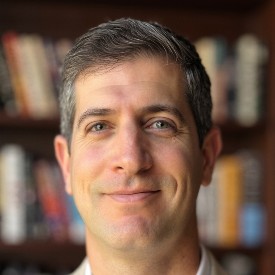












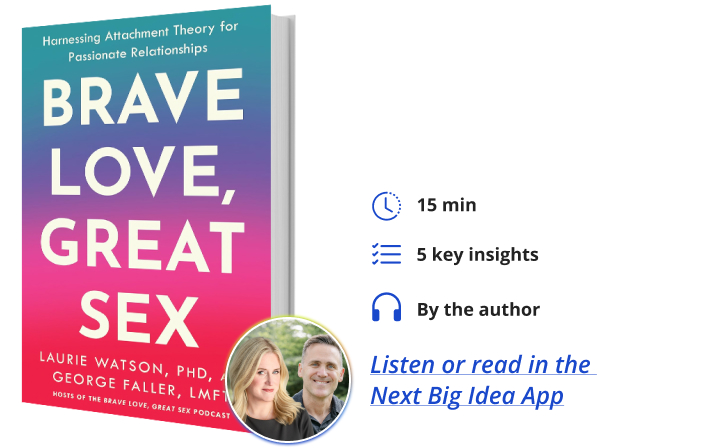
Below, Dr. Laurie Watson and George Faller share five key insights from their new book, Brave Love, Great Sex: Harnessing Attachment Theory for Passionate Relationships.
Laurie is a Certified Emotionally Focused Therapist for couples, a Certified Sex Therapist, trainer, and podcaster. Her podcast co-host and co-author, George , is a renowned trainer of couples therapists in Emotionally Focused Therapy, as well as a sought-after supervisor and therapist. His online training platform, Success In Vulnerability, has trained thousands of therapists.
What’s the Big Idea?
Our deepest relationship conflicts come from fears of disconnection. By breaking negative cycles and risking vulnerability, couples can build the security that allows both love and passion to thrive.
Listen to the audio version of this Book Bite—read by Laurie and George—in the Next Big Idea App, or buy the book.
1. The blueprint of love.
Attachment theory tells us that the way we were loved as children becomes the blueprint for how we expect love to work as adults. We leave childhood with beliefs about two fundamental questions:
- Can I count on the people I love?
- Am I worthy of being loved?
When we fall in love, we often experience sexual attraction first, and then our romantic partner becomes deeply important to us. They matter to us, and we want to matter to them. They become our new primary attachment figure.
That’s why even a small disruption in our connection can feel enormous. It isn’t just disappointing—it feels threatening. Is this logical? No. Does it make sense? We think it does. Why? Because our bodies don’t distinguish very well between physical danger and attachment danger. When the bond with the person we depend on feels threatened, our nervous system responds as though our survival is at stake.
Suddenly, it’s as if we’re standing alone on the wide-open savannah. Exposed. Without protection. Unfortunately, our partner looks like the enemy. Instantly, our bodies mobilize into either fight or flight. No longer a team, partners protect themselves from each other—often in opposite ways.
One partner fights. They pursue, ask questions, explain, protest, repeat themselves, criticize, demand reassurance, or get angry—desperate to get their partner to engage. The other partner goes into flight. They withdraw, become quiet, intellectualize, try to stay positive while misattuned to their partner’s distress, shut down, sometimes even leave the room—not because they don’t care, but because conflict feels so overwhelming, maybe even frightening.
Ultimately, this pursue-withdraw cycle leaves them both alone, more unsafe than ever. While it feels so bad, the dire nature of these cycles is really because our partner means so much to us.
2. Criss-crossed lovers.
According to attachment theory, romantic love requires two kinds of connection: emotional and erotic. We meet our partner’s needs in both arenas through a third aspect of love: care.
Without emotional connection, we can feel lonely, unsafe, uncertain about the future, and unimportant to our partner. Worse, we wonder if we’re worthy of love.
Without sexual intimacy, we can lose the vitality of love. We may question whether we’re still in love, or still being loved. We can become vulnerable to temptation by another. Or love can simply erode under the grind of everyday life.
Sexual rejection may feel especially vulnerable because our need is so primitive, so reminiscent of our earliest needs for holding, soothing, and oneness. It can leave us feeling cast off and undesirable, questioning whether we’ll ever be enough.
“Negative push-pull cycles strangle emotional goodwill and sexual desire.”
The more we lose connection, the more we protect ourselves. We tell ourselves our partner is just a selfish person. Our bodies respond to this assumption by making us feel sick to our stomachs or tightening our chests. These negative push-pull cycles strangle emotional goodwill and sexual desire.
To complicate things further, we may switch our protection strategy in these two important areas of love. The emotional pursuer becomes the sexual withdrawer. The emotional withdrawer becomes the sexual pursuer. One partner says, “I need to feel emotionally close before I can want sex.” The other says, “I need to feel sexually close before I can open up emotionally.”
In this crisscross pattern, both feel frustrated. Both experience rejection. Both want their partner to give first, afraid that they will be taken advantage of if they meet the needs of their partner.
3. A method that heals the madness.
What feels like madness between couples is actually a pattern—and patterns are easier to solve than a hundred seemingly unrelated arguments.
All of us get caught in pursue-withdraw patterns in relationships that mean so much to us. We’ve learned survival strategies that worked for us at one time. But now these same strategies can separate us from the person we love most.
One problem is that our relationship reactions happen incredibly fast. A look. A tone. A word. In a fraction of a second, we decide what it means:
- You don’t care.
- I’m not important.
- You’re always critical of me.
- I’m failing you.
Couples can learn how to slow that moment down. With training, it is possible to separate what actually happened from the story their brains instantly told them about what happened—and then notice the emotion, the body alarm, and the protective reaction that followed. Once you see the sequence, you have a choice. You don’t have to automatically use your old protective strategy.
You pursue because you’re terrified of being abandoned—but unfortunately, they experience your pursuit as proof they’ll never be good enough. You withdraw because you’re terrified of failing—but your partner experiences your withdrawal as proof that they don’t matter. That’s the madness. And seeing it is the way out.
4. Risking vulnerability.
To change the cycle, we must risk vulnerability. Joey and Maria had lost each other emotionally and sexually. Like so many couples, in protecting themselves from rejection, they were creating more of it. The turning point came when they began showing each other what was underneath. Instead of anger, criticism, or withdrawal, they risked saying:
- I miss you.
- I’m afraid I don’t matter to you.
- I want you, but I’m scared you don’t want me.
That’s what we mean by Brave Love. Vulnerability is brave because we’re showing our partner the very place where they could hurt us most. We’re saying: Here I am. This is what I need. Do I matter to you? Will you be there for me?
And when our partner responds—when they reach back and let us know that we matter—something begins to change. Our nervous system learns: I’m not alone. I can reach for you, and you’ll be there.
We follow Joey and Maria through this process—from growing new emotional safety to changing their sexual relationship from obligatory to erotic. As they heal, they begin to risk talking about desire, rejection, what they want, and what they are afraid to want. Instead of protecting ourselves from the person we love, we need to risk letting them truly know us.
Not all negative cycles look like classic pursue-withdraw. We explore parallel cycles, LGBTQ+ couples, and the particular challenges of aging, affairs, and trauma. The details differ, but the work is the same: recognize the protection, risk showing what’s underneath, and learn to reach for each other differently.
5. Brave love sets passion free.
As we become braver by vulnerably sharing our hearts, needs, and emotions, we become more securely attached as a couple. Secure love may sound routine or even boring—unsexy—but in the sexual realm, security sets passion free.
If we are anxiously attached, we may have mistaken intensity for intimacy. As we become more secure, the chase for intensity can be replaced by the deepening of intimacy and intoxicating pleasure. We feel safe from abandonment, knowing our lover will still be there in the morning.
“We are built for connection.”
If we are more avoidantly attached, we may have learned not to need too much, ultimately fearing rejection if we let our needs break the surface. With greater security, we dare to need again—to feel and express desire. Our fear of rejection can become comfort in closeness.
And in secure love, it becomes safer to reveal our erotic fantasies and longings—the eternal source of sexy ideas. Research shows that securely attached lovers experience greater sexual satisfaction, responsiveness, communication, frequency, and variety. They’re more open, engaged, experimental, playful, and curious. They’re freer from performance anxiety and more flexible with each other in bed. And throughout all the mundane tasks of life, they don’t lose sight of their partner as an erotic being.
We are built for connection. And when we can rely on each other, free from negative cycles, we gain the freedom to risk, create, explore. Freedom to love and make love.
Enjoy our full library of Book Bites—read by the authors!—in the Next Big Idea App: