












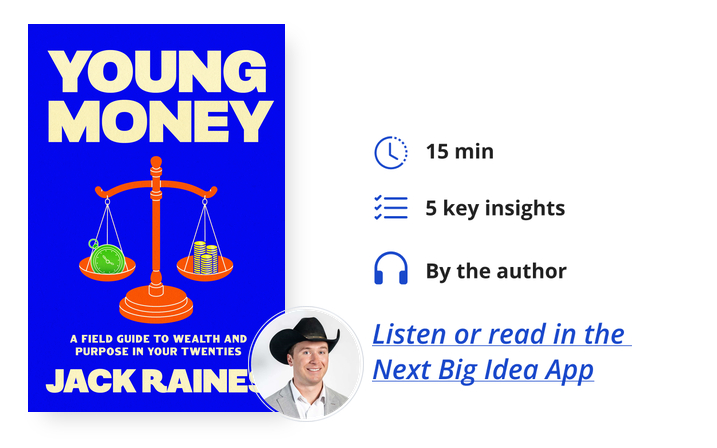
Below, Jack Raines shares five key insights from his new book, Young Money: A Field Guide to Wealth and Purpose in Your Twenties.
Jack is an investor at Slow Ventures, an early-stage venture capital fund.
What’s the Big Idea?
Most advice for twenty-somethings is really advice for forty-somethings delivered ten years too early—save aggressively, optimize your career, build stability. But your twenties are a distinct stage with their own windows, their own risks worth taking, and their own version of fun that won’t be available later. The question isn’t just what you want out of life. It’s what you want out of this part of life, while you’re still in it.
Listen to the audio version of this Book Bite—read by Jack himself—in the Next Big Idea App, or buy the book.
1. Everything in life is stage-specific.
A bad trade that a lot of young people make is treating their twenties like throwaway years—expendable, just a foundation for the rest of their life. It’s important to use your 20s to build, but it’s just as important to recognize that a lot of the opportunities available when you’re young won’t be available later. And they certainly won’t be as enjoyable as they would have been in the prime of youth.
When I was 24, I quit my job on a whim and spent a year backpacking Europe and Latin America before going to business school. I was hostel-hopping, hanging out with strangers, spending almost no money, and having a genuinely great time. At one hostel in Lagos, Portugal, I met another American named Simon. He was 33—nine years older than me. We grabbed a couple of beers and started trading life stories.
Simon had spent his first decade out of college optimizing for money, and money alone. Now, here we were on the same trip to Portugal. He said he was having fun, but he would have enjoyed it so much more five or ten years earlier. Back then, his friends were in their twenties too. Nobody was married or had kids, so some of them could have tagged along. But at 33, that window had closed. There was a version of young, reckless fun he could have had at 24 that he simply couldn’t access anymore.
The version of you that exists at 25 is not the same version that will exist at 35 or 45. So you have to think about not just what you want out of life, but what you want out of each specific stage of life while you’re in it. The part of life you’re in right now is going to end. Being aware of what you want, and the best time to go get it, matters enormously.
2. Be “risk-on” when you’re young.
The hard part about being 22 or 23 is that you don’t really know anything yet, and you’re constantly comparing yourself to people a few years ahead of you. They seem to have things figured out. So a lot of young people land on the same logic: I need to gather more experience, reach some level of financial stability, and then I will do something different.
The flaw in that plan is that the right moment never actually arrives. Your cost of living only goes up with time. Your responsibilities only get more complex as you move into your thirties. If you’re too focused on maxing out stability before you take any risks, you’ll never feel comfortable enough to take them.
“Your cost of living only goes up with time.”
Young people should be far more risk-on before those costs and responsibilities accelerate. By risk-on, I mean anything that deviates from your default: moving to a new city, joining a startup, starting your own business, ending a lackluster relationship. The opposite of inertia. It’s much easier to do this when you’re young because you have time to recover. Your burn rate at 24, living with a couple of friends, is cheap. No spouse, no kids, no mortgage—so you can take a lot of shots, and if they don’t work out, you have time to make more money and bounce back.
A second benefit of being “risk-on” when you’re young is developing self-knowledge. You learn a lot about yourself by having a wider range of experiences when you’re young. Follow one straight path through your twenties and you’ll arrive at 30 having never flexed the muscle of trying different things—and you won’t know how. You won’t even know what you like, what you’re good at, or what you actually want. The cost of experimentation when you’re young is low. The upside is high. So be more risk-on.
3. Optionality is useful until it isn’t.
When you’re young, optionality is one of your most valuable assets. By optionality, I mean the ease with which you can move from one thing to another. You can pretty seamlessly end one chapter and start another at 23 or 24, be that switching jobs, cities, or relationships. But by 33 or 34—once you’ve made progress in your career, gotten married, or bought a home—your life becomes more rigid. That’s not a bad thing because it’s usually a sign that things are compounding. But it does mean the optionality you had at 24 is largely gone.
The upside of optionality is that when you find yourself on the wrong path, you can move to something else. But the value of optionality declines over time, because optionality is only worth what you actually get out of it. The reason to be exploratory when you’re young is to use that freedom to figure out what you like, what you’re good at, and where you want to spend your time. At some point, you do have to make a choice, but shop around while it’s worth it.
4. It’s okay to have a lower savings rate when you’re young.
Most financial advice centers on saving money and cutting expenses. Very little of it addresses how you actually want to spend money—and, importantly, when you want to spend it.
Here’s the trap: you’re not making much money when you’re young, and that’s scary. Combine that with the standard playbook—save 15 to 20 percent of every paycheck, put it in the market, build a nest egg—and it can feel like there’s nothing left for fun stuff. My counterintuitive take: while you shouldn’t blow thousands on bottle service every weekend, you can (and probably should) spend a higher percentage of your money on fun when you’re young.
Two reasons. First, the amount you save in your twenties matters less than the slope you’re on to earn more over your career. If you’re in a field where your income is likely to climb significantly over time, then whatever you sock away at 23 just isn’t going to move the needle on your lifetime savings. If you’re making $65,000 at 23 and you expect to be making multiples of that a few years later, you shouldn’t skip the ski trip or fun night out with the people you care about purely for the sake of financial hygiene.
“The older you get, the more your tastes change, and the more you have to spend to get the same enjoyment.”
Second, the fun you get per dollar spent is just so much higher when you’re young. Cheap thrills are fun. Going out with your friends and spending a couple hundred bucks is fun. The older you get, the more your tastes change, and the more you have to spend to get the same enjoyment.
When you have this finite window—where you and all your friends have just started making money, you’re out of school, and nobody has spouses or kids yet—take the trip. Your life satisfaction is going to be much higher for it. Financial advice isn’t black and white. Everything is stage-specific—including how much fun costs, and when to spend on it.
5. Status games make you a spectator of your own life.
For most of human history, the biggest threats we faced were physiological. You had to find shelter, food, and safety. Today, if you live in a wealthy country, you can get a cheap apartment, eat fast food or shop at Trader Joe’s, and survive on what amounts to a couple thousand dollars a month. The problems we face now are psychological, and the biggest one is status.
Humans are status-seekers. We’re bad at measuring our objective standing in life, and we’re very good at measuring how we stack up against everyone else. Historically, that comparison was limited to the people immediately around you. Now, thanks to LinkedIn, Instagram, TikTok, and Twitter, you can now see what billions of strangers are doing at any given moment and compare yourself to them on salary, life milestones, everything.
It becomes very easy to feel insecure, envious, or anxious that you’re not keeping up. And you start, almost subconsciously, making decisions about where you live, what you do for work, and how you spend your time based on what you believe will earn you more status. The danger is that on a long enough timeline, every major decision you make is really just a bid for approval you wouldn’t otherwise care about. At that point, you’ve stopped living your own life. You’re just watching it. Pay attention to the motivations of those around you, and you’d be shocked to see how much status games drive everything.
Enjoy our full library of Book Bites—read by the authors!—in the Next Big Idea App: