












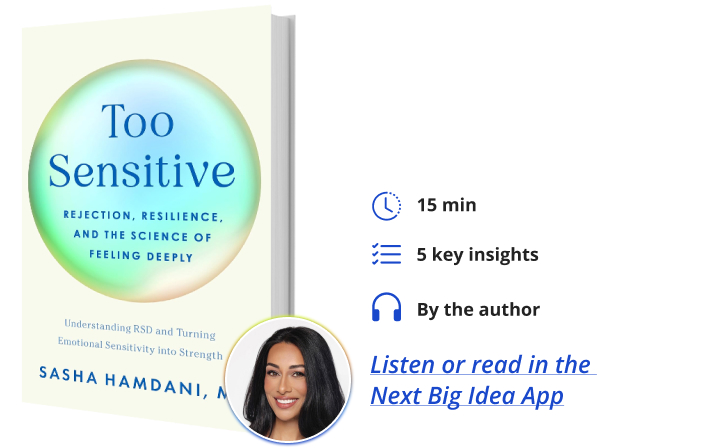
Below, Dr. Sasha Hamdani shares five key insights from her new book, Too Sensitive: Rejection, Resilience, and the Science of Feeling Deeply.
Sasha is a board-certified psychiatrist specializing in ADHD.
What’s the Big Idea?
Emotional sensitivity isn’t a flaw to overcome. It reflects how some nervous systems process emotions and social cues more intensely. Once we understand those patterns and learn to regulate them, sensitivity can become a source of powerful emotional intelligence.
Listen to the audio version of this Book Bite—read by Sasha herself—in the Next Big Idea App, or buy the book.
1. You’re not broken. Your nervous system is speaking.
At a medical school reunion, a friend made an offhand joke and before anyone else seemed to notice, I felt the energy in the room shift. One person smiled too quickly. Another went quiet. For many years of my life, I would have blamed myself for reacting so strongly, telling myself I was too emotional, too sensitive, too much. Many of us have lived with that same story for so long that it feels like truth.
But what if emotional sensitivity isn’t a character flaw? What if some people simply have highly responsive nervous systems? Their brains and bodies notice subtle shifts in facial expressions, tone of voice, relationships, and social dynamics more quickly and intensely than others do.
They aren’t imagining things and they aren’t weak. Their systems are processing emotional information differently. Understanding this distinction changes everything. Instead of asking, “What’s wrong with me?” We begin by asking, “What does my nervous system need?” That shift can loosen years of shame and replace it with compassion, clarity, and self-understanding.
2. ADHD is more than an attention disorder.
One of the most overlooked features of ADHD is emotional dysregulation. Many of my patients don’t come in because they can’t pay attention. They come in because their emotions feel out of control. Criticism derails them for hours. Conflict feels unbearable. They replay conversations on loop, long after everyone else has moved on. For people who experience rejection sensitive dysphoria, those emotional reactions can feel especially immediate and overwhelming.
“The problem is not that these emotions happen.”
In Europe, emotional dysregulation was formally recognized as a core part of ADHD in 2019, but the U.S. lags behind, often reducing ADHD to just an attention problem. When that’s the framework people are given, their actual experience makes no sense to them. The problem is not that these emotions happen. The problem is that no one has ever explained why. When we understand ADHD as a disorder of regulation, not simply attention, people can finally see themselves clearly.
3. Emotional sensitivity doesn’t look the same for everyone.
One of the greatest misunderstandings about sensitivity is that you’re either sensitive or not. Either you feel too much or you’re fine. But human experience is far more nuanced.
Sensitivity doesn’t show up in one uniform way. Some people respond by becoming perfectionists, trying to prevent criticism. Some become chronic people pleasers, constantly adjusting themselves to keep others comfortable. Some avoid conflict at all costs because even minor tension feels deeply unsettling. Others replay conversations for hours, assume rejection quickly, or remain emotionally activated long after a difficult moment has passed. These behaviors may look different on the surface, but can reflect the same underlying reality: A nervous system that processes emotional and relational information with greater intensity.
It helps to understand where we fall on the sensitivity spectrum. Not in a way that boxes us in, but in a way that gives language to our experience. Some responses may be more blunted, some may fall into a more typical range, and others may be more expansive. This is a pivotal step because you can’t regulate what you can’t recognize. When we see our patterns more clearly, we stop judging ourselves so harshly. We begin to understand why we react the way we do, what support we actually need, and how to respond with more compassion instead of shame.
4. Regulation is a skill that can be sharpened.
A good friend once told me, “The feeling hits, and by the time I realize what’s happening, I’ve already reacted.” That experience is so common. For some people, emotions can feel fast, overwhelming, and impossible to interpret, which often leads them to believe that they’re simply bad with emotions, but that’s rarely the case. Emotional regulation can be practiced. Our nervous systems are remarkably adaptable and, with repetition, can learn new patterns.
“Small tools can create profound changes.”
What feels automatic today does not have to stay automatic forever. Small tools can create profound changes. Naming an emotion helps organize a brain’s response and makes it feel less amorphous. Slowing the physiological response through breath, grounding, or pausing can reduce the sense of threat. Creating even a little space before reacting gives a thinking brain time to come back online. When you’re able to create enough space between the feeling and the reaction, you can then choose your next step instead of being driven by it. That space may only be a few seconds at first, but even a few seconds can begin to change a life. With practice, those moments of pause become strength, freedom, and trust in yourself.
5. Sensitivity can become your greatest strength.
Many people have been told that they feel too much, react too strongly, or take things too personally. Over time, sensitivity can start to feel like a liability that needs to be fixed or hidden. But I don’t think the goal is to become less sensitive. Sensitivity often comes with empathy, creativity, intuition, and the ability to form deep, meaningful connections. Sensitive people tend to notice subtleties that others miss. They can pick up on emotional shifts, read between the lines, and respond with depth and care.
Those qualities are beautiful and advantageous. They’re often the foundation of insight, compassion, and emotional attunement. What needs to change is the suffering that comes from not understanding those qualities. When sensitivity is unsupported, it can feel overwhelming. A person may become flooded by emotion, confused by their reactions, and ashamed of how deeply they feel. But when people learn how to regulate their nervous systems, sensitivity begins to change form. It becomes less about pain and more about perception. They still feel deeply, but they’re no longer ruled by every emotion that passes through them. That’s where emotional sensitivity can become emotional intelligence.
The ability to feel deeply while also understanding and regulating those feelings creates clarity, discernment, and choice. The goal is not to be less sensitive. The goal is to be more in control. Emotions aren’t your enemy. With the right understanding and tools, they can become one of your greatest strengths.
Enjoy our full library of Book Bites—read by the authors!—in the Next Big Idea App: