











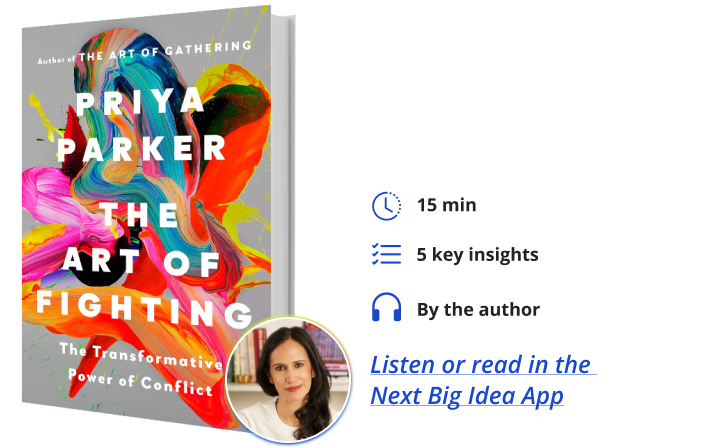
Below, Priya Parker shares five key insights from her new book, The Art of Fighting: The Transformative Power of Conflict.
Priya is a conflict facilitator, strategic adviser, and the author of The Art of Gathering: How We Meet and Why It Matters. For the past two decades, she has worked with organizations, teams, and families around the world to help them have hard, collective conversations during moments of transition and decision-making.
What’s the Big Idea?
Conflict isn’t the opposite of connection. Done well, it can deepen our relationships. The art is knowing which fights are worth having, and how to stay in them with care.
Listen to the audio version of this Book Bite—read by Priya herself—in the Next Big Idea App, or buy the book.
1. Conflict aversion is keeping us lonely.
We are pretty bad at fighting. When conflict arises, one of two things usually happens: we escalate and burn the house down, or we ignore the conflict completely. We avoid having tough but important conversations with our friends, coworkers, and families, which leads to shallow relationships and fragile communities.
The tools for having healthy conflict exist, but most of us never learned how to use them. Many of the organizations I work with suffer—and they would agree with this—from unhealthy peace, where no one says anything. People don’t actually say what they mean. Every now and then, there’s an explosion of unhealthy conflict. If we can learn to hold healthy heat in our relationships, conflict can be generative rather than destructive. We can use it to strengthen our relationships and the groups we belong to.
We’ve also been taught that good people, good families, good teams don’t fight. But that’s not true. Conflict isn’t dysfunctional. It can be highly functional, which means it serves a purpose. Conflict is a sign of relevance, of investment. And when a group or a friendship, marriage, or a team doesn’t take time to have its hard conversations, it’s not going to stay peaceful forever. Connection quietly dissipates. People drift. They go low-contact. They stop showing up. The unhealthy peace was never actually peace. It was postponement.
2. If you want your people to get better at fighting, start with banter.
To get better at heat, add warmth. If you want to get your team or group to get better at handling real conflict, don’t wait for a crisis. Start instead with getting good at and normalizing banter. It might sound counterintuitive, but arguing about something trivial is good preparation for arguing about something that matters. Investing in low-stakes conflict builds the capacity you need for high-stakes conflict.
I once attended a leadership summit for a large, publicly traded technology company at a genuinely pivotal moment in their business. The company had gathered its senior leadership for a three-day retreat to work through a series of controversial, high-stakes strategic decisions—the kind of conversations the group had a track record of avoiding.
“Investing in low-stakes conflict builds the capacity you need for high-stakes conflict.”
On the first morning, a senior vice president walked onstage. His face was grave, and he told the room, “To remain competitive, we have to have the tough conversations. We’re going to start in a very heavy place, which I don’t like doing on day one.” The room tensed up, bracing for something serious. Then, on a massive screen behind him, the first slide appeared: Pineapple on pizza. Yes or no?
People looked around, confused, and then started laughing. But the vice president, Lionel Maury, wasn’t joking. He meant it. He told them to get into small groups, debate it for 10 minutes, and come back ready to defend their position. It felt ridiculous in a room full of senior executives who were preparing to make real decisions. But that was the point.
By the time this group got to the actual hard conversations later that day, they’d already practiced the physical experience of disagreeing with each other out loud in front of the room and surviving it. The heat of arguing about pizza toppings gave them a low-stakes rehearsal for the much higher-stakes heat to come.
The group completely shifted based on that exercise. Maury showed them that they can argue with each other in prosocial ways. Banter is the elixir of prosocial conflict.
3. Not all fights are worth facing.
As James Baldwin wrote, “Not everything that is faced can be changed, but nothing can be changed until it is faced.” With due respect, I would add a third clause: And not everything should be faced.
Sometimes the wisest move isn’t to resolve a tension. It’s to leave it exactly where it is. Not every disagreement in your life, or your team, or your company is a problem waiting to be solved. The artful fighter has discernment, using questions like these to decide whether to face or not:
- Can I continue to engage meaningfully without facing it?
- Do I care enough about this group to take this on?
- Do I still have longing for this group?
- Is this conflict touching on a core value of mine?
- Does the group need to reflect those values for me to be a part of it?
- Conflict arises in every group. Are these the people I want to be in a mess with?
4. Groups that last don’t share answers. They share the same questions.
We tend to assume that a strong, healthy group is one that has settled all its big questions, once and for all. But the opposite is true. The groups that hold together longest are the ones that like sharing the same hard questions. They keep returning to them over and over again.
In The Art of Fighting, I look at all kinds of groups: festivals, conferences, sports teams, Boy Scout leagues. And I look at the questions they’re asking.
For example, take Burning Man, one of the groups I look at in The Art of Fighting. The founders have shared the same questions over decades, such as: What kind of structure do you need internally to create a temporary utopia externally?
5. Funerals aren’t just for people.
We know how—or we’ve seen how—to honor the end of a human life with real ceremony: a funeral, a wake, a shiva. But we almost never extend that same care to the ending of a group, a friendship, an organization, or even a community, though we really should.
There’s a small theater collective from the early 2000s called 13P, short for 13 Playwrights. 13P banded together and pooled their resources so that each one of them could get the notoriously difficult chance to fully produce one of their own plays—something that, particularly then in the theater world, was really hard to do.
They only had one rule: Nothing that happens can destroy the group’s ability to keep going until all 13 plays are done. Their motto was, “We don’t develop plays. We do them.” They had no permanent space of their own. They met weekly at a Starbucks. They lasted for almost a decade.
“Their ending wasn’t a failure of the group.”
Crucially, their mission was deliberately finite. They didn’t want to become a permanent institution. After the 13th and final play was produced, it was time for the group to end. But instead of quietly disappearing, the way many collectives do, they threw themselves an “implosion party” at the Public Theater in New York.
Friends came and sang songs from their old productions. One member’s band got up and performed a song called “We’re Gonna Die.” One of the playwrights, reflecting on 13P, said that she wanted the group’s life to be both vivid and bright before eventually collapsing into darkness.
Their ending wasn’t a failure of the group. It was its ultimate fulfillment. Some groups in our lives need a real, proper funeral. This group did exactly what it had come together to do.
Enjoy our full library of Book Bites—read by the authors!—in the Next Big Idea App: