












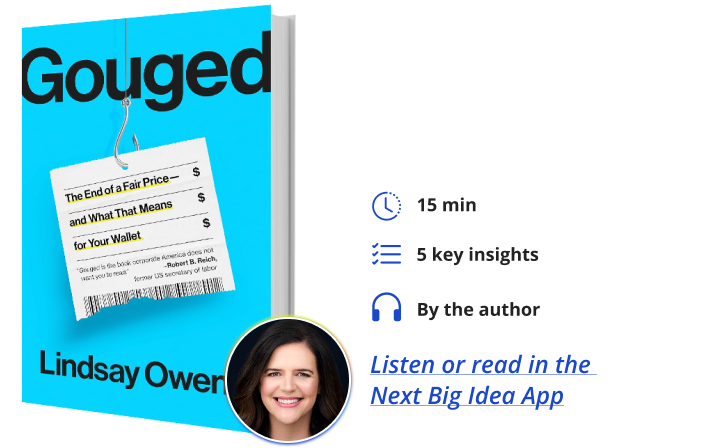
Below, Lindsay Owens shares five key insights from her new book, Gouged: The End of a Fair Price–and What That Means for Your Wallet.
Lindsay is the President and CEO of Groundwork Collaborative, an economic think tank and corporate watchdog. She regularly advises government officials, candidates for elected office, and members of Congress and has served as a senior advisor to lawmakers including Senator Elizabeth Warren.
What’s the Big Idea?
Corporations are using AI, algorithms, and personal data to find new ways to squeeze more money out of consumers. As the idea of a fair, predictable price disappears, new protections are needed to keep companies from exploiting what they know about us.
Listen to the audio version of this Book Bite—read by Lindsay herself—in the Next Big Idea App, or buy the book.
1. Big Tech reinvented the ripoff.
Personalized pricing is not new. Before the invention of the price tag at Wanamaker’s department store in Philadelphia in the late 19th century, personalized pricing was the norm, not the exception. Sellers haggled with customers, looked at them, and decided how much they were willing to pay.
But the Quakers of Pennsylvania felt that charging different customers different prices was morally wrong, and since then, American consumers have operated under a basic assumption: every customer is charged the same price for the same item.
For more than a century, making a purchase has been based on the posted price of an item. Prices were set by the “cost-plus” model: a company takes the cost of producing a good and adds a reasonable profit margin on top. But more recently, executives and consultants have began urging companies to capture the full extent of what customers are willing to pay.
As a result, the price tag is rapidly disappearing. The same technologies that once promised transparency, choice, and empowerment for consumers have been co-opted by gougers for the opposite: opacity, manipulation, and control. Algorithms and AI-powered tools help companies profile you and charge you more based on what they think you’ll tolerate. The best price has become the one you are personally willing to pay.
How did corporations reinvent the ripoff right under our noses? Like any crime, this one had three key ingredients: motive, means, and opportunity.
- The motive? Good old-fashioned profit. After decades of looking for savings elsewhere, from outsourcing and union busting to cutting costs on packaging and even reducing the number of potato chips in the bag, pricing is the last untapped frontier for profit growth. Cost cutting gave way to price hiking.
- The means? Unprecedented corporate consolidation combined with algorithms that test, personalize, and coordinate prices at a scale unimaginable a decade ago have given companies incredible power.
- The opportunity? The economic shocks of the past several years gave companies cover to raise prices without looking greedy, even as they hiked prices well beyond what was necessary to cover their increased costs.
2. The new tools of corporate profiteering are coming for every line of your budget.
Everywhere you turn, you are getting ripped off.
At this point, we’re used to airlines jerking us around when it comes to pricing. In fact, the airline industry pioneered many of the pricing practices Americans are most frustrated by: junk fees, dynamic pricing, and even surveillance pricing. I dug to see how far these pricing practices have spread into other sectors and industries. The evidence shows our entire economy is moving swiftly in this direction.
Companies deploy a dizzying array of tactics designed to extract maximum profit from each transaction. Random fees get tacked onto your hotel reservation and concert tickets. Free trials keep you on the hook for recurring monthly payments by requiring your credit card upfront and quietly rolling you into a paid subscription. Rideshare prices spike when the weather turns nasty, or when your phone battery is low and you’re more desperate for a ride. Car insurance companies base their premiums on driving data your vehicle collects about you.
My organization worked with Consumer Reports to deploy secret shoppers who exposed the secret algorithmic pricing experiments Instacart ran on millions of Americans while they shopped for groceries. The result was shocking: some shoppers were being charged as much as 23 percent more for the same item from the same store at the same moment.
These practices are growing ubiquitous. Even the savviest shopper can’t comparison shop their way around the high-tech pricing war corporations are waging on their customers. And opaque, unpredictable pricing makes it nearly impossible for families to budget and plan. Surveillance pricing, algorithmic price fixing, and other tech-enabled forms of price gouging are the latest frontiers in corporate profiteering—and they’re gutting the American economy and your wallet.
3. Price fixing has moved out of the smoky backroom and into the algorithm.
One of my favorite stories is about the Phoebus Cartel. In late 1924, a light bulb CEO gathered his international competitors in snowy Geneva, Switzerland, for a clandestine confab. Their problem: light bulbs lasted too long, so customers weren’t buying replacements. With a little engineering and a lot of coordination, they put together a plan to shorten a light bulb’s lifespan. If all their lightbulbs burned out at the same approximate rate, they could stand to make a lot more money.
But these days, CEOs don’t need to clink their scotch glasses in smoke-filled rooms or travel to Geneva to hatch a deal to keep their prices high. They’ve got software for that! Across the economy, companies are deploying sophisticated algorithmic pricing tools to collect, analyze, and share troves of product and pricing information with competitors to collude and keep prices and profits high.
“Algorithmic price fixing is so incredibly lucrative, it’s almost too good to be true.”
This isn’t brand new. In the early 1990s, airlines used newfound computing power to broadcast pricing intentions to competitors. These days, landlords and gas station owners can solve what once seemed like an insurmountable coordination problem with algorithms that standardize rent-setting and pricing decisions. In the book, I even detail an FBI raid into an alleged price-fixing scheme among landlords.
Algorithmic price fixing is so incredibly lucrative, it’s almost too good to be true. Which explains why price-fixing is already illegal. But when a company supplies the hub, the data, and the enforcement, collusion—whether tacit or intentional—follows. Today, it’s easier than ever for companies to coordinate to choke off competition, bring supply and demand to heel, sanction defectors, degrade product quality, manufacture scarcity, and overcharge consumers.
4. Companies are pricing people, not products.
We’ve all gotten used to the idea that companies use the personal data they collect on us to target the advertisements we see. But that same data is now also being used to personalize the prices we’re shown.
Corporations have a panoply of different types of data they can use to better ascertain when we need something immediately or when we’re in a bind, like when our phone battery is about to die or when we’re making a late-night panic purchase. They use this data to determine how much they can get away with charging us.
Imagine you’re the parent of a sick child. It’s midnight. You ask Walmart’s AI shopping assistant Sparky to suggest a thermometer and some Tylenol. Sparky knows that your purchase is urgent, potentially leveraging that vulnerability to overcharge you.
This is called surveillance pricing. It combines the two things Americans hate: being spied on and being ripped off. And as more and more commerce moves online, consumers are isolated, and companies gain access to data on your habits, purchases, and other personal information. It gives companies the perfect opportunity to charge you more than your neighbor without ever tipping you off.
“It combines the two things Americans hate: being spied on and being ripped off.”
A large cottage industry of data brokers, AI pricing companies, and pricing consultants has emerged to offer price optimization services to major retailers. These firms are being showered with venture capital money and have even been directly acquired by retailers. And if you listen in on quarterly earnings calls, you’ll hear a lot of CEOs state quite clearly that surveillance pricing is something that they’re either already implementing or planning to pursue. That’s why the personal data market is estimated to be nearly $700 billion by 2030.
Consider loyalty programs. We all love our points and giveaways. But in many cases, loyalty programs are just sophisticated data harvesting operations. These programs lure consumers in with the promise of personalized discounts, freebies, and other generous perks. But once you’ve handed over the keys to your data, companies can use your purchase history and browsing activity to set your prices.
Even worse, they then sell that data to other companies to do the same. Our personal data has become the coin of the realm. And increasingly, the price you pay reflects not what something is worth, but what the seller can ascertain about you.
5. It’s not too late to preserve the fair price.
A growing backlash is emerging against these pervasive pricing tactics and tools, from consumer-led boycotts to politicians running on fighting surveillance pricing to a wave of legislation across the country targeting personalized pricing. It’s not too late to turn the tide, but first we need to understand how corporations have weaponized these technologies to squeeze every last cent from us. Then we need to fight back before fair pricing becomes a relic of the past.
Restoring the basic bargain between shoppers and retailers requires simple guardrails around the technologies and policies that companies are currently using to gouge us. One framework to rebalance the scales is called The Shoppers’ Bill of Rights. It is designed to keep pace with the speed and sophistication of the modern economy through a set of core rights. To name just a few:
- A right to a fair price: The answer to surveillance pricing isn’t teaching every consumer how to beat the machine. It’s setting clear rules so the machine plays fair. The most direct path is to ban surveillance pricing outright.
- A right to an agent that works for them: Agentic commerce is reshaping online shopping at warp speed. As AI agents gain access to our habits, purchases, and personal conversations, opportunities to get ripped off will only grow. AI agents should be held to the same fiduciary duties and conflict-of-interest rules that govern their human counterparts, ensuring that when consumers hand over their data and decisions, their agent is actually working for them.
- A right to an upfront price: Policymakers can and should ban junk fees by requiring “all-in” pricing, meaning the full price, including all mandatory or reasonably unavoidable fees, displayed clearly and conspicuously from the start.
It’s time to recover a little of what John Wanamaker and the Quakers gave us more than 150 years ago, and restore some basic transparency, predictability, and fairness to the economy. A Shoppers’ Bill of Rights, tailored to the age of digital commerce, could be a good place to start.
Enjoy our full library of Book Bites—read by the authors!—in the Next Big Idea App: