










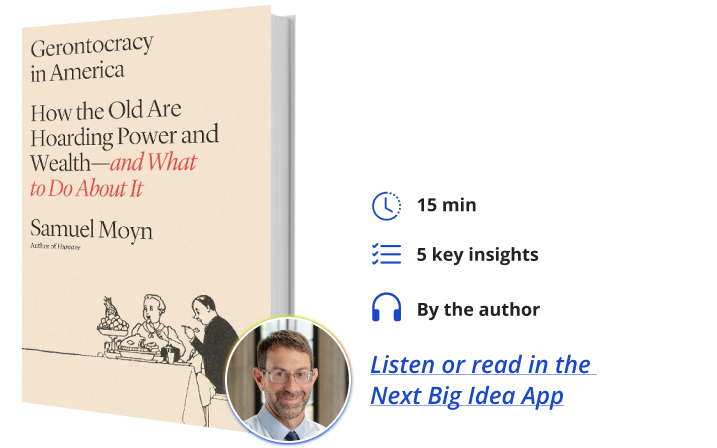
Below, Samuel Moyn shares five key insights from his new book, Gerontocracy in America: How the Old Are Hoarding Power and Wealth―and What to Do About It.
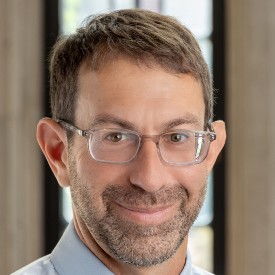
Samuel is the Kent Professor of Law and History at Yale University. He is cohost of the Digging a Hole podcast and frequently contributes to the New York Times and many other publications.
What’s the Big Idea?
We are living through one of the biggest demographic revolutions in human history: the rise of old age. That revolution has quietly reshaped who holds power, wealth, and opportunity—and now it demands a new vision of fairness between generations.
Listen to the audio version of this Book Bite—read by Samuel himself—in the Next Big Idea App, or buy the book.
1. Our deaths have been postponed.
You know the old song that says that only the good die young? Well, almost everyone in the United States—and in most other countries—dies old, whether they’re good or bad. With this extension of life, there are now political consequences.
It is revolutionary that most of us live long lives. There have always been old people, just not so many. A Psalm of the Bible says you get 70 or 80 years if you’re lucky, and that’s still basically true. We don’t know if the average can be pushed higher, though there are always some super agers in every generation. The novelty is that so many are living in old age.
Élie Metchnikoff was a Russian-born Nobel Prize winner in medicine who coined the term gerontology. He went on a trip to find aging Bulgarian shepherds who he thought knew the secret of long life. He assumed it was because they ate yogurt, which was first widely eaten in Southeastern Europe before it conquered our food ways, too. He went on to counsel that if you had your large intestine removed, you could survive even longer. He didn’t do it and died at 71 of heart failure, but a Scottish surgeon did try that tactic.
Our societies, thanks to contributions of life extenders, are now very different than past societies. In 1920, only five million Americans were 65 or older, which was less than five percent of the population. Now there are nearly 60 million, and that’s about 17 percent of the population.
2. Getting older means accumulating power.
Most people in most places for most of history have been governed by old men. Probably the central political institution that humans have devised to rule themselves is the council of elders. Even our sci-fi commonly includes them as a governing body. In The Matrix movie series, there’s a council of elders in the last human city, Zion. In the Superman comic books, there is a council of elders on the foreign planet that Clark Kent comes from.
There have been councils of elders throughout human history all over the world. The most famous is the Roman Senate, which influenced the founders of the United States. In American politics, the upper chamber of our legislature is called the Senate, which means the “chamber for old men.” Gerontocracy, rule by elders, is a blast from the past that we’ve reinvented thanks to the extension of life.
“Most people in most places for most of history have been governed by old men.”
Old-school gerontocracy was just about putting elders—the ones closest to our ancestors—in charge, very openly. In the modern world, power consists of getting elected and serving in political office, but that means the citizens doing the voting are in power, and our voters are getting older. In the modern world too, power means having money, including to pay for those candidates in elections. And our money in America is old.
3. How old are our politicians and voters?
Everyone knows that our presidents (especially the last two) are up there in years. In fact, they’re the oldest ever elected. And yet, it’s really in Congress where there are so many aging politicians, including ones even older than Joe Biden and Donald Trump.
The risk isn’t just cognitive decline but death on the job, which can have big consequences. The same is true in the judiciary, where Ruth Bader Ginsburg passed away at an advanced age with a lot of implications, including for abortion rights.
But everyone knows that we’ve got a problem in the United States with aging politicians. More deeply, and maybe more disturbingly, is how old the voting population is. The median age of Americans eligible to vote is 48 and rising, but actual voters are 52. If we exclude presidential elections, in which more people vote across generations, the median age of voters rises to about 55 or 56, and for some primaries, the median age is about 65. In New Mexico in 2024, the median age of voters was 71. Our voting population is heavily skewed toward older age groups.
4. Who is wealthy in terms of money, employment, and housing?
We expect people to accumulate more as they age, but it was long expected that they would spend it at the end of their lives. But that’s not happening. The sheer proportion of our wealth that the aged control has reached staggering proportions.
In 2019, Americans under 40 (about 37 percent of the population) held only 4.9 percent of our wealth. Those over 54 (the same percentage of people) held 71.6 percent of the wealth. And it’s not just money. People are staying in jobs, whether that’s to make ends meet or because they want to, and that is creating pipeline and succession issues across many fields.
The best-funded lobby in world history is the American old folks’ lobby, the AARP. It successfully lobbied to end mandatory retirement. The consequences have been immense. Whether you look at CEOs or university professors, only a few professions like air traffic controllers or pilots are time-limited and age-limited. Supreme Court justices certainly aren’t. In fact, the Constitution says it can’t be age-limited.
“The best-funded lobby in world history is the American old folks’ lobby, the AARP.”
Then we look at housing, and an astonishing percentage of American housing stock is controlled by older people. That means our cities are graying because younger people, especially younger people with expensive families, can’t move into urban cores. Our whole lives together are being refashioned due to the aging of American society.
5. There’s hope for intergenerational rethinking.
I’m not against old people. I like them. I’m 54 years old, so, as my daughters always tell me, I’m one of them. And like everyone, I want to live as long as I can and enjoy the life I’ve been given for as long as I can. The question is about what’s fair.
In the U.S., we don’t have a very good welfare state for older people, especially when it comes to long-term care. Most people hoard or stash so many resources because they fear not having enough to live the very long lives that we now live. Of course, there are others who can’t imagine retiring because they’ve invested so much of their self-worth in their jobs and people are in love with the places where they live, their houses, even when others need those spaces.
There are many solutions for folks to consider. I’m trying to start a conversation, not end it. Whether it’s the age of politicians, the aging of the electorate, or the aging of wealth, I’ve got a list of possible fixes. It’s time to reimagine our social contract in a new situation in which there are so many more old people living so much longer.
Enjoy our full library of Book Bites—read by the authors!—in the Next Big Idea App: