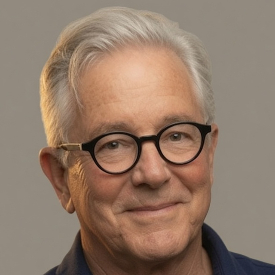











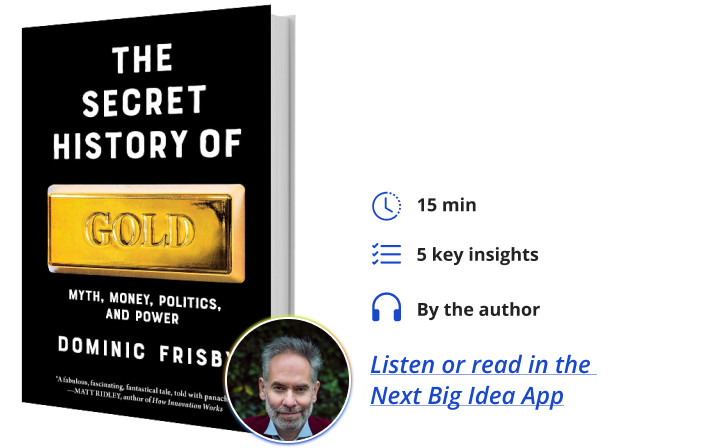
Below, Dominic Frisby shares seven key insights from his new book, The Secret History of Gold: Myth, Money, Politics, and Power.
Dominic is a financial writer and comedian. For 20 years, he has written a weekly blog column for MoneyWeek about gold, while his Substack, The Flying Frisby, ranks among the world’s top financial reads.
What’s the big idea?
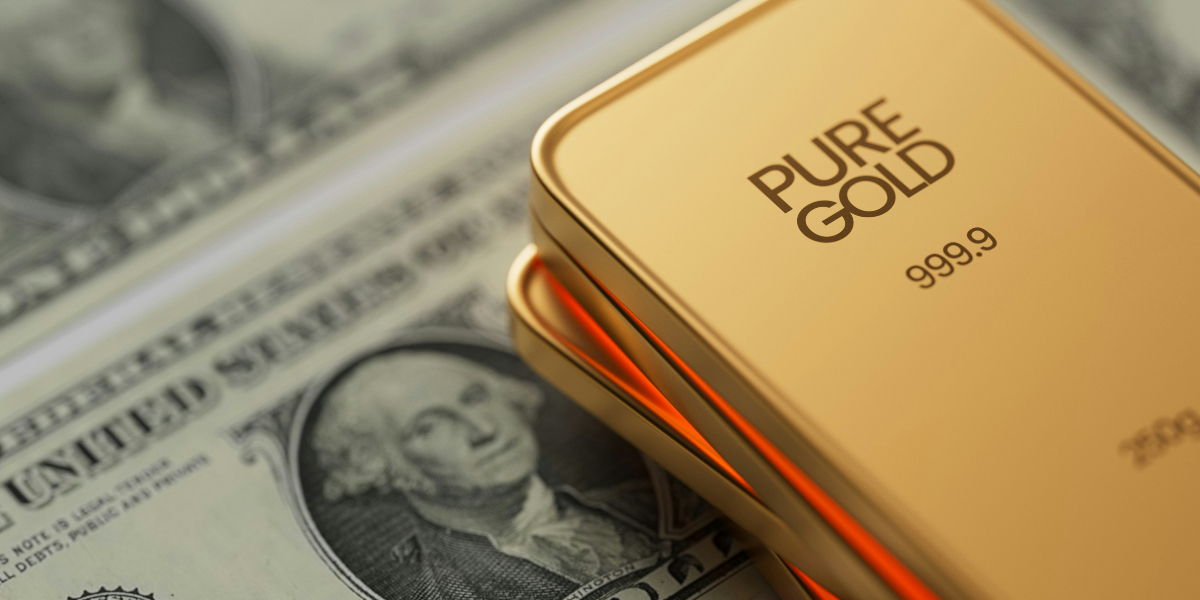
Gold remains one of humanity’s most enduring and powerful forms of wealth because it combines permanence, rarity, universal trust, and psychological influence in a way no other asset does.
Listen to the audio version of this Book Bite—read by Dominic himself—in the Next Big Idea App, or buy the book.
1. Gold is the first metal human beings ever used.
Tens of thousands of years before the Bronze Age—before iron, tin, or even copper—we were using gold. We found it in riverbeds as little gold nuggets or alluvial gold, and we kept it as jewelry, a prize, or a tool of barter. In other words, we used it for the same reason we use it today: to store and display wealth. Gold is the purest form of wealth there is.
2. To touch gold is the closest you will ever come to touching eternity.
Gold was present in the dust that formed the solar system, and it hasn’t changed. Gold doesn’t rust, it doesn’t tarnish, it’s inert, and it’s as good as impossible to destroy. It always keeps its shine. Therefore, that little bit of gold around your neck or on your finger is not just older than Earth itself—it is older than the solar system. It is the closest thing we have on this planet to permanence. To touch gold is the closest you will ever come to touching eternity.
3. Gold has no use.
Gold has some industrial applications, but these are minimal. Around six percent of the annual gold-mining supply goes into dentistry, and a little bit into mobile phones, space visor coatings, and things like that. But for all intents and purposes, it is useless. Yet we never stop using it. You could take a time machine to any culture in history, anywhere in the world, and they would understand that gold has value. It is truly universal money. Nothing is as useful and as useless at the same time.
4. Gold is constant.
Just as you can’t destroy gold, you can’t destroy its purchasing power. It buys you as much food, clothing, accommodation, and energy as it did a thousand years ago. If you look at the US dollar, the British pound, or the Euro, they buy you less and less each year. Gold, however, is constant.
5. Gold is the ultimate human motivator.
Empires were built and destroyed for gold. The Romans engineered water wheels and Archimedean screws deep underground just to mine more of it. The Spanish conquest of South America was essentially one giant gold heist. No other substance has driven human beings to do such extraordinary, incredible—but also terrible—things. Why? Because it’s pure wealth.
6. All the gold in China.
China has been the world’s largest importer of gold for 25 years. It has also been the world’s largest producer of gold for 20 years, and it does not export any of its gold, because it’s not allowed to. So gold is going to China, and China has dramatically understated its gold holdings, perhaps by a factor of 10. Why? What is the significance of this?
Well, I think China has more gold at the national level—not just at the retail level—than the United States government does. And if China were to suddenly turn around and say, “We have much more gold than you,” that would be almost a declaration of financial war. China’s motto is “We must not shine too brightly.” So, if China were to suddenly say, “We have more gold than you,” the US dollar would come under extraordinary threat in the foreign exchange markets, and the announcement would rock financial markets. This is why China discloses the minimum amount to be credible and continues accumulating as it runs extraordinary budget surpluses. Meanwhile, the United States has not audited its gold at Fort Knox in a full, public way since the 1950s.
7. What is gold’s role today?
Gold pays no dividend; it has no official role; it is outside the monetary system—and yet central banks have been accumulating it at the fastest rate in decades. Private investors have been buying too, and the price has hit record highs above $5,500 an ounce. Why does gold keep mattering, even when every rational argument says it shouldn’t?
You can say that gold is natural money, but the horse was natural transport for thousands of years, and then they invented the motor car, quickly making the horse irrelevant. Could you say the same about gold? You’d think so, but people keep buying, hoarding, and accumulating it. Gold still matters.
Enjoy our full library of Book Bites—read by the authors!—in the Next Big Idea App: