












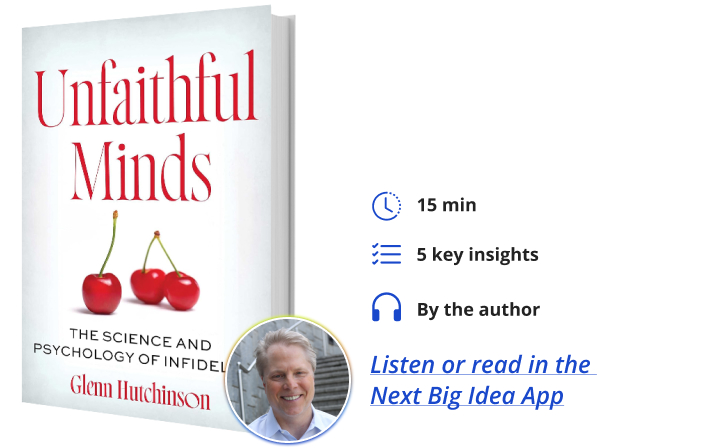
Below, Glenn Hutchinson shares five key insights from his new book, Unfaithful Minds: The Science and Psychology of Infidelity.
Glenn is a psychologist whose career spans clinical practice, psychological research, and education. He previously led the development of personality assessments used by Match.com and Yahoo! Personals, taken by more than 10 million users. He later founded Psyc.TV, an online continuing education platform for mental health professionals.
What’s the Big Idea?
We can’t fully understand infidelity by viewing it simply as a conscious decision to betray a partner. Modern psychological research shows that much of human behavior is shaped by unconscious processes that generate desires, impulses, and inclinations outside our awareness. Those processes can conflict with our values and commitments, and they vary considerably from one person to another. Understanding infidelity therefore requires understanding both the unconscious forces that create the temptation to stray and the psychological mechanisms that enable—or fail to enable—people to resist that temptation.
Listen to the audio version of this Book Bite—read by Glenn himself—in the Next Big Idea App, or buy the book.
1. Scientific psychology has done a complete about-face.
Prior to 1980, researchers were extremely skeptical that our brains harbor hidden, or unconscious, mental processes. They also completely rejected the idea that unconscious processes play a significant role in our decisions and behaviors. Now, just a few decades later, they believe that such processes drive most of our thoughts and actions.
In the early 20th century, the scientific community began to openly shun the notion of unconscious processes. Researchers rejected this idea, in part, because Freud and his contemporaries had developed elaborate theories about the unconscious with little or no scientific evidence. But even then, when scientists first banished unconscious processes from consideration, researchers were aware of a few peculiar findings that strongly suggested their existence.
Decades later, in the 1970s, researchers returned to those findings and replicated them. Shortly thereafter, a pair of Israeli scientists, Daniel Kahneman and Amos Tversky, identified several heuristics—essentially decision rules that our brains use outside our awareness when making certain kinds of judgments and decisions. For instance, when we estimate the frequency of a particular type of event—say, armed robberies in the city where we live—our answer largely depends on how easily we can recall specific examples. So, if we recently saw a few dramatic headlines, we’ll be inclined to grossly overestimate the frequency of such incidents.
In the 1980s and 1990s, researchers discovered a wide range of other hidden processes and began to understand their diverse functions. By the time the 21st century arrived, an entirely new view of the sources, or causes, of human decisions and behaviors had taken hold within the experimental psychology community.
Over the last 10 to 15 years, scientists applying this new perspective have made extraordinary progress in understanding long-term romantic relationships—particularly what causes them to evolve and devolve. In just the last few years, a contemporary perspective on the role of unconscious processes has transformed our understanding of infidelity.
2. Subjective experience is wildly misleading.
What seems to be happening inside our head when we make decisions is vastly different from what actually occurs. Most of the time, as we go about our daily lives, we have the subjective sense that our conscious self is in the driver’s seat, giving us total control over what we think, believe, decide, and do. But a vast body of scientific evidence proves that this impression is false. I am not saying that our conscious selves don’t play a role in decision-making, but it is much less involved than our subjective experience leads us to believe.
How do our behaviors come about? Research indicates that, in most instances, we act because our unconscious mind has offered a suggestion to our conscious self—in the form of a behavioral urge or inclination—and we simply act on it.
“In most instances, we act because our unconscious mind has offered a suggestion to our conscious self.”
Where do our beliefs and opinions come from? Experiments have shown that as we consider information that’s relevant to a particular issue, our unconscious mind generates feelings and impressions and inserts them into our conscious awareness. These impressions powerfully sway, if not determine, the view that we ultimately settle upon.
Where do the impressions and suggestions within our unconscious mind come from? At every moment, countless processes are running in our head, outside of conscious awareness. These include the activation of neural networks that process sensory information, ones that enable language abilities, a system that continuously monitors what other people are thinking and feeling, as well as networks related to hunger, attachment, sex drive, and innumerable other life-sustaining functions. Also, at every moment, countless concepts (like dog, car, freedom, and sex) are activated below the level of our conscious awareness. The unconscious activation of each of these concepts and processes surges and subsides, and many of them interact. It’s a massive mashup of activity. From this great welter, a “suggestion” emerges and is inserted into our conscious awareness.
Our conscious self can evaluate and decide to decline a suggestion from our unconscious mind. But that’s not what usually happens. Often, our conscious self fails to realize that it has received a suggestion, in which case the suggestion or impulse becomes default behavior. Even if our conscious self does assess a suggestion and decide to decline it, doing so can be a herculean challenge, because our unconscious mind may continue to offer the suggestion relentlessly.
3. Every human sometimes engages in behavior that violates their own values.
Psychologists have known about this phenomenon for almost a century. Usually, when we do something that conflicts with our values, the consequences are not as obvious or painful as infidelity. But regardless of severity, the underlying mechanisms are the same.
Here’s an example that illustrates the sort of hypocrisy that, at some point, most of us have unknowingly been guilty of: Imagine a guy who is always complaining about gratuitous sex and violence on television. At his church, he serves on the Media Watch Committee. Also, he sometimes brags about having lobbied his state’s legislature to ban explicit sex and violence scenes from television. But it turns out he loves to watch a number of TV shows that are riddled with exactly that sort of content. How could any person flout a value so blatantly and fail to recognize that they’re violating it?
“Hypocrisy is inevitable.”
Our unconscious processes sometimes fail to activate the attitudes and values that we hold about the behavior we’re currently engaging in. If the neural networks that represent those attitudes are not activated, it’s impossible for our conscious self to be aware of them.
Why would our hidden processes fail to activate an attitude that’s obviously important for us to consider? There are several reasons. All of them result from the way our brains represent and activate concepts and attitudes. Hypocrisy is inevitable.
4. Most scientists believe that Homo sapiens are monogamish.
The human brain evolved incrementally over eons. It contains countless neural networks that were wired to increase our ancestors’ chances of survival. Biological anthropologist Helen Fisher argued that to understand the love lives of humans, we need to focus primarily on three major brain systems: sex drive, romantic love, and long-term attachment. Each of these systems evolved at different times in our evolutionary history, and each serves a different purpose, so they suggest different kinds of behaviors to our conscious selves.
To a large degree, these systems operate independently. What one system suggests can conflict with what another suggests. The fact that someone has a healthy long-term attachment to their spouse does not stop their sex drive system from triggering carnal desire for an attractive stranger. It also may not prevent their romantic love system from causing them to develop a crush on a colleague.
There are countless additional ways in which the suggestions emanating from various unconscious brain systems can conflict with one another. Suggestions that arise from our hidden processes do not necessarily comport with 21st century moral values.
5. Some individuals are more inclined to be unfaithful.
Fisher’s theory does a good job explaining why humans are somewhere in the middle on the continuum from monogamy to nonmonogamy. But why are some individuals more likely than others to be unfaithful?
“Every hidden process contained in the human brain varies somewhat from one person to the next.”
In the same way that we differ on traits like height, weight, and intelligence, every hidden process contained in the human brain varies somewhat from one person to the next. Many of those unconscious processes influence how much temptation to stray that a person will experience. Other hidden processes determine how capable a person is of anticipating or resisting untoward suggestions from their unconscious mind.
Some people have impressive self-control, while others appear to have hardly any. To understand a given individual’s risk of being unfaithful, you have to know both how much temptation they are destined to experience and the strength of their self-control. The key question is: how powerful are these forces in relation to one another?
Enjoy our full library of Book Bites—read by the authors!—in the Next Big Idea App: