







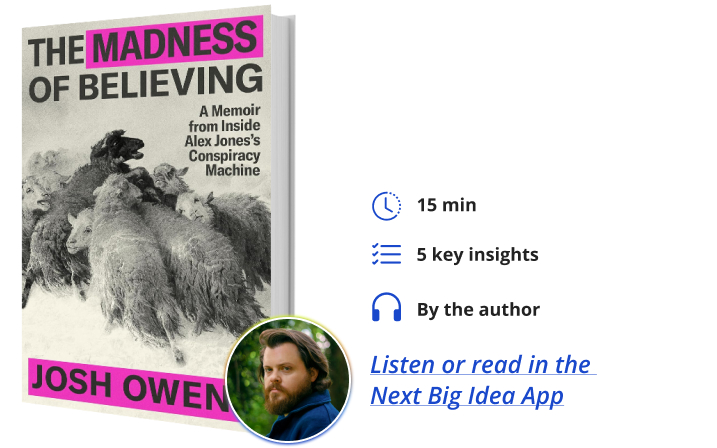
Below, Josh Owens shares five key insights from his new book, The Madness of Believing: A Memoir from Inside Alex Jones’s Conspiracy Machine.
In 2013, in his early twenties, Josh dropped out of film school and moved halfway across the country to take a job at what was then a fringe media company called Infowars. After nearly four years there, he quit and began speaking out against conspiratorial thinking. He has since written about his experiences for The New York Times Magazine and CNN, been interviewed in dozens of media outlets, including Vice News and PBS, as well as appeared in the HBO documentary The Truth Vs. Alex Jones.
What’s the big idea?
Conspiracy culture seduces people through storytelling, certainty, and belonging. Escaping it requires learning to live with ambiguity instead of comforting fictional narratives.
Listen to the audio version of this Book Bite—read by Josh himself—in the Next Big Idea App, or buy the book.
1. When the world starts to feel like a movie.
From the first time I heard Alex Jones’ name to the first time I met him in person, and even the first time we traveled together, movies were always part of the story. They provided the narrative structure for his ideology, the centerpiece his conspiracy theories revolved around. Without them, I’m not sure Jones would exist in his current form or that I ever would have found my way into his world.
For me, it all began with Stanley Kubrick. In 2008, a television in my friend’s apartment flickered with the black and white images of Dr. Strangelove, a fictional Cold War era story of paranoia and catastrophic misjudgment. When we reached the scene where Sterling Hayden’s character launches into a manic tirade about the dangers of water fluoridation, my friend grabbed the remote and hit pause. He turned to me, his face lit by the frozen frame on screen and asked a question that would change the trajectory of my life. He asked if I’d ever heard of Alex Jones.
Five years later, after dropping out of film school and moving to Austin for a job at Infowars, I met Jones in person for the first time. Minutes after we were introduced, he began quoting that same film. But the most surreal moment came six months into my job as one of Jones’s camera operators and video editors.
We had traveled to Dallas to crash the 50th anniversary ceremony of JFK’s assassination when we ran into Kubrick’s daughter, Vivian, and ended up spending the evening with her. She told stories about creating the score for Full Metal Jacket, building sets on A Clockwork Orange, and spending time with Jack Nicholson and Shelley Duvall during the filming of The Shining. I remember saying how strange it was that I had ended up at this event. Jones leaned in and told me that none of it was an accident, that everything was connected, and that all the decisions we make in life guide us to these moments. In that moment, I couldn’t help but believe him. Looking back, what stands out is how often coincidence was used as proof in that world. Chance encounters and stray connections were rarely allowed to remain accidents. Instead, they became evidence.
That same logic showed up in the stories we told. Research would be pulled out of context, details rearranged, everything shaped to fit a larger narrative, and the structure of that narrative often came from movies. Films like Network, They Live, and Eyes Wide Shut weren’t treated as fiction or satire. They were treated as something closer to documentary, as if they were glimpses behind the curtain of how the world works. For someone like me who had spent years studying film and already understood the world through that kind of storytelling, it was a perfect fit. It’s why quitting school to work at Infowars felt like the right decision. I thought to myself, why learn how to make a movie when I could live in one?
2. Truth wasn’t the point.
When I first started working at Infowars in 2013, I believed in what we were doing, or at least the idea of it. I believed that there were powerful people operating behind the scenes, that the government wasn’t always telling the truth, and that there were real abuses of power. The ideas that vaccines could be dangerous, fluoride in drinking water lowered IQ levels, Monsanto was creating genetically modified foods that led to higher rates of cancer, and that secretive, ultra-rich groups were behind it all weren’t farfetched to me. I was exactly the kind of curious, self-proclaimed, open-minded person, susceptible to messages from people like Jones. At the same time, I wasn’t sold on everything. I didn’t believe Sandy Hook was a staged event to push for gun control, just like I didn’t believe that God revealed the secrets of the universe to Jones while he ate chicken fried steak at a diner. There were moments when I felt an internal resistance.
“I just needed to believe enough so that the overall framework felt true.”
The tricky part is I didn’t need to believe everything for that worldview to take hold. I just needed to believe enough so that the overall framework felt true. And once that framework was in place, my brain shut off and everything filtered through that foundational belief system. And these belief systems, at least in my experience, don’t collapse all at once. They erode over time.
If the first part of my experience felt like stepping into a story, the second part was realizing how that story worked. Gradually, I began to pick up on inconsistencies or lies that didn’t always seem especially significant in the moment, but created cracks in the foundation. One of the first was when Jones began selling his own private label supplements. I shot and edited the very first ad for an iodine tincture, marketed as a shield against nuclear fallout. He brought on a guest he introduced as a doctor to promote the supplement—someone Jones said had so many doctorates behind his name that he couldn’t even name them all. But when I looked into it, the man wasn’t a medical doctor at all. He was a chiropractor and a naturopath.
A few months later, I was sent to California to document what Jones believed was a radiation crisis along the West Coast. Convenient timing, given the supplement he had just begun selling. The trip came together in a day. Jones had seen a video online, drawn a conclusion, and by the time we got on the plane, the outline of the story was already in place. Our job wasn’t to find answers. It was to confirm beliefs. We drove up the coast, stopping every few miles to measure radiation levels with Geiger counters we didn’t know how to use and send reports back.
As the trip went on, it became harder to ignore the disparity between what we were seeing and what we were supposed to be finding. We reported what we found and Jones got angry, but it wasn’t like he was explicitly telling us to lie. Instead, he was undermining us, making us feel like we weren’t competent, like we weren’t seeing what we were supposed to see, like we were the problem, not him. I saw the same thing on trips to the border where stories about immigration and border security were treated like foregone conclusions. I saw the same thing at Muslim communities in upstate New York and Michigan. Traveling to these places, speaking to public officials and people who lived there never made a difference because it didn’t match what we were told to believe. At the time, I didn’t even try to make sense of it.
In the back of my mind, I told myself there was something I wasn’t seeing—that Jones understood things on a level I didn’t and eventually it would all come together. But the longer I stayed, the harder it was to ignore what was happening. The pattern was clear. Conclusions came first and evidence followed. It wasn’t that we had set out to find the truth and got it wrong. It was that truth had never really mattered all that much.
3. What kept me there?
For a long time, I told myself I stayed because I needed the job or because I didn’t have a plan for what came next. But looking back, that’s only part of it. Even though it was often precarious, there was a kind of stability there. The money was steady. I knew what was expected of me. And more than that, I was good at it.
Jones would pull me aside and tell me I was one of the best employees he’d ever hired and that if he could build a team of a hundred people just like me, then everything would run the way it was supposed to. And at that point in my life, I’d be lying if I said that wasn’t important to me. It gave me a sense of direction and purpose that I hadn’t had before. I was in an environment where I felt useful and valued, where I felt like I was moving toward something, even if I couldn’t explain what that something was. I had also moved a thousand miles away from my home state to a place where I didn’t know anyone. I was isolated and I worked so many hours that the people I spent the most time around were the ones in the same situation as I was.
“It gave me a sense of direction and purpose that I hadn’t had before.”
There was also a fear underneath everything. Jones said that being a part of Infowars wasn’t just a temporary sacrifice, but an irrevocable black mark on all of us. That working alongside him would forever stay in our resumes and limit our prospects. I was convinced that if I left, I wouldn’t be able to find something else because I would be banished into poverty as penance for my transgressions. I was also terrified that despite the chaos and grueling atmosphere, this might be the most interesting chapter of my life. Leaving always felt like a major risk. I just couldn’t imagine the drastic change, but that gradually began to seem more possible for one major reason.
4. The company we keep.
One thing I understand more clearly now, and didn’t appreciate back then, was how much the people around me shaped what felt normal. It was in the conversations we had. It was in the assumptions that never got questioned. The way Jones would move from one idea to the next with absolute certainty and how quickly that certainty became the tone everyone else adopted. But Lacey, my partner, was the first real disruption to that.
She had moved with me when I first took the job, but by then we were living very different lives in Austin. She had started teaching at a community arts school and was spending her time organizing fundraisers for Planned Parenthood, volunteering on down-ballot races, and getting more involved in work that felt grounded in people’s lives. Meanwhile, I was at Infowars, producing content that often pushed in the opposite direction. That divide became harder to ignore in the spring of 2015 when Jones organized a protest at a local Planned Parenthood. He had signs printed comparing the organization to the KKK, and I was there with my camera as he worked the crowd, provoking people, escalating the situation, and turning it into a spectacle.
Later that afternoon, Lacey heard about it on the radio while driving home from work. When I got home, the first thing she asked me was if I had been involved. I told her I hadn’t organized it, but that I had to be there with Jones. She looked me in the eyes and said, “What the hell is the matter with you?” It was a fair question. At work, everything was framed as exposure, as revealing something hidden. But at home, she began to push me in ways I hadn’t pushed myself, not by arguing with me or trying to prove me wrong, but by asking questions about what I was doing, about the stories we were covering, and how those stories might be affecting people. She never tried to force me to confront what I wasn’t ready to face, but she didn’t let me ignore it. Without her, I’m not sure I would’ve made it out.
Toward the end, I met another person who was instrumental in my choice to leave Infowars: the writer, Jon Ronson. He had spent years reporting on fringe communities and conspiracy movements, but he approached them differently. There was a kind of curiosity in the way he worked—a willingness to sit with people and understand how they saw the world without immediately trying to flatten it into something simple.
“Without her, I’m not sure I would’ve made it out.”
No one set out to change me. I don’t think you can argue someone out of a belief system or situation. What matters is being around people who are willing to ask questions and engage without trying to force an outcome.
5. The comfort of certainty.
At Infowars, there was always an explanation waiting. If something confusing happened in the news, it didn’t stay unresolved for long. In minutes, sometimes seconds, there was already a way to interpret it and fit it into a larger framework. And if that explanation didn’t quite hold together, there was always another one behind it, something deeper or more alarming that restored the sense that everything was connected.
The story was always written ahead of time, and when we couldn’t make reality match that fictional narrative, we readjusted, reframed, or made it up. That way of thinking created momentum. The stories we told were structured like movies, and eventually the world itself started to feel that way. In that narrative, immigrants became invaders. Racial and religious minorities became scapegoats. Political opponents became demons. And vulnerable communities became convenient villains.
If anything, that experience clarified the difference between narratives that close our minds and the ones that open them. Conspiracy theories promise a hidden script explaining everything, but the truth is that the world is far more complicated and far more human than any conspiracy could ever allow.
Enjoy our full library of Book Bites—read by the authors!—in the Next Big Idea App: