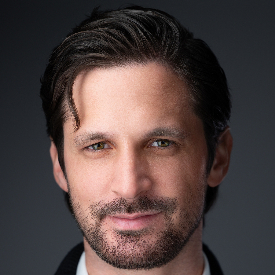












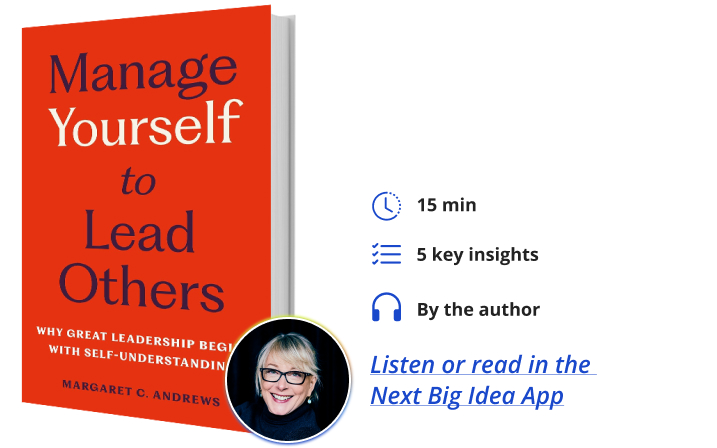
Below, Margaret Andrews shares five key insights from her new book, Manage Yourself to Lead Others: Why Great Leadership Begins with Self-Understanding.
Margaret teaches courses in leadership, emotional intelligence, and creativity at Harvard University. She is also the founder of MYLO Center, a private leadership development firm. Her clients include Amazon, Citi, the United Nations, Walmart, and Wayfair.
What’s the Big Idea?
Great leadership starts with leading yourself. Intelligence and expertise may get you into positions of responsibility, but what sets great leaders apart is self-understanding: knowing who you are, recognizing how your behavior affects others, and continually adapting how you show up.
Listen to the audio version of this Book Bite—read by Margaret herself—in the Next Big Idea App, or buy the book.
1. Leadership requires more than intelligence, hard work, and skills.
For nearly two decades, I’ve been running an exercise where I ask people to think of their Best Boss and then to think of the Top 3 reasons they chose that person as their Best Boss.
The Top 3 reasons almost always fall into three categories, or “buckets”:
- IQ. They were very intelligent.
- Technical and Functional Skills. They were good, if not expert, at their job or in their field.
- Interpersonal Skills. They could relate well to others. This includes things like trust, listening skills, understanding, giving helpful feedback, or coaching and mentoring.
Whenever I run this exercise, the overwhelming majority of reasons that people give for someone being their Best Boss are in that third bucket: Interpersonal Skills. Every. Single. Time.
Across industries, geographies, and levels in an organization, approximately 85 percent of the reasons people choose someone as their Best Boss relate to Interpersonal Skills. The remaining 15 percent of responses is relatively evenly split between IQ and Technical and Functional Skills.
The interpersonal skills most frequently mentioned in this exercise include that the manager:
- Trusted the employee
- Listened well
- Cared about the person as an individual
- Offered support and empathy
- Had strong communication skills
- Appropriately challenged that individual with stretch assignments and feedback
- Gave the employee a lot of autonomy or independence
These are some of the most important interpersonal skills we find attractive in someone we work for. And they are all learnable behaviors that relate to understanding and managing ourselves. Our Best Bosses had those compelling interpersonal skills because they understood and managed themselves well, which allowed them to understand, and connect with, us.
This doesn’t mean that IQ and Technical or Functional Skills aren’t important in leadership, but they tend to be more of threshold skills, meaning you need to have enough of these to do the job. However, what makes the difference between a good leader and a great leader comes down to Interpersonal Skills. Leadership is the human side of business—it’s about the human-to-human interactions—and that’s why interpersonal skills have an outsized role in our success as leaders.
From working with thousands of people throughout my career, I’ve found that the biggest barrier to great leadership isn’t a lack of talent, hard work, or strategic or operational skills. The biggest barrier to great leadership is a lack of self-understanding and self-management.
2. Leadership emerges from one’s life story and unique perspective.
We all have different backstories, values, and ambitions. Properly harnessed, these features offer our competitive advantage.
Self-understanding is about clarity regarding who we are and what we want, as well as understanding how our behaviors affect others. It includes understanding the people, events, and ideas that have shaped our perceptions, what motivates us, what we value, and what we want to accomplish in our lifetime, both personally and professionally, and what we are willing to trade off to accomplish these things. Knowing all of this helps us focus on what is important to us.
“Closing that gap is the first step in becoming a more competent leader.”
It’s understanding ourselves from the inside, as well as from the outside, which means that we understand how our emotions affect both us and those around us. Once we really know who we are, we have our foundation for effective leadership.
Yet, most of us lack true self-understanding. Research by organizational psychologist Tasha Eurich found that while over 90 percent of people believe they’re self-aware, only about 15 percent are. Closing that gap is the first step in becoming a more competent leader.
When we understand ourselves, we’re more grounded, know who we are, what we want, and are therefore more clear in our goals and less buffeted by outside events and circumstances. We’re less drawn in to people and situations that aren’t good for us.
3. We judge ourselves by our intentions—others judge us by our behaviors.
Many leaders feel misunderstood, and this is often because they don’t understand the impact their behaviors have on others. They often have good intentions. Someone who micromanages may have good reasons for hovering over their employees—their intentions may be to help and to educate—but that’s not how it feels on the receiving end. Employees judge their managers by their behaviors, and how those behaviors make them feel.
As part of this insight, there are two important sub-points:
- The way someone treats us says more about them than it does about us.
- Our behavior toward others says more about us than it does about them.
4. What got you here won’t get you to your next level of success.
Once we understand ourselves, we can begin to better manage ourselves. This entails realizing that we have the ability to manage our emotions and behaviors toward a desired state or outcome. It means taking responsibility for our actions and behaviors and modifying them to get closer to our goals. This might be learning to listen more fully, have more understanding and control of our challenging emotions, or to let go of patterns of behavior that hold us back.
Self-management is about managing our behaviors toward the leader, or person, we want to become. It’s about being very intentional, making conscious choices to resist a preference or habitual way of reacting to people and situations and instead, demonstrating a more productive behavior. A behavior that gets you closer to the leader you want to be.
“Self-management is about managing our behaviors toward the leader, or person, we want to become.”
As Chinese philosopher Lao Tzu said, “Knowing others is intelligence; knowing yourself is true wisdom. Mastering others is strengths; mastering yourself is true power.” This is the power of understanding and managing yourself. And this is true, and powerful, in both your professional life and your personal life.
As you’re working on a new skill or behavior, you won’t be good at it from the start. When learning a new skill or behavior, progress isn’t linear. It usually follows an s-curve, or Sigmoid curve, where we make a lot of mistakes early on. But as we keep at it, and with practice and feedback, we get better slowly and then quickly as things click into place. We level off as we approach mastery of this new behavior.
Self-management isn’t easy. Keep these three things in mind:
- You’re not trying to change your personality; you’re trying to change your behavior.
- Discomfort with new behaviors is often a sign of growth.
- Particularly in the beginning of learning a new behavior, strive for progress, not perfection. It takes time to change an ingrained way of behaving.
We are all a WIP (work in progress) and always in the process of becoming. We evolve as leaders because different levels of our life and career require a different level from us. There are always many new s-curves ahead.
5. There is rarely a single right answer to any question in leadership.
It can take a lot of creativity to find the best-fit solution to a specific leadership problem. This solution will depend on:
- The situation and its context
- The long-term and short-term goals and priorities
- The tradeoffs involved
- Your own abilities and values
- The people involved
In leading others, there’s no one right style and certainly no algorithm. If you have siblings, you know how differently you think and behave compared to your siblings. And if you have children, you know how different each of those children is, even if they are from the same genetic material and raised in the same household. So, if our own children are so different, why would we expect the random collection of people we work with to be similar?
Just as we are unique, so too is each of the people we work with: our boss, our peers, and those we lead. They each have different backstories, values, and ambitions. These differences are their features, and properly developed and harnessed, become our collective competitive advantage.
Understanding the people we lead helps us to connect with them, develop them, and influence them toward a common goal, which is what leading others is ultimately about.
Enjoy our full library of Book Bites—read by the authors!—in the Next Big Idea App: