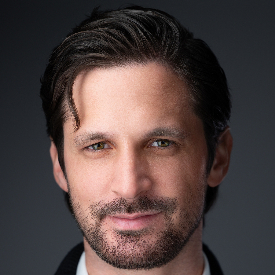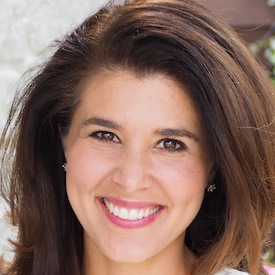












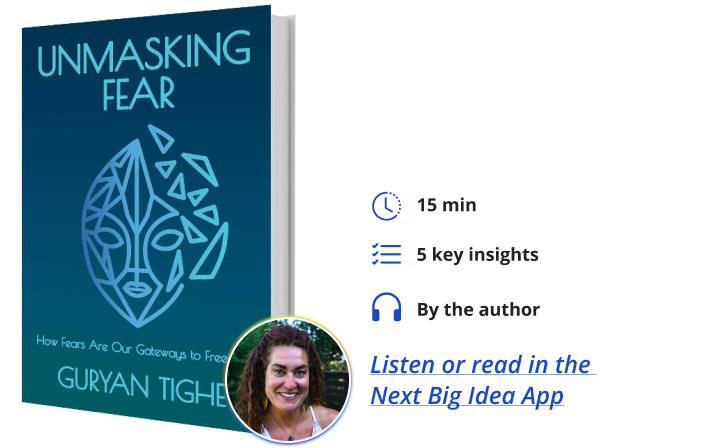
Below, Guryan Tighe shares five key insights from her new book, Unmasking Fear: How Fears Are Our Gateways to Freedom.
Guryan refers to herself as a Fear Technician. Through coaching and group facilitation, she specializes in helping people understand the value of fear and how to have a healthy relationship with it. She founded her company, FOURAGE, on the belief that understanding and working with our fears yields more professional success and personal fulfillment.
What’s the Big Idea?
Our greatest obstacle isn’t fear itself but our unconscious relationship with it. By listening to fear instead of fighting it, we can transform it from a force that keeps us stuck into one that points us toward the life we’re meant to live.
Listen to the audio version of this Book Bite—read by Guryan herself—in the Next Big Idea App, or buy the book.
1. Fear is not the enemy. Fear is data and can become our greatest teacher.
Fear gets a bad rap. In truth, it’s a wonderful evolutionary gift that’s greatly misunderstood. Fear is meant to protect us. It orchestrates the perfect response if we find ourselves in a situation where a rational fear is present. If a shark is chasing you, fear motivates you to swim faster or fight back and punch the shark hard on the nose. This is fear at its most useful.
But another type of fear is irrational fear. For example, if you’re worried you may not know where you want to head (what to do next for your career, a move, a relationship, etc.), and as such, you’re going to fail or lose out or be rejected. You might start sharing less about your confusion or uncertainty with others and disengage from them. Or you might constantly engage others in helping you figure out what to do and start driving them away. In this context, fear can make things worse. The trick is to know the difference between rational and irrational fear. We must teach our brains the difference.
Irrational fear knows how to protect you as you currently are. Growth means that fear needs to work harder to learn how to protect the newly emerging version of yourself—and fear doesn’t like to work harder than it must. It’s ironic: fear shows us exactly where we want to grow by making us fear that very thing. If we can begin accessing the information our irrational fears have for us, then we can find our pathway to what we truly want and the life we want to create.
2. Fear and pain are in cahoots.
We fear fear, and we fear pain. While it’s not always the case, most commonly the link between pain and fear begins quite early. We experience a pain, which could include being teased on a school playground (feeling rejection), being sexually or physically abused (feeling worthless), or being left by a parent or loved one (feeling abandoned).
What’s more, we may not even recall the experience of pain. At that time, fear—your fierce protector—came in and said, “Hey, I’m going to make sure you never feel like this again. I’m going to protect you from this pain. No matter what. Forever.” Talk about fierce loyalty.
“What’s more, we may not even recall the experience of pain.”
In the case of the schoolyard, maybe a bullied child stopped sharing their personality as brightly. Maybe the abused made themselves seem smaller. For the abandoned, perhaps they began doing anything and everything to prove they were worth staying for.
At that moment in time, some of these behaviors may have been helpful: to stop the bullying, hide from the abuser, stay engaged in life. The problem is, because we don’t have a conscious relationship with our irrational fears, we don’t know when this protective force is no longer needed.
When we are aware of irrational fears, we will be better equipped to determine whether our old methods of protecting ourselves are still relevant and supportive of who we are today. The problem is not fear. The problem is our unexplored fears making decisions on our behalf.
3. The power of pause.
Over years of coaching, I have developed numerous exercises to help people unwire patterns that are no longer serving them so that they can move into intentional living. As I developed these exercises, I kept them in a master document. When I searched, the word that appeared more than any other, by a landslide, was “pause.”
Learning new tools, approaches, and practices is a necessary and incredibly supportive part of the change process. We must also unlearn, unwire, and repattern previous behaviors and thought forms that aren’t serving us, or they will remain fixed. Otherwise, these new learnings simply act as Band-Aids, protecting us from old patterns if not provoked, which is unrealistic. These new learnings might even work most of the time. But when we are triggered—when an old pain is provoked or when a value is threatened—our old pattern can reemerge and run the show if we haven’t taken the time to unwire and unlearn that pattern.
Pausing enables us to use our powers of self-awareness and observation to choose to engage differently. Pauses create the space needed to unwire automatic reactions, so that we have time to engage in a new way. When you pause, slow down, and distance yourself from a reaction to a situation, you are creating space.
“When we pause, we can practice curiosity.”
Space is where choice can be applied, allowing an important shift to take place. When we pause, we can practice curiosity. What fear reaction are you noticing? Do you fight the threat? Flee from the situation? Freeze and stay in place? Or please and appease? Are you holding your breath or experiencing tunnel vision? What is beneath the trigger? What pain did this awaken? Are you feeling overlooked or underappreciated? What value isn’t being honored?
One of the surprises of this powerful practice is that it needs to last only a moment, the length of a breath, to stop an automatic reaction. And even though it’s taken years to hardwire these patterns, the more we pause, the faster we can create space to respond intentionally. It does not take the same amount of time to lodge these patterns into our subconscious as it takes to unwire them. Pausing increases the rate of unwiring by ensuring that we’re not letting our subconscious lead our decision-making.
4. Rejection is redirection.
What if rejection isn’t telling you you’re wrong, incapable, or incompetent? What if instead, it’s redirecting you to a new path—one that is more aligned with your north star and purpose?
We can begin connecting to our yeses by understanding what our noes are. Whether that be relationships, career paths, a move, etc., if we don’t make the most aligned choice the first time around, it’s the “this isn’t it” that redirects us to a new path. What if we could see rejection as a redirection to alignment? Through this lens, perceived rejection becomes a powerful tool in helping us to find our true path. If we look at it through the lens of force and flow, rejection helps you discover your yeses. It’s not the end point; it’s taking you someplace different.
A common place people might see this is imposter syndrome. This can become a clue to pause and get curious. What might it be trying to show you? If I have a big presentation coming up, is it making me question my value? Making me doubt my abilities? Protecting me from something? Maybe it’s showing me that it’s important to rehearse. Perhaps it’s to throw out the scripted talking points and have fun with the audience. The imposter syndrome might bring my attention to something that I haven’t considered—which makes a relationship with it worthwhile. Don’t ask, Why is this happening to me? Instead, wonder, Why is this happening for me?
5. Fear is courage unrealized.
Think of any courageous decision you have made. What did you feel beforehand? Probably fear.
Growth can be hard but has a rewarding outcome. We can break the cycle and create new paths forward in service of building the life we want, supported by intentional ways of being. It may not be the easy way until it becomes the simple way of being. Be patient with the process, allow the body to do its work, and support yourself with love and the knowledge that everything is changing all the time.
“It may not be the easy way until it becomes the simple way of being.”
Again, nothing is better at doing its job than fear. As we step out of our comfort zone and make a change, our fear will get louder. This is because when we remain the same, staying in our comfort zone, fear knows how to protect us. When we step outside our comfort zone and practice new ways of being, fear doesn’t yet know how to protect us. It’s a good thing that courage can help close the gap. Courage isn’t the absence of fear; rather, it’s the transformation of energy.
We are living in a moment that calls for a new cultural conversation about fear. For too long, fear has been treated as something to suppress, outrun, or deny. Yet when examined with honesty and awareness, it reveals itself as one of the most powerful forces shaping our decisions, relationships, and collective future.
Enjoy our full library of Book Bites—read by the authors!—in the Next Big Idea App: