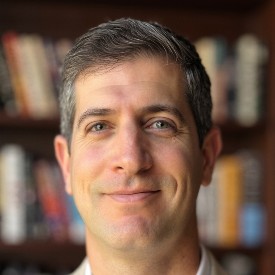










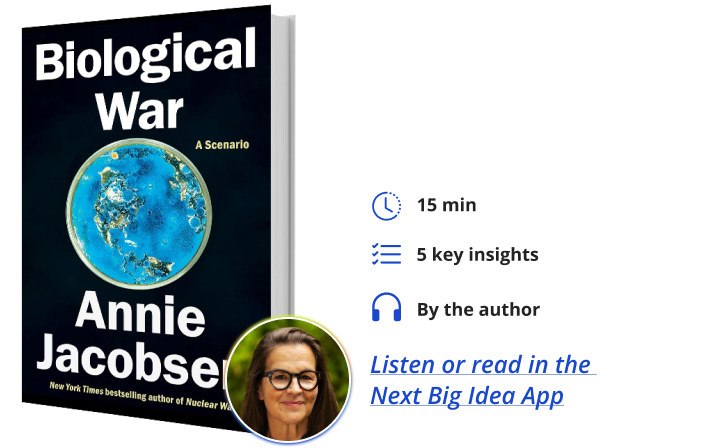
Below, Annie Jacobsen shares five key insights from her new book, Biological War: A Scenario.
Annie is an investigative reporter who writes about war, weapons, U.S. national security, and government secrets. She was a 2016 Pulitzer Prize finalist in the History category and was a contributing editor at Los Angeles Times Magazine.
What’s the Big Idea?
We have entered an era in which biological warfare poses a greater threat than most people can imagine, yet few understand how vulnerable we truly are. The danger is no longer theoretical, and unless we confront it now, the consequences could overwhelm modern civilization.
Listen to the audio version of this Book Bite—read by Annie herself—in the Next Big Idea App, or buy the book.
1. Biological warfare is illegal.
Biological weapons are illegal and yet biological weapons exist. The biological weapons that exist today include genetically modified weapons designed for hypervirulence and human-to-human transmission. These are weapons with a high lethality rate and no known cure.
The use of such a biological weapon would trigger a global pandemic causing mass death, total societal breakdown, widespread insurrection and anarchy, leaving behind a plague-ravaged wasteland that no longer resembles modern civilization. Everyone in the business of preventing biological warfare knows this to be true.
2. There is no homeland defense against a large-scale biological attack.
Dr. Thomas Ehrhard, a retired Air Force colonel who designed and ran large-scale nuclear and biological war games for the Secretary of Defense, puts it starkly: In the event of a nuclear or biological incident, there are no solutions. There are only ways to mitigate extermination.
3. Of all weapons of mass destruction, biological weapons pose the greatest overall threat.
Nuclear weapons are often considered the ultimate weapons of mass destruction. But biological weapons may pose a greater threat. While nuclear weapons require tightly controlled fissile materials such as uranium and plutonium, biological weapons have a dangerously low barrier to entry.
“Biological weapons can be developed far from the oversight and chain-of-command controls that protect nuclear arsenals.”
Biological weapons can be engineered by someone with minimal training in biology using widely available tools, including AI-enabled systems. Unlike nuclear weapons and their delivery systems, which remain under control of a national militaries, biological weapons can be developed far from the oversight and chain-of-command controls that protect nuclear arsenals.
The release of a biological weapon could trigger a global pandemic, leading to mass death, societal breakdown, civil unrest, and anarchy. Where are our safeguards?
4. Not all biological weapons are created equal.
There are many classes of pathogens. A pathogen is any organism that causes disease, including viruses and bacteria. But when it comes to biological threats, one characteristic matters above all else: transmissibility.
Some of the deadliest pathogens, such as Ebola, Marburg virus, and Lassa fever virus, spread through direct contact with bodily fluids. They are extraordinarily lethal and have limited treatment options, but they are not airborne. That distinction is key because by not being airborne, their ability to spread is far more limited.
Airborne transmission happens in two ways:
- Droplet transmission: The relatively large droplets of saliva, mucus, or other respiratory fluids expelled when a person coughs, sneezes, talks, or sings.
- Aerosol transmission: Microscopic aerosol particles can remain suspended in the air, allowing a pathogen to spread far beyond close personal contact.
Nature has already given us highly contagious airborne diseases, such as smallpox, chickenpox, and measles. But biotechnology has changed the game. One of the most controversial areas of modern virology is gain-of-function research. In these experiments, scientists working in high- or maximum-containment biosecurity facilities, known as Biosafety Level 3 (BSL-3) and Biosafety Level 4 (BSL-4), deliberately alter viruses or bacteria to give them new capabilities. That can include spreading faster, infecting humans more easily, evading existing immunity, and surviving longer in the environment.
Proponents of gain-of-function experiments argue that by making a pathogen more dangerous, scientists can better understand how to defend against a catastrophic biological incident or attack. Critics say these experiments create unacceptable global catastrophic risk, blurring the line between legitimate scientific research and illegal biological weapons work. Laboratory accidents and containment failures have happened hundreds of times over the decades, raising concerns about what could happen if an enhanced pathogen escaped.
What happens if a genetically modified pathogen begins spreading uncontrollably?
5. Devolution.
Devolution is a highly classified continuity-of-government program designed to keep the federal government functioning after a catastrophic biological incident or attack. While the program’s name is public, most details remain classified.
“Laboratory accidents and containment failures have happened hundreds of times over the decades.”
Through a series of interviews with Craig Fugate, President Obama’s former FEMA administrator, who approved the current devolution protocols, I learned unclassified details about devolution that have never before been reported. These include plans to move a small group of preselected officials into secure, classified bunkers, where they would try to maintain the basic principles of the U.S. Constitution even as the nation’s infrastructure collapses, society succumbs to anarchy, and a majority of citizens die. The government rehearses for this kind of biological war scenario. Fugate calls it “a maximum of maximum events.”
The very existence of this program and the fact that it is regularly rehearsed by the military, FEMA, and other federal agencies, exposes a deep chasm between what government officials prepare for and what the public grasps.
Enjoy our full library of Book Bites—read by the authors!—in the Next Big Idea App: