











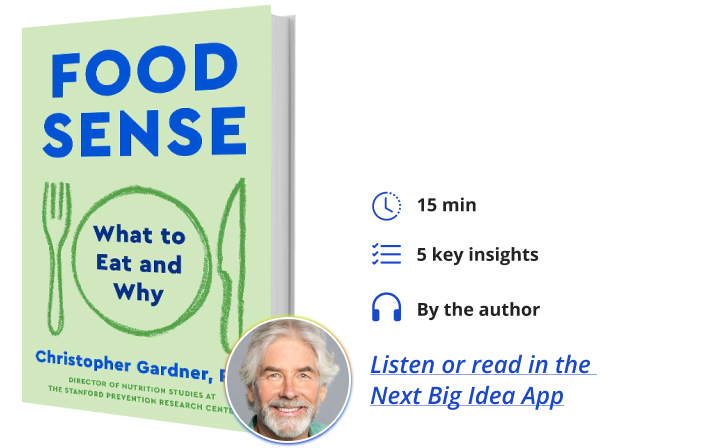
Below, Christopher Gardner shares five key insights from his new book, Food Sense: What to Eat and Why.
Christopher is the director of nutrition studies and a professor of medicine at Stanford University, where he has spent more than 30 years researching what we eat and how it affects our health. He has conducted more than 20 large-scale randomized clinical trials involving over 2,000 participants, helping bring clarity to some of today’s most debated food topics.
What’s the Big Idea?
There’s no single perfect diet, and eating well doesn’t have to mean giving up foods you love. Nutrition science gives us a solid foundation, but the best way to eat is one that supports your health, fits your values, and brings you joy.
Listen to the audio version of this Book Bite—read by Christopher himself—in the Next Big Idea App, or buy the book.
1. There’s more consensus than controversy.
If you follow nutrition in the news or on social media, you might think nutrition scientists disagree about almost everything. Should you eat low-fat or low-carb? Are eggs good or bad? What about dairy? Meat? Seed oils? Ultra-processed foods? And how much protein do you really need?
Those disagreements get a lot of attention. But there is actually a striking amount of consensus. I like to describe some of that consensus as the “Big Four.” These are the four things that we can all agree on:
- Eat more vegetables.
- Eat more whole foods.
- Eat less added sugar.
- Eat fewer refined grains.
Then there are what I call the “Solid Six.” These are foods for which the overall evidence is generally reassuring, and that most nutrition scientists agree can be part of a healthy diet:
- Beans
- Fruits
- Nuts
- Eggs
- Fish
- Yogurt
That still leaves an enormous amount of flexibility. There isn’t one magical diet that everyone needs to follow.
Instead of obsessing over the latest nutrition controversy, start with the areas where the science is remarkably consistent. Once you have that foundation, there is a lot of room to figure out what works best for you.
2. Ask, “Instead of what?”
Nutrition discussions often label individual foods or nutrients as “good” or “bad.” But foods don’t exist in isolation. Comparison can completely change the answer.
Imagine someone asks, “Is fish healthy?” My response might be, “Instead of what?” If you’re eating fish instead of processed meat or a large serving of red meat, that may be a beneficial swap. But suppose the alternative is beans, lentils, nuts, or another nutrient-dense plant food. Now it’s a different comparison.
The same idea applies to dietary fat. People ask whether butter is healthy. Or olive oil. Or seed oils. But what are you replacing it with? If you remove one source of calories from your diet, you don’t replace it with air. Something else comes in.
“Comparison can completely change the answer.”
This is one reason nutrition headlines can sound so contradictory. One study may compare a food with something less healthy and find a benefit. Another may compare that same food with an even healthier alternative and find something different. Both findings could be true.
So the next time you hear that a food is “good for you” or “bad for you,” resist the temptation to stop there. Ask: Instead of what?
Those three words can eliminate a surprising amount of nutrition confusion. They shift the conversation away from demonizing individual foods and toward making better choices among the options that are available to you.
3. Align your food choices with your values.
We eat for many reasons. Food is connected to our families, cultures, traditions, budgets, communities, and identities. And increasingly, people are thinking about questions like climate change, environmental sustainability, animal welfare, and the conditions of the people who grow, harvest, prepare, and serve our food. Those considerations belong in the food conversation too.
For me, this is one reason I refuse to suggest that there is one perfect diet everyone should follow. Imagine that I designed a nutritionally perfect eating pattern for you. But it included foods you disliked. Or foods that were inconsistent with your culture. Or foods you couldn’t afford. Or foods produced in ways that conflicted with something you cared deeply about. How sustainable would that diet really be? Probably not very sustainable at all.
Instead, I encourage people to think about what matters to them. Maybe environmental sustainability is especially important to you, and you decide to eat fewer animal foods and more beans and lentils. Maybe supporting local farmers is important to you, and you decide to eat more local foods. Maybe your cultural traditions are deeply connected to particular foods, and maintaining those connections brings important meaning to your life.
Those aren’t distractions from eating well. They are part of eating well. Nutrition science can help us understand the health consequences of different choices. But science doesn’t get to decide all of your values for you. The goal is to use the evidence to create an eating pattern that supports your health while also fitting the person you are and the things you care about. That’s a much more realistic foundation for lasting change.
4. Don’t forget joy and pleasure.
Sometimes nutrition science becomes so focused on nutrients and biochemical pathways that it ignores critically important aspects of flavor, texture, and taste.
We can spend an enormous amount of time talking about calories, carbohydrates, protein, saturated fat, fiber, vitamins, and minerals. All of those things matter. But humans don’t sit down for dinner and eat nutrients. We eat food!
And food can be one of the great sources of pleasure in our lives. It brings people together. We cook for people we love. We celebrate with food. We pass recipes down through generations. We travel and discover new foods. A smell from the kitchen can instantly remind us of a person or a place from decades ago. That really matters.
“Healthy foods can and should be unapologetically delicious.”
I often use the phrase “unapologetically delicious,” which I learned from my colleague and friend Greg Drescher from the Culinary Institute of America. I love this term. It has a particularly important meaning to me. Let me explain.
In the early days of my nutrition research, I tried urging people to give up their unhealthy junk food for healthier options. I remember feeling very apologetic. It was as if I was saying, “Please give up the foods you love, for foods that don’t taste as good, but are healthy for you.”
When I started working with chefs from the Culinary Institute of America, they reminded me that healthy foods can taste great. I shouldn’t have to apologize. Healthy foods can and should be unapologetically delicious.
So instead of thinking that pleasure is something you have to sacrifice in order to eat well, make pleasure part of the goal. When prepared the right way, vegetables can be craveable. Find bean dishes you love. Explore herbs, spices, sauces, textures, and cuisines from around the world.
Healthy eating doesn’t have to mean deprivation. If the food is nutritious, consistent with your values, and unapologetically delicious, you have a much better chance of maintaining healthy eating habits for a very long time.
5. Food is a journey.
Food choices should be more of a journey than a final destination. However far you’ve come in that journey, there is always the opportunity to make change.
Nutrition discussions often encourage people to choose a camp. Are you vegan? Keto? Paleo? Low-fat? Low-carb? Mediterranean? Once we give ourselves one of those labels, it can start to feel like changing what we eat means admitting we were wrong.
I don’t think food needs to work that way. Our lives change. Our health changes. Our families change. Our budgets change. The foods available to us change. And importantly, nutrition science continues to evolve too. The way you eat at 25 may not be the way you want or need to eat at 45 or 75. And that’s okay.
“Food choices should be more of a journey than a final destination.”
In my decades of doing nutrition research, my own thinking about food has continued to evolve. That’s what science is supposed to do. New evidence should make us curious enough to reconsider what we thought we knew. I’d encourage you to bring some of that same curiosity to your own food choices.
You don’t have to completely overhaul your diet in the next week, and stick with that. Try something new. Maybe learn to cook lentils. Maybe add another vegetable to dinner. Maybe replace a sugary breakfast with something built around whole foods. Maybe look up if there’s a healthier version of a dish your family already loves. See what works.
Keep the changes that make you feel good, that fit your life, and that you genuinely enjoy. Then keep learning. Eating well isn’t about achieving dietary perfection. It’s about developing enough food sense to make thoughtful choices again and again, throughout your life.
Enjoy our full library of Book Bites—read by the authors!—in the Next Big Idea App: