











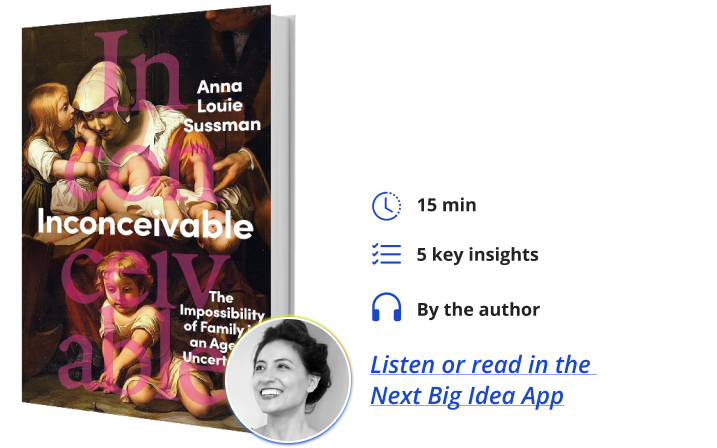
Below, Anna Louie Sussman shares five key insights from her new book, Inconceivable: The Impossibility of Family in an Age of Uncertainty.
Anna is a journalist covering gender, economics, and reproduction. She is a contributing Opinion writer at the New York Times, as well as a contributor to The New Yorker, The New York Review of Books, The Atlantic, and other publications.
What’s the Big Idea?
The fertility crisis isn’t really about people wanting fewer children. It’s about a society that has made having the families people want feel increasingly precarious and out of reach. If we want to understand falling birth rates, we need to look beyond baby bonuses and fertility statistics to the economic and social conditions that make caring for one another so difficult.
Listen to the audio version of this Book Bite—read by Anna herself—in the Next Big Idea App, or buy the book.
1. Numbers can’t explain why people are having fewer children.
When I was in my thirties and saving up to freeze my eggs, I started wondering: If becoming a parent seems so difficult to me, a person with many advantages in life, then how are other people doing it? On paper, I was a college-educated homeowner. By many measures, I “should” have been ready to have children. But something was still standing in the way.
Barely a day goes by without a headline about baby busts or declining fertility, but there’s so much more to this story than those figures. Parenthood is an intimate, personal, and complex decision. Data points can’t tell you why someone wants to become a parent, what they are ready to sacrifice, or the obstacles they perceive. After interviewing over a hundred people who were struggling to start a family, I concluded that there are as many different stories about having children as there are people. Only by listening to their stories can we understand what’s holding them back, and how to help.
2. People want more children than they ultimately have.
Statistics about fertility decline miss something fundamental: the love and joy that is lost when people who want to have families aren’t able to.
Of course, a growing number of people are choosing not to become parents because they don’t want children, and the increasing acceptance of that choice is a sign of much-needed social progress. But this explanation tells only part of the story. Studies show that there is a huge number of people who want kids but feel like it’s not possible for them.
Surveys over the past few years show that Americans want between 2.1 and 2.7 children on average, depending on the respondent’s gender and age. But right now, American women have 1.6 kids on average. That’s countless people who are an entire child short of building their dream family.
Common obstacles include:
- Cost of childcare
- Student debt
- Lack of paid leave
- Housing constraints
- No guaranteed healthcare
- Fear of school violence
- Educational competition
- Lack of a partner
- Work demands
- Climate anxiety
- Inaccessibility of fertility care
For many people, two or more of these factors operate simultaneously. Beyond these easily identifiable obstacles, there was a gnawing sense of precarity and anxiety that ran through many of the conversations I had, including with people who seem reasonably comfortable. They worried about their own ability to parent in this competitive, stressful world, and they worried about what kind of life a potential child would have.
3. It’s the capitalism, stupid.
Our current version of capitalism is increasingly inhumane, and when we create an inhumane world, it should not come as a surprise that young people are hesitant to create more humans. We have truly shocking levels of inequality, declining social mobility, a cutthroat labor market, and a way of producing and consuming that has run our planet into the ground. We’ve made decades of policy choices that have put corporate profits ahead of people’s health and ability to earn a living. This system thrives on scarcity, and leaves little time or space for people to care for themselves or those around them.
Capitalism has become a mindset, a way of life, a way of thinking about yourself as a neoliberal actor. It encourages the financialization of daily existence, increasing the pressure to monetize everything from posting a spare room on Airbnb to dedicating idle hours to driving for Uber. It changes how you think about your time and relationships. It can bleed into how we perceive potential romantic partners and the dating process, leading people to think in terms of assets, trades, and someone’s market value. We even see the language of the market in our discourse on children, framing education in terms of human capital.
4. We need more than a few family policy tweaks.
A small baby bonus or a bit of paid leave isn’t going to cut it. People need a genuinely secure and stable foundation from which to contemplate their future. But if you look at Scandinavian countries with much better social welfare systems and very robust family policy, they’ve also seen an ongoing decline in fertility rates since around 2008. Why is that?
Researchers studying population dynamics found that after the financial crisis, people reacted to a global sense of unease that—in an interconnected world with a 24/7 news device in your pocket—can be hard to distinguish from one’s personal circumstances. That uncertainty has been linked to fertility decline in the US and many European countries, including Nordic countries. Key milestones, such as buying a home or feeling established in one’s career, take on even greater importance. At the same time, those milestones take longer and longer to achieve.
“As markers of stability drift further out of reach, so does parenthood.”
It’s basic human nature to perceive things in relative terms. As an American, when I look at Norwegian society, I think, Wow, if I lived there, I’d have six kids by now. But young Norwegians compare themselves to their parents’ generation and think, Wow, things are so much harder today. For them, too, buying a home is more expensive, and it’s harder to get established professionally. As markers of stability drift further out of reach, so does parenthood.
In the U.S., we have never even tried what other countries have. Our baseline for family policy is pathetic, so the most basic of good policies could make a dramatic difference.
5. We’re interdependent and should act like it.
All of us, parents or not, are part of a larger society. All of us were kids once. And all of our well-being and health and happiness is dependent on the people around us. No one lives in isolation, so our society and our policies should reflect that.
In practice, that looks like guaranteeing a basic level of security and dignity for everyone. This could be accomplished through fairer taxation and allocation of our abundant resources. It looks like holding institutions and corporations accountable for the damage they do to our planet. It means enacting policies that treat basic goods (housing, childcare, medical care) as essentials instead of sources of profit.
“No one lives in isolation, so our society and our policies should reflect that.”
In our own lives, it means trying to be more relational in how we meet our needs: participating in community life, asking others for help, and being available to return the favor. The writer Leah Libresco Sargeant calls it being “interruptible” to others who may need your time or assistance.
Even people who don’t want children feel they don’t have enough time and space for the important relationships in their lives, especially during peak working years. People on both the right and the left want things like paid family leave, decent health care, and affordable housing. There’s a broad recognition, even in our very divided country, that we’ve lost sight of what matters and that we can do much, much better.
Enjoy our full library of Book Bites—read by the authors!—in the Next Big Idea App: