










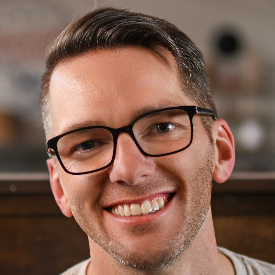
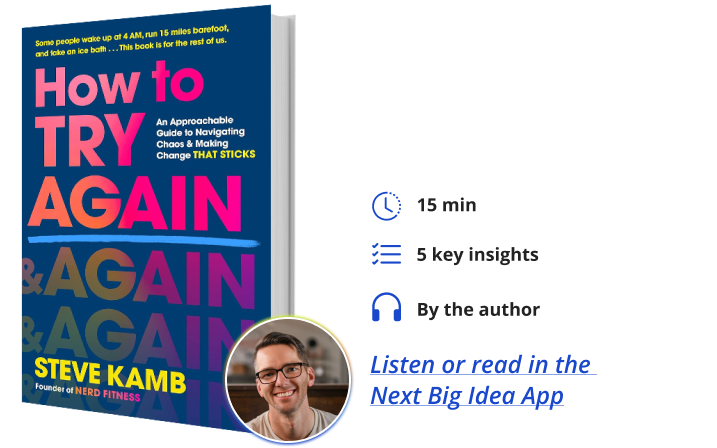
Below, Steve Kamb shares five key insights from his new book, How to Try Again: An Approachable Guide to Navigating Chaos and Making Change That Sticks.
Steve is the founder of Nerd Fitness, an approachable fitness company that helps busy humans level up their lives. Since 2009, he has published research-backed essays and a weekly newsletter that explores failure, self-compassion, and making change that sticks.
What’s the Big Idea?
Failure is part of doing anything worthwhile, and every setback teaches us something we can use moving forward. Success comes from accepting reality, staying afloat when life gets hard, and pursuing goals we genuinely want.
Listen to the audio version of this Book Bite—read by Steve himself—in the Next Big Idea App, or buy the book.
1. Failure is one possible outcome for anything worth doing.
In 2023, I visited the touring Museum of Failure, packed with history’s most famous failures, flops, and frauds. Wandering around this museum was an absolute delight, as I got to see some truly baffling decisions. The Hula Chair worked more like a medieval torture device than a fitness product. King Gustav II of Sweden commissioned a comically expensive military warship that sank to the bottom of the harbor 50 minutes into its celebratory voyage. However, my favorite failure on display was probably Hooters Airlines. Yes, that Hooters.
If you ever feel like a failure for not making wiser decisions, just imagine how many people had to agree with the following statement: “We got rich making chicken wings; how hard could it be to run a profitable airline?”
The more failures I encountered, the more I came to understand failure differently. This museum didn’t only exist to poke fun at bad inventions. I mean, it did that too. I’m still laughing about Hooters Air. But it also showed the ways in which failure was one of many possible outcomes, and no company was immune to failed initiatives. In fact, most of the world’s most successful companies were on display too. Nintendo and the Virtual Boy, Microsoft and its Zune MP3 player, even Apple, whose Pippin videogame console was such a flop that I, proud nerd gamer, had never heard of it.
Interestingly, there were many products on display that were simply casualties of poor timing: early chatbots, multifunctional cell phones, personal digital assistants, and the first digital camera back in the 1970s that Kodak never released for fear of it cannibalizing their sales of physical film! The vision was there, as was the ambition, and once technology finally caught up, the road had been paved for companies to achieve far greater success.
“Rather than trying to prevent failure, we can instead decide to embrace it as a possibility and focus on recovering quickly after failure.”
We need to reframe how we think about failure. Rather than trying to prevent failure, we can instead decide to embrace it as a possibility and focus on recovering quickly after failure. Ed Catmull, one of the founders of the animation studio Pixar, said it best “Failure isn’t a necessary evil. In fact, it isn’t evil at all. It is a necessary consequence of doing something new.”
Many of the best rewards in life are only available to those willing to open themselves up to failure as a possibility. Our biggest success might be hiding behind our next failure, so let’s see what can happen when we embrace failure openly. Even if that failure is Hooters Air.
2. We never go back to “square one.”
No matter how far backward we’ve fallen after a setback, we never truly start over. Let’s say we tried to build a workout routine last year. We went to the gym a few times and then gave up. We’re demoralized that we’ve gone all the way back to “square one.”
Fortunately, we’ve also learned the most difficult parts! After all, going to the gym isn’t one decision. It’s multiple decisions. We had to research which one to join, find parking, and then go through the sign-up process. We had to learn where the locker room was, how the equipment worked, and where to fill up our water bottle. And then we had to find the courage to exercise in public. Most importantly, we had to do all of this within the confines of our busy lives. Just getting to “I went to the gym” takes a ton of mental bandwidth, effort, and courage.
So sure, we might be starting over with how much we can lift on the bar or how fast we can walk, but every past attempt is still with us. We know where the gym is. We know where to park. We know how the equipment works. We know what to wear. We’ve already navigated the toughest parts.
Furthermore, our hard-earned past failures might help us avoid the pitfalls we fell into last time. We learned what type of workout or routine didn’t work for us. Or what time of working out doesn’t work for us. That knowledge lets us use our precious energy to hopefully make it further on this next attempt. When viewed through this lens, each failure is not a step backward, but a step forward. We should be thankful for our past attempts, because they got us where we are today. Failure isn’t the end, but the beginning.
3. Treading water isn’t the opposite of progress; it’s the next best thing.
When we think about moving toward a goal, the first word we think of is “progress.” And boy, do we humans love progress. It makes us feel good! Seeing positive movement toward a goal gives us that warm, fuzzy feeling and a sense of control that we are making things better. And when we are not making progress? We feel like we’re falling behind. We feel “stuck.”
However, there’s an important third option we’re not considering. The opposite of progress isn’t stagnation or staying still. It’s “regress.” Moving backward. Away from our goal. When we find ourselves struggling, our inclination is to try again, but harder. Trying again or working harder might be the wrong move, especially if we’re trying again at the wrong thing, and we might be making things worse. So, compared to those options, “treading water” can be the best, most optimal decision. Allowing ourselves to do less is more than just okay. It can be life-preserving.
“Allowing ourselves to do less is more than just okay.”
When we feel weighed down with the pressure that we’re so far behind or that we’re not doing enough, we can pause. We can realize that what might feel like a “motivation” problem is actually a “resources” problem. We’re asking too much of ourselves, and we’re going to burn ourselves trying to continue doing it all. We need to redefine what “enough” is for us.
Instead of worrying about how much farther we need to go on a goal, or how far behind we feel, we can ask, “What needs to happen today to show I haven’t given up yet?” We can remind ourselves that an “all or nothing” mentality quickly becomes “all, then nothing.” In between those two extremes, “some” is a perfectly acceptable amount. And “some” can keep us afloat for a long time. One healthy meal, a single exercise, a five-minute walk reminds us that we’re still here, and still afloat. Let’s see what tomorrow brings.
4. Acceptance isn’t giving up. It’s the only way forward.
No matter how much we want to have control of our future, we’ll never be able to accurately predict what life will throw at us next week, let alone next month or next year. Which leaves us with two choices. We can spend all day raging at the universe when things don’t go the way they should, or we can get to work on accepting things as they are now. We can get mad at ourselves for not magically developing the skills to plan better, or we can learn that life is going to remain chaotic and never go according to plan.
This requires acceptance. As a recovering overachiever, I used to believe that acceptance was a sign of weakness. I thought it meant giving up all ambition, letting myself off the hook, and enabling lazy behavior. So, I made things worse instead: I set ridiculously high standards and remained unbelievably critical of myself, always felt behind, and never felt “enough.”
Fortunately, I couldn’t have been more wrong. Acceptance is the only way we can finally start to see reality for what it is. We can stop waiting for “next week to get back to normal,” and accept that our life right now, warts and all, is normal. We can stop getting frustrated when our schedule falls apart and start expecting it. We can prepare for our plan not going according to plan. The sooner we accept that our current “normal,” with clothes on the floor and life being messy, is normal, the sooner we can choose to act differently.
Acceptance is the only way we can function in a world that feels contradictory, because it lets us embrace those contradictions. What’s the best way to do that? By practicing “yes and” thinking. Yes, we accept that life is challenging right now, and we have some real limitations. Here’s where we’re focusing our efforts today: on things we can control.
5. Don’t just ask, “Is the juice worth the squeeze?” Make sure you like juice.
I love watching documentaries about amazing things I have absolutely no desire to do. My heart skipped two beats watching the Academy Award–winning documentary Free Solo about climber Alex Honnold scaling “El Cap” in Yosemite National Park without a safety rope. I’ll stick with my safe indoor rock-climbing walls, thank you.
Unfortunately, that reasonable mentality does not apply when I learn about things I kind of want to do, or think I could do, or think I should do. This is where I get myself into trouble. It’s unsexy to accept that success in anything requires sacrifices in other areas of life, and just because somebody else is doing it, and doing it well, doesn’t mean it’s the right path for me.
“When we see someone who has what we think we want, it’s tempting to assume they have found the one correct path and are living a blissful life without any problems.”
We humans are social creatures. We love learning how to be successful, happy, or healthy by copying others who we hope have all the answers. When we see someone who has what we think we want, it’s tempting to assume they have found the one correct path and are living a blissful life without any problems. That’s what the folks selling us the dream want us to believe, anyway. As long as we live like them, and buy their product or service, we can be successful too. No compromises required!
This is where we must be careful. When we take our life, motivations, and expectations, and compare them to others who are playing with a different scorecard, we forget that everything has a cost attached to it. We see a financially successful entrepreneur telling us to rise and grind. We don’t see that person working late nights at the office to avoid their family (because they are fighting with their spouse), their deep insecurities, or the void they’re trying to fill with just making more money. The truth is that we can never truly know what’s going on in somebody else’s life, especially when we only see their public-facing highlight reel.
Everything has a cost attached to it, and the cost of chasing greatness or trying to reach an arbitrary level of success might require more sacrifices than you or I are willing to make. That’s okay! I like it when people are honest about it. When the Smartless podcast hosts asked Ken Burns, arguably the most accomplished documentarian alive, how he manages to be so prolific and still keep a healthy work-life balance, he replied, “You’ll have to ask my two ex-wives about that.”
There’s nothing wrong with admitting to ourselves that we don’t want to do the work and make the sacrifices for the chance at succeeding. The problem isn’t that we lack the required dedication. It’s that we have the expectation that we should have that dedication or be willing to make those sacrifices. It’s perfectly okay that we don’t want those things, or that we’re not willing to go down that path.
We shouldn’t forget to ask, “What if this works?” When we encounter videos, interviews, or success stories, we can pause and challenge our thoughts. Instead of only asking, “Is the juice worth the squeeze?” we should also ask, “Do I even want juice?”
Enjoy our full library of Book Bites—read by the authors!—in the Next Big Idea App: