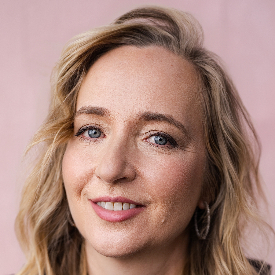












Below, Fay Bound-Alberti shares five key insights from her new book, The Face: A Cultural History.
Fay is a historian of medicine, emotion, and the body. She founded the Centre for Technology and the Body at King’s College London where she leads Interface, the world’s first and only multi-million-pound project examining technologies of the face.
What’s the big idea?
What we think of as the face—the unique, authentic marker of identity and character—is not a timeless human truth but a modern cultural invention. Tracing history reveals the rise of facehood as personhood and its lasting hold on our understanding of identity.
Listen to the audio version of this Book Bite—read by Fay herself—in the Next Big Idea App, or buy the book.

1. For most of history, people had no idea what they looked like.
In 1667, the English diarist Samuel Pepys recorded visiting a looking glass shop in London, considering buying a mirror to hang above his chimney. It reads as a perfectly ordinary errand, and yet for most of human history that would have been unthinkable. Most people never saw their own face.
Mirrors existed in the ancient world, made from obsidian or bronze, but they were rare and owned by elites. In ancient Egypt, mirrors were associated with ritual and the divine. For most people, they never experienced a mirror. Their faces were what others saw. Your sense of self came from community, role, and reputation, rather than your reflection.
By Pepys’s time, glassmakers had refined mirror production, and the results were reaching the aspirational middle classes. That shift accelerated through the eighteenth and nineteenth centuries, as industrialization made mirrors cheap and widespread. For the first time, ordinary people could look at themselves regularly, and what they saw began to matter.
The expansion of the mirror market coincided with urbanization: more strangers, more judgment, more need to manage your appearance. Just as portraiture expanded during the Renaissance as the merchant classes emulated elites, so too did mirrors become more common. Each technology invented along the way, from the portrait, to the mirror, to the photograph, deepened the idea that the face was the self. Pepys buying a mirror to brighten a wall was, without knowing it, part of a revolution in human self-consciousness.
2. The face as identity is a surprisingly recent idea.
Photography was invented in the 1840s, and yet for decades we did not have photographs in passports. That gap hints at something important: for most of history, the ordinary human face did not matter as a tool of identity. The only faces recorded and circulated were those of the powerful. Think of Alexander the Great on a coin: his strong chin, his wide eyes. This representation was not vanity, and it does not matter whether it looked like Alexander. The face was recognizable as a symbol. Aristotle, Alexander’s teacher, believed you could read a person’s character from their face, and a leader’s profile had to project authority.
“The face was recognizable as a symbol.”
When mass migration and urbanization brought new concerns about how to manage populations and know who people were, governments debated what constituted a person’s identity. In France, the policeman Alphonse Bertillon built a biometric science around body measurements of criminals. The Victorians loved classifying people; in the colonies, the British used fingerprinting. Faces were just one option.
It took the First World War, with mass mobilization and borders becoming critical, for the face to become the official marker of identity. We have never looked back. But the idea that one person equals a unique and identifiable face is a modern assumption I call “facehood,” and it has become so powerful it seems inevitable.
3. Not everyone recognizes faces—including me.
I have prosopagnosia, also known as face blindness. I have never been able to reliably recognize people by their faces alone, and that only matters because we have built an environment around the idea of facehood. With scans of my own brain feeding into my research, I started to think about what face blindness tells us about the increased importance of the face in the modern age.
Prosopagnosia was named as a neurological condition by Joachim Bodamer in 1947, soon after faces became the unit of identity in official documents. Bodamer was mostly interested in brain-damaged forms of acquired prosopagnosia rather than developmental versions. But neuroscience was defining what ‘normal’ human behavior looked like, and one thing it declared universal was the ability to recognize faces. Those who could not were, by definition, disordered. We think around two percent of people have prosopagnosia today, though there has been little testing.
In 2009, researchers identified super-recognizers at the opposite end of the spectrum: people with an extraordinary ability to remember once-seen faces. So, we now have a hierarchy, with a medical condition at one end and a superpower at the other, built around a skill we decided was important.
People have always known each other through voice, gait, smell, and context. The face is one route to recognition, not the only one. When we build that assumption into law, surveillance, and AI, those who fall outside it become invisible, or worse, misidentified.
4. Physiognomy is the pseudoscience that never died.
In the 1880s, Francis Galton, a cousin of Charles Darwin and the founder of eugenics, photographed hundreds of people, overlaying their portraits to find a composite criminal face. He was searching for features that marked someone as degenerate or dangerous, layering photographs to link personality and profile—and he wasn’t the only one. These projects tell us everything about how deeply the ancient belief in physiognomy had embedded itself in modern science.
Physiognomy, the idea that character can be read from the face, goes back to Ancient Greece and our discussion of Alexander the Great. Physiognomy was revived in the Renaissance, and by the nineteenth century, it had fused with Darwinian theory to claim that some faces were more evolved than others. This is one of the intellectual foundations of scientific racism: the color and shape of your face and head determined your worth and place in the social order.
“What we are seeing says more about our own belief systems than about the person whose face we are reading.”
These habits of mind about what constitutes biology and fact have not disappeared. Even Paul Ekman’s hugely influential twentieth-century theory, that facial expressions are universal and biologically fixed, has since been challenged by researchers who argue that reading emotion in a face is shaped by culture, not nature.
Yet every day we imagine we know what a person is thinking by looking at their face, and we make decisions about who to employ, marry, avoid, and in some courtrooms, sentence to death. What we are seeing says more about our own belief systems than about the person whose face we are reading.
5. The real face-off created by face transplants.
In November 2005, a French woman called Isabelle Dinoire became the first person to receive a face transplant, after being mauled by her dog. Surgeons gave her the nose, lips, and chin of a brain-dead donor. At a press conference months later, she drank from a cup with her new lips and said: “I have a face like everyone else.” Isabelle died in 2016 of cancer. The immunosuppressant drugs she took to keep her face weakened the body’s immune system and made cancer more likely.
There have been about 52 face transplants worldwide since 2005, and the surgery will never be mainstream. But Dinoire’s story sits at the heart of this book, because if a face can be transplanted like any other organ, what does that make it? Is it the same as a liver or a kidney, or, if it is something more, the site of our identity, feeling, and communication, how can we transplant it?
And there’s an ethical challenge: can we justify giving someone the face of a dead donor—which is life-enhancing rather than life-saving—if it also radically reduces their lifespan? Face transplants also stop people from being abused in public because it gets rid of their ‘unusual’ faces, and the only reason people are abused in public is because we put so much value in appearance. Until a better solution to rejection is found, face transplant recipients are predicted to live only 10 years.
“Cosmetic surgery still chases youth and beauty, but it does not seem to bring lasting happiness.”
We reached this point from the First and Second World Wars, when surgeons like Harold Gillies developed reconstructive techniques to rebuild the faces of disfigured soldiers. After the Second World War, those skills turned towards a new market, made up of people who wanted improvement rather than repair. Consumer culture promised self-reinvention, and the marketing ideal was white, European, and supposedly based on the golden ratio. Cosmetic surgery still chases youth and beauty, but it does not seem to bring lasting happiness.
Beyond surgery, we now have deepfakes and AI-generated faces; the possibility of wearing someone else’s identity without going near a scalpel. In all these ways, the one-to-one relationship between a face and a person—facehood—is being destabilized.
The face has never mattered more, and yet it has never been less certain. The real face-off, perhaps, is how far we can move beyond the prejudices we have internalized, to see the face as a means of connection: something that makes us uniquely human, rather than perfectible.
Enjoy our full library of Book Bites—read by the authors!—in the Next Big Idea App: