










Below, Michael Bond shares five key insights from his new book, Animate: How Animals Shape the Human Mind.
Michael is a science writer specializing in human behavior. He is a former editor and reporter at New Scientist and currently teaches writing as a Royal Literary Fund Fellow at Oxford Brookes University.
What’s the Big Idea?
Our belief that humans are fundamentally separate from and superior to other animals is not an eternal truth but a psychological and cultural construction. Across history, archaeology, religion, art, and even modern identity, the evidence suggests that humans have always experienced a much deeper kinship with other animals than our dominant worldview admits.
Listen to the audio version of this Book Bite—read by Michael himself—in the Next Big Idea App, or buy the book.

1. The psychology behind our attitudes toward animals.
There’s a theory in psychology that many of our cultural values and the ways in which we understand the world are shaped by our search for meaning. We all want to know the answers to those important existential questions: what is the purpose of my life, what happens after I die, where humans fit into the rest of the natural world?
One way we’ve tried to answer those questions is to consider ourselves superior to other animals and the rest of nature. In most cultures, we have convinced ourselves that humans possess attributes that other animals do not: intelligence, rational thinking, morality, spirituality. At the same time, we’ve discounted the things we share with animals: our bodies, our mortality. We’ve taken this position not from any great knowledge of how animals function, but as a result of our own existential insecurities.
This attitude has resulted in a great contradiction in our relationship with animals. We consider them inferior, and yet we are fascinated by the wild ones, and love our pets. Animals have had a huge influence on our culture and art. They are vividly present in our unconscious, in our dreams, hallucinations, and various states of mental illness. They enter our minds whether we’re thinking of them or not. Whatever we believe about animals, they are not just present in our physical worlds; they live in our psychology too.
2. Animal artists of the Ice Age.
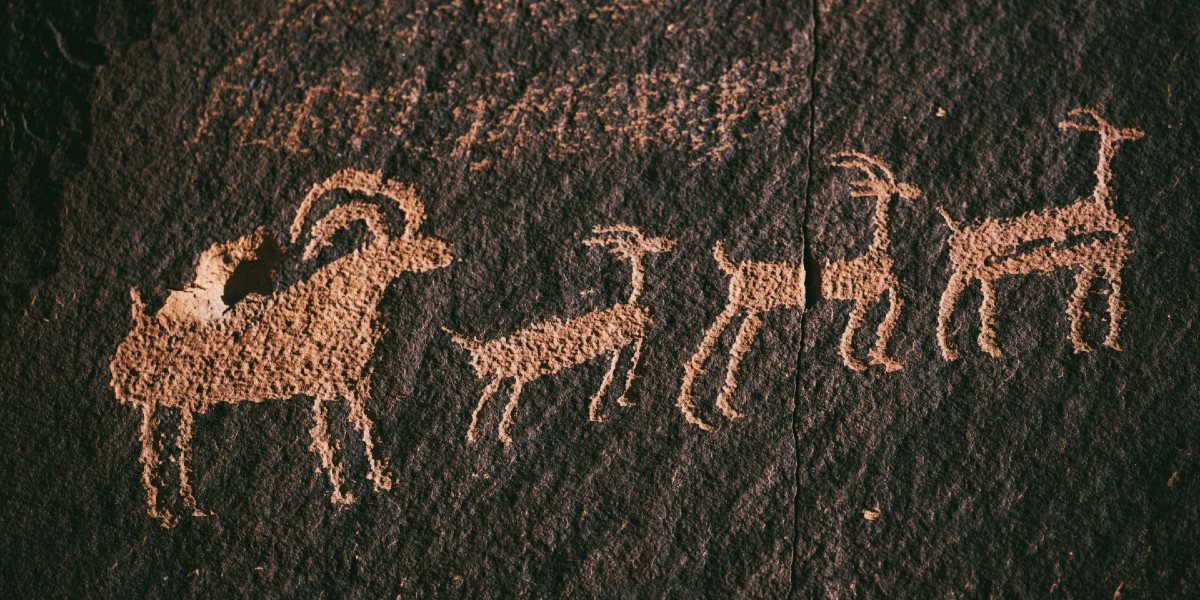
We don’t know much about how our ancestors lived in prehistoric times, but we know something about what they thought of animals because they painted them on the walls of caves. In southern France and northern Spain, the inner surfaces of hundreds of caves are adorned with paintings, engravings, and sculptures of animals that date to between 10,000 and 40,000 years ago.
The paintings are precise and detailed, which suggests the artists were close observers of the animals they lived among. Many of those animals are long extinct: the woolly mammoth; the aurochs, predecessor to domestic cattle; the giant megaloceros deer. Notably, there are very few paintings of humans in the caves, perhaps because the artists were more concerned with the animals around them, which far outnumbered them.
“The paintings are precise and detailed, which suggests the artists were close observers of the animals they lived among.”
Some of the Ice Age caves are open to the public. Most visitors are awestruck by the sheer number of paintings, their artistic quality, their beautiful colors, how well they are preserved, their extraordinary age, and the reverence with which the people of that time painted animals. We will never know why they made the artworks, but it seems clear that, for our prehistoric ancestors, the line between themselves and other creatures was either non-existent or at least far less pronounced than it is today.
3. Animal relics in ancient graves.
Aside from the cave paintings, there is another body of evidence that suggests humans have been assimilating animals into our culture for at least 100,000 years. In 1930, in what is now northern Israel, archaeologists uncovered the remains of a child with the antlers of a fallow deer on her chest, and a few miles away the body of another person who had been buried with their left arm clasping the jaw of a wild boar. Both had been left that way between 80,000 and 120,000 years ago.
Since that find, many other examples have surfaced of early humans being ushered into the next world with animal charms. In 1975, in modern-day Denmark, researchers discovered the 6,000-year-old remains of a young woman lying next to her newborn baby. The baby had been placed on the wing of a whooper swan.
It is hard to dismiss the symbolism of this, and of the many instances of people from that period who were buried with parts of bird wings next to their hands—as if, in a bird’s embrace, the deceased might transcend death, or escape their body as a winged soul. This idea exists in many different cultures and goes back at least to the ancient Egyptians, and more than likely, far back into the Ice Age.
4. Animals on trial.
For much of the past 2000 years, theologians, philosophers and scientists have observed a strict divide between humans and animals. But this has never been the whole story. For many people, the human-animal boundary is either porous or doesn’t exist at all.
During the Middle Ages, it was commonly believed that animals were responsible for their actions. This sometimes led to them being tried in court. In 1713, a group of Franciscan monks at a monastery in Brazil took legal action against some termites. The termites had destroyed their furniture, eaten the wheat in their granary, and were threatening the foundations of their building. The termites were appointed a lawyer, as was customary, and the lawyer reminded the tribunal that the termites had occupied the site first, and deserved clemency since they were considerably more industrious than the monks. To no avail: guilty as charged. The sentence was immediate removal from the monastery grounds.
“In 1713, a group of Franciscan monks at a monastery in Brazil took legal action against some termites.”
In Dresden in 1559, a Protestant parson ordered a flock of intrusive sparrows to be exterminated on account of, “their unceasing and extremely vexatious chatterings and scandalous unchastity during the sermon.” Being treated as an equal in the Middle Ages did not always mean you were treated fairly.
5. The people who think they are animals.
There are people who feel that they are living as another species in the wrong body. They are known as therians, derived from therianthropy, which is the state of being both human and animal simultaneously. When I say they feel like an animal, I mean they physically feel it in their bodies. Many of them have the sensation of phantom body parts, feeling fur instead of skin, or a wolfish tail, or large imaginary ears like a coyote, or bear paws in place of hands.
Therians are neither psychotic nor delusional, and the way they feel is unaffected by medication. They have simply felt from an early age that they are more animal than human. They straddle the human–animal boundary in ways that can be hard for the rest of us to imagine.
It is not clear why therians feel the way they do, though it is likely there have been therians for as long as there have been humans. Of the few human figures that our ancestors painted on cave walls during the Ice Age, most are human-animal hybrids, composites, or shape-shifters, with antlers, tails, bovine limbs, or beaks for heads. Modern-day therians, like their prehistoric counterparts, perhaps embody the enduring truths of being human: that we’re no less animal than the next creature.
Enjoy our full library of Book Bites—read by the authors!—in the Next Big Idea App: