












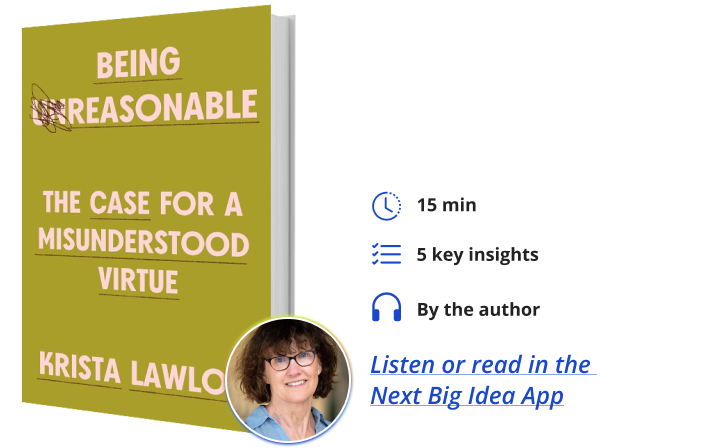
Below, Krista Lawlor shares five key insights from her new book, Being Reasonable: The Case for a Misunderstood Virtue.
Krista is a professor at Stanford University, where she teaches philosophy.
What’s the big idea?
Being reasonable isn’t about being logical or self-interested. It’s about recognizing what truly matters in a situation and responding accordingly. That shift in perspective changes how you think about judgment, emotions, and what it really means to act well.
Listen to the audio version of this Book Bite—read by Krista herself—in the Next Big Idea App, or buy the book.
1. Being reasonable is not the same as being rational.
You can define rationality in several ways. Many people define it as the capacity for using knowledge to achieve goals. Now, reasonableness is very different than using knowledge to achieve goals. What if your goals are bad? It might be rational for a gangster to brutally eliminate his rivals—that achieves his goals. But is it reasonable? The gangster isn’t reasonable in eliminating his rivals, even if he is rational.
Another way people define rationality (economists may favor this version) is that it involves acting to maximize one’s self-interest. Being reasonable is different than maximizing your self-interest. It might be reasonable to do things that don’t maximize your self-interest—like donating a kidney to a stranger, or giving away some of your lottery winnings. These things might be entirely reasonable even though they don’t maximize your self-interest.
It is important to distinguish reasonableness from rationality: our culture tends to focus on rationality, and even valorize it. But being reasonable is important too. When you call someone reasonable, you’re praising them. But for what? For maximizing their self-interest? No, hardly. For reasoning well? Not necessarily. You don’t always do any reasoning when you feel an emotion, and you can have reasonable emotions. So, what does it mean to be reasonable?
2. Being reasonable starts with being good at evaluating your circumstances.
From the moment you wake up in the morning to your last moment of consciousness at bedtime, you are making a stream of evaluations: This bagel is tasty… my sweater isn’t warm enough…and so on.
And we’re not just making one-off evaluations. We are weighing some values against others: this bagel is tasty (that’s good), but it has lots of carbs (that’s not so good), but it’s whole wheat, so there’s fiber (that’s good—I need that!).
“We, human beings, are evaluators just as much as we are reasoners.”
Your evaluations also spread out: the bagel is what’s available (that’s good), and if I don’t eat, I’ll crash at the meeting later (that would be really bad—it’s an important meeting). In this way, we build whole maps of the value landscape, tracking where the good things are, where the bad or yucky stuff is, what’s great or matters a lot, and what’s no big deal. We map all the mountains and molehills.
We, human beings, are evaluators just as much as we are reasoners. When you call someone reasonable, you are saying that they are good at evaluating their circumstances. An unreasonable person messes up in evaluating their circumstances, making mistakes about what matters. For example, suppose I am evaluating one thing way too much: I’m obsessing over what’s good and bad about the bagel, and I don’t see that I’ve got better things to be thinking about. That is an instance of unreasonableness.
We count on each other to be reasonable. We count on each other to make good evaluations of circumstances. Imagine you’re an early human. You want to hunt with others—that’s efficient—but you don’t want to hunt with just anyone. You want to hunt with the person who tends to evaluate situations correctly: you need the other person to see that it’s good to chase the antelope this way into the box canyon, and it’s bad to chase it that way across the river. You’re counting on them to see that the canyon is the better choice. You’re counting on that other person to quickly map the landscape of value accurately—not just the physical landscape, but also what counts as an opportunity and what counts as an obstacle. Being reasonable starts with being good at evaluating what’s good and bad.
3. To be reasonable, you must care about promoting the value you see.
Imagine someone who’s very good at seeing what’s valuable in a situation, but they just don’t care about advancing or delivering the overall valuable outcome in those circumstances. I recently saw someone who’d gotten into the left-turn lane at a stoplight, and he didn’t want to turn left—he wanted to go straight. So, when the left turn light came on, he just sat there, waiting until he could merge into the line of traffic that was heading straight. Everyone behind him in the left-turn lane was irritated that he was blocking their way. If this driver just didn’t want the inconvenience of detouring himself, then he was being unreasonable. He wasn’t caring about the costs to others and acting accordingly.
You might even imagine a case where the guy doesn’t move even though he sees that one of the vehicles stuck behind him is an ambulance with its siren going. He registers what’s happening, he sees that people need him to turn so that traffic can get going, but he doesn’t act in a way that promotes what matters most. Instead, he prioritizes saving himself a few minutes. That’s unreasonable. This guy may be able to see the landscape of value, but he doesn’t act to promote the most important value in the circumstances.
Being reasonable isn’t just seeing the landscape of value correctly, it also means promoting overall value where you see it.
4. Emotions can be reasonable.
Some philosophers mark a bright line between reason and emotion, or reason and “passion.” Some argue that reason should control or triumph over emotion. Some philosophers argue that we should modulate our emotions down to a vanishing point. Seneca, the ancient Stoic, says that anger is to be avoided, and you should instead work to have only cool indignation.
In my view, if you feel angry when someone steals something from you, that can be entirely reasonable. Your anger may be accurately tracking that something bad has happened. Or, if you’re happy when your child succeeds, your happiness is accurately tracking that a good thing has happened. If your emotions are fitting and proportional to the scale of the value that they are registering, then they’re reasonable and informative.
“Emotions can even be a tool for us as we try to be reasonable.”
Let’s say I hold a bitter grudge against you for a slight that you have already apologized for. Well then, I’m not registering some important things that matter: your apology and your contrition are good things—you are trying to repair the social fabric. If I don’t see that because I’m stuck ruminating on the initial slight, then I’m being unreasonable—I’m not seeing the value landscape correctly. If, instead, I feel forgiveness, then I’m registering the good that you’re trying to create by apologizing. My feeling forgiveness is a reasonable emotion.
It’s important that we acknowledge emotions can be reasonable. Emotions can even be a tool for us as we try to be reasonable. As we try to map the landscape of value accurately, our emotions can be the first indicator of what’s good or bad in a situation.
For instance, at the traffic light where that guy sits there blocking the left turn lane, your irritation is registering the disvalue that he is creating and your anger is registering the fact that this guy is being unreasonable. Your emotions may be your first conscious sign that something is going wrong. So, while the old trope about reason vs passion makes it seem as though emotions are always the enemy, that’s not true: emotions are not the enemy of reasonableness. Emotions can help us evaluate situations.
5. Being reasonable is not subjective.
Being reasonable is not subjective. Beauty is “in the eye of the beholder,” or the tastiness or yuckiness of food is subjective. I might say, “Licorice is delicious,” while my kid says, “Licorice is disgusting,” and it seems there’s no deciding the question of whether licorice is objectively tasty. We each have our reactions, and whether licorice is tasty is just not something that there is an objective fact about.
Some things are subjective, but reasonableness is not. Think about cases where it is obvious that I’m being unreasonable: Imagine I always call you when I know you’re sleeping, just to talk, without thinking of how disruptive it is for you. Unreasonable—and selfish, too. Even if I claim that I’m being reasonable, that doesn’t make my action reasonable. It’s just plain true that I am unreasonable in calling you at 3 am all the time.
“Disagreement doesn’t mean reasonableness is subjective.”
Why do we get tempted to think reasonableness is subjective? I’m guessing it’s because we focus on the hard cases, where reasonable people can reasonably disagree about what is reasonable. Is medically assisted dying a reasonable policy? That’s disputed a lot. There are good arguments on both sides, and real values at stake that compete against each other.
Thinking about hard cases tempts us to say that reasonableness is subjective. Our conversations in these cases can sound a bit like a disagreement about the tastiness of licorice. One side says medically assisted dying is right, the other says it isn’t, and it’s not clear how to get to an agreement. But disagreement doesn’t mean reasonableness is subjective. There are all these easy cases where we can see that it isn’t subjective. In the hard cases, it’s just that the landscape of value is complex and tricky, so we reasonably disagree. The fact that we can reasonably disagree about a difficult question doesn’t mean reasonableness is subjective.
Enjoy our full library of Book Bites—read by the authors!—in the Next Big Idea App: