









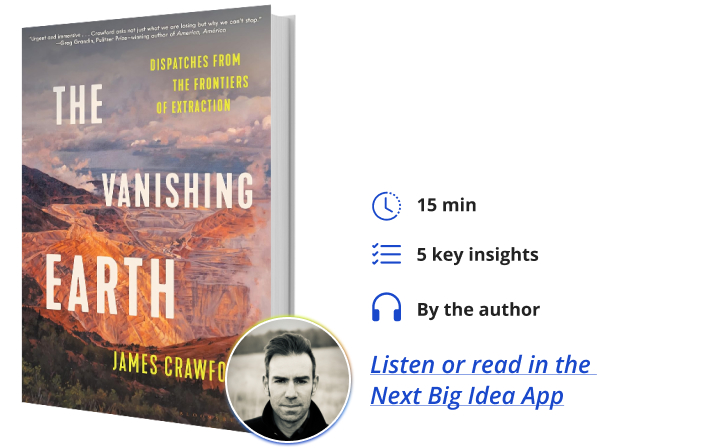
Below, James Crawford shares five key insights from his new book, The Vanishing Earth: Dispatches from the Frontiers of Extraction.
James is a writer, historian, journalist and BBC broadcaster. His work spans deep history and urgent contemporary crisis, examining how the decisions of the past shape the landscapes and liabilities of the present.
What’s the Big Idea?
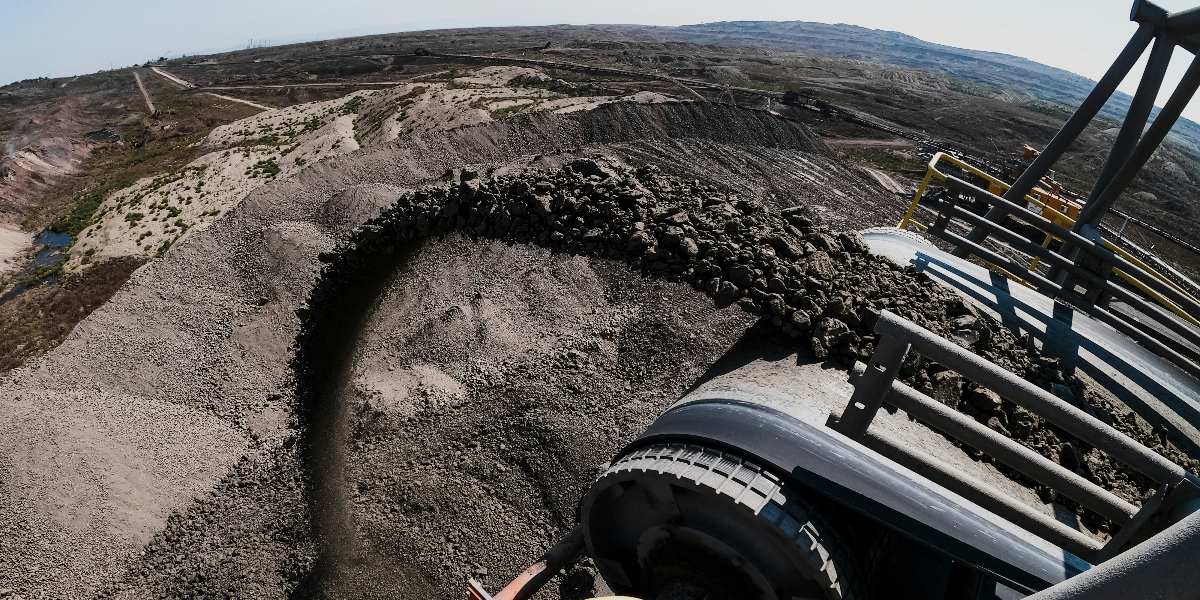
Over just the last 50 years, we have taken more out of the earth than in all the rest of human history combined. As a result, in 2020, a staggering threshold was crossed: for the first time ever, the mass of everything that humans have made came to exceed the weight of all living things on the planet. The wounds left behind by this extraction—mines, quarries, poisoned rivers, hollowed-out industrial towns—now form the true map of our civilization and our age. But it is only by confronting these ruins that we can find the path toward something better.
Listen to the audio version of this Book Bite—read by James himself—in the Next Big Idea App, or buy the book.
1. Extraction is our global operating system.
Extraction isn’t a sector of the economy that can be reformed or replaced while leaving everything else intact. It is everything else. It’s our food, our buildings, our roads, our medicines, our microchips—all of it is downstream of extraction, built from it, dependent on it, saturated with it. Humans have effectively merged with extraction. Hydrocarbons live permanently in our bodies and microplastics are ever-present in our lungs, our breast milk, and the placenta of our unborn babies.
Asking “how do we stop extracting?” isn’t the right question, because the answer is that we can’t. At least not while maintaining anything resembling modern civilization. The harder, more precise question is: which extractions can be made circular, which must be wound down, which are simply incompatible with a habitable planet, and what kind of civilization remains if those incompatible extractions end?
2. The idea of the mass extraction came before the damage.
Mass extraction was powered the very recent idea of economic growth. As a concept, economic growth is only a few hundred years old, emerging out of a late-17th-century desire to break free from the confines of nature (which often brought famine, starvation and death). That desire, supercharged by the energy-generating potential of fossil fuels, was predicated on the assumption that the earth’s resources were either infinite or infinitely substitutable.
This became an unshakeable ideology. It was championed by thinkers from Francis Bacon—who wrote of how nature must be “conquered”, subdued,” “tortured,” “bound,” and “enslaved”—to Nobel Prize-winning economists like William Nordhaus, who claimed that the exhaustion of certain resources wasn’t a problem and might even aid economic growth.
“It is a level of use and consumption that simply cannot be extended to every nation and every person on Earth.”
Yet it was the ecological world— the earth, the soil, living organisms—that offered the building blocks for our political and economic freedoms in the first place. Maintaining the basic upward trend of the global economy requires at least a quarter of the entire biomass our planet produces each year to be brought into commercial use or sacrificed to make space for it. Already, in the world’s wealthiest countries, the rate of demand on our environment’s biocapacity exceeds supply by over 100 percent. It is a level of use and consumption that simply cannot be extended to every nation and every person on Earth.
Climate change, species extinction, and collapsing ecosystems are not just side-effects. They are the logical products of a set of philosophical commitments made over three centuries ago and never revised. Oil companies didn’t accidentally contribute to climate change; they have known the impacts of their businesses for more than half a century, and chose profit and damage instead.
That is at once disturbing and clarifying. Disturbing to recognize that we chose to damage our planet. Clarifying because a choice, based on an idea rather than an immutable law of nature, can always be unchosen.
3. The cost of extraction is paid somewhere else—until the distance runs out.
The phosphorus that grows our food leaves behind billions of tons of radioactive waste in central Florida’s Bone Valley. The lithium powering the decarbonization of transport requires the sacrifice of Atacameño water sources in Chile’s Atacama Desert—sources that have sustained life for millennia. Spain’s “Sea of Plastic”—400 hundred square kilometers of greenhouses that grow a huge percentage of Europe’s fruit and vegetables—will destroy a landscape within a decade in the pursuit of profit.
Every chapter in my book traces the same structure: benefit extracted here and now, cost deposited there and later, onto people with less power to resist it. What’s changing is that the spatial and temporal distance between cause and cost is collapsing. The radioactive waste in Florida is making its way into the water supply of Tampa. Megacities around the world, from São Paulo and Cape Town to Los Angeles and London, are facing the prospect “Day zero”—the day when they run out of water and the taps are turned off for hundreds of millions of people.
“Increasingly, our whole planet is the sacrifice zone.”
As wildfire smoke blackens the skies of major North American cities, it brings home the reality that the discrete sacrifice zones have shifted. Increasingly, our whole planet is the sacrifice zone. At the same time, neurotechnology on the consumer market is harvesting our brain data, meaning extraction has arrived at perhaps its final frontier: us. When the sacrifice zone is nothing less than our own minds, there is truly nowhere further to push the damage.
4. Law is further along than politics.
Some 1,500 years ago, the Roman Emperor Justinian introduced the concept of the public trust doctrine. This is the principle that governments must hold the atmosphere, water, and land in trust for present and future generations. It has never been applied to the vast planetary impacts of climate change—until 2023.
That year, the first-ever youth climate case came to open court in America. In Held v. State of Montana, 16 plaintiffs aged two to 18 years sued Montana for violating their rights to a clean and healthful environment, their public trust rights, and their rights to life, liberty, dignity, and personal security. It was the first time that climate change was ever put on the stand in American legal history.
On August 14, 2023, the presiding judge ruled overwhelmingly in favor of the plaintiffs, affirming the “scientific certainty” of the impact of fossil fuels on climate change. The ruling effectively held that Montana’s still-substantial reserves of untapped fossil fuels would have to stay in the ground—a landmark judgment in the world’s largest producer of fossil fuels.
What a case like this is reminds us is that we don’t need a revolution to change course. We already made firm commitments in law to future generations.
5. Some damage to the planet is permanent.
At the end of the book, I travel to Butte, Montana. Once a booming copper hub dubbed “the richest hill on Earth,” Butte today is poisoned by toxic soils, homes tainted by decades of arsenic smelter dust, and a half-kilometer-deep lake of 50 billion gallons of acidic wastewater. This lake, the Berkeley Pit, is the ruin of an open-cast mine that once provided America with two-thirds of its copper. The only solution to prevent the water from overspilling and poisoning the surrounding landscape is to pump it out and treat it. Forever. Which means, in principle, that BP—made financially responsible by a 2020 settlement—will have to pay for it forever.
“Some debts cannot be repaid by future growth, because future growth cannot undo them.”
This is the true balance sheet of extraction, including the liabilities that run beyond any human timescale. No corporation has ever presented that balance sheet honestly, because doing so would make the economics of extraction visibly impossible. What the concept of a “forever repair” forces is a different relationship with time. Economic growth is structurally short-termist. It borrows from the future to pay the present, always assuming the future will be larger and therefore able to bear the debt. Forever repair reverses that logic completely. Some debts cannot be repaid by future growth, because future growth cannot undo them. The Pit will still be there, requiring its pump, still poisoning its water table, when every person alive today is dead, and the political arguments about why it was mined have been entirely forgotten.
Young people in the city of Butte—descendants of generations of miners who once went to university to specialize in extractive industries—are now specializing in environmental repair, industrial cleanup, and biotechnology. Researchers studying the extreme environment of the Berkeley Pit have even found microbes capable of attacking ovarian cancer cells. Out of one of the most toxic ruins of the growth ideology in the world, something new might be emerging: an ideology of stewardship and sustainability in perpetuity. In this one city, there may be a model for the forever repair our whole planet needs.
Enjoy our full library of Book Bites—read by the authors!—in the Next Big Idea App: