










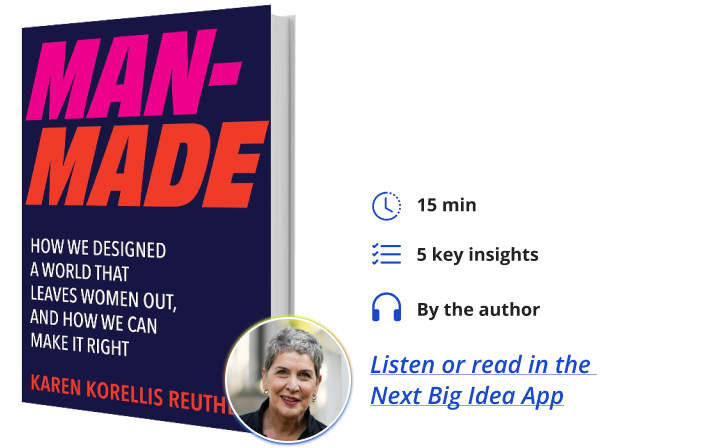
Below, Karen Korellis Reuther shares five key insights from her new book, Man-Made: How We Designed a World That Leaves Women Out, and How We Can Make It Right.
Karen has been a designer by training and practice for decades for some of the most recognizable brands in the world, like Nike and Reebok. Today, she is an activist focused on ending gender bias in our built world.
What’s the Big Idea?
Not accommodating the female body in the design of products and places has led to a world that is less hospitable and more dangerous for women. In the best case, it can be insulting. In the worst case, it can be deadly. We need to fix that.
Listen to the audio version of this Book Bite—read by Karen herself—in the Next Big Idea App, or buy the book.
1. “Shrink it and pink it” and other foolish ideas.
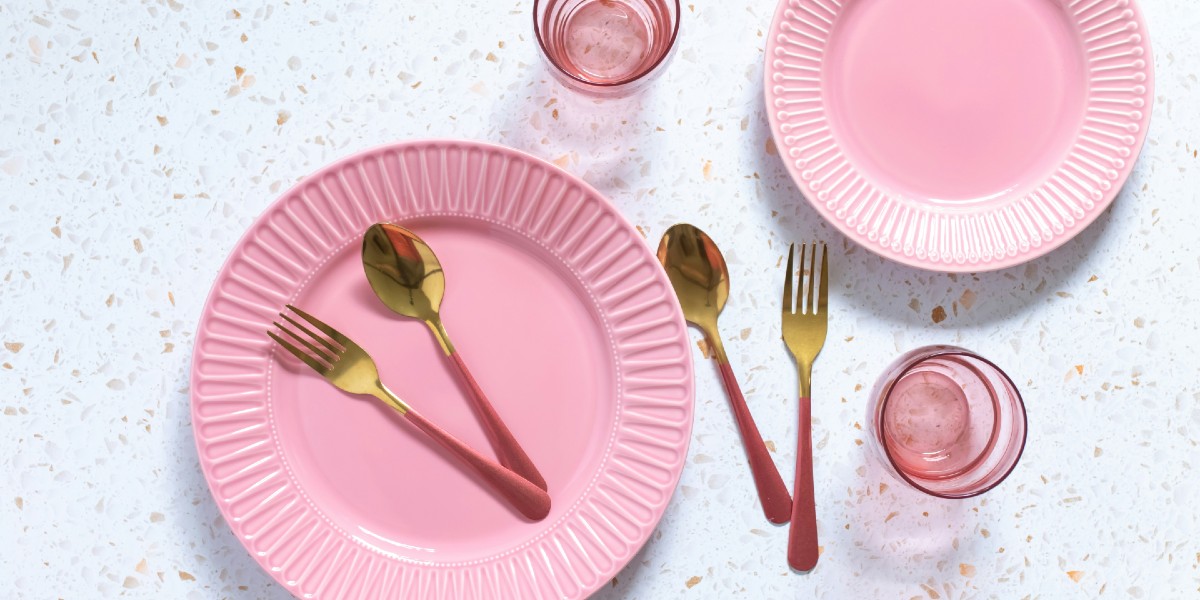
I don’t remember exactly when I heard it for the first time. Certainly, it was early in my design career—before Nike. In all likelihood, I was a young, impressionable college student when I heard the insidious little earworm first: “Shrink it and pink it.” Don’t let the cuteness fool you. It’s a euphemism for biased design and a blatant lack of consideration for women. Unfortunately, it’s a common phrase in the lexicon of design and marketing jargon, and often one that manifests as a legitimate strategy whereby a product originally designed for a male user is made smaller and in a stereotypically feminine color, like pink, to become viable to female consumers.
There exists a spectrum of gendered design examples in the built world—what we wear, use, and what surrounds us—that have resulted in consequences that range from insulting to deadly. Although shrinking something shows an acknowledgment of differences between male and female bodies, women are not just smaller men.
“Shrink it and pink it” doesn’t consider the user at all, failing to respect and address the distinct anatomical and functional needs of women. This all-too-common tactic, along with other foolish ideas that ultimately ignore women during the design process, from “unisex” apparel to menstrual products designed by men, manifests in products that are misleading, compromising, and undignified. “Shrink it and pink it” is not merely a flawed approach to product design; it is emblematic of a broader systemic issue that reduces women’s experiences to afterthoughts, and worse, commodities. The result is a daily reality where women are conditioned to accept less: less functionality, less dignity, less confidence. Each time our bodies meet a built world that doesn’t fit, we pay a price.
2. Thought it had to be this way.
We seldom notice the physical contortion that is constantly required and tolerated by women to get through the day. It’s everywhere: the woman struggling to reach and hold on to the strap on the moving subway car; the corporate attorney changing her gait to avoid blisters from her heels; any woman choreographing her every move inside a public restroom stall, accommodating a space designed to be barely sufficient. We fail to scrutinize these daily discomforts and instead accept them as more of life’s subtle disappointments. But they whisper to us in tenuous ways.
The distraction caused by an ill-fitting built world has a tangible consequence: headspace that would otherwise be focused on a goal or fulfilling one’s potential is wasted on silly workarounds. This is a headspace that our male counterparts have available to them. I call this the headspace gap. It perpetuates the man-made world, and it is a product of design.
“Headspace that would otherwise be focused on a goal or fulfilling one’s potential is wasted on silly workarounds.”
I’ve spent decades collecting anecdotes and evidence about gender bias in product design, focusing largely on products and environments that cater to male end users while leaving women behind, as well as the systems that enable and perpetuate those designs. Most of those products neglect women because they are designed first and foremost by and for men, occasionally with a last-minute “Hail Mary” size or color adaptation to make it more viable for women. What would a world look like if women didn’t have to expend time and energy on workarounds? If women’s voices were heard at the design table? I believe it would look quite different. More productive, happier. Safer. But if you still need convincing, let’s raise the stakes.
3. Labor pains.
Danger is inherent to life, but it exists in greater quantities and higher frequencies for women. My parents started a roofing company in the northwest corner of Indiana in 1960. They were first-generation Greek Americans who grew up with very humble beginnings. Both worked hard, but my dad did the physical labor of roofing in the cold days of winter and in the brutally hot days of summer. I remember a photo from when he was still employed by another roofing company in which he was standing near his truck, his arm in a sling. The kettle that kept the tar boiling hot, at over four hundred degrees Fahrenheit, had splashed onto him and covered his arm as he lowered the hundred-pound brick of asphalt into the tar-filled kettle. He kept working because he didn’t want to lose the wage. When he went to see the doctor at the end of the day, the hardened tar was still on his arm. Years later, he told me the doctor had told him that leaving the hardened tar on his injured arm had been a good thing because it protected the wound. I believed him then, but I don’t believe it now. The fact that he was in this dangerous situation in the first place is something we wouldn’t accept today. My dad was proud that when he opened his own company, it was a union operation that worked to secure a living wage and safe conditions for everyone. And they were all men then.
I didn’t follow in my father’s footsteps, but I maintain the deepest respect for the trades. Our world can’t operate without them. A shortage of labor in the skilled trades compromises the ability to rebuild—from paving the roads we travel to constructing and maintaining the roofs over our heads. To overcome this challenge, we must embrace a workforce that has historically been absent from these essential, well-paying jobs.
Women represent an immense and largely untapped pool of available talent. The trades remain highly male-dominated. Women still make up only 10 percent of construction workers in the U.S. in 2024, and although 10 percent isn’t a lot, it does equal 1.2 million women. This trend of women joining the field will need to continue to grow in order to support the massive work on aging infrastructure needed in the U.S. and Europe. So we should make sure our 1.2 million and growing tradeswomen are empowered, supported, and safe—that their protective gear helps rather than hinders.
“There really is no excuse for failing to provide items that keep women safe, focused, and productive at work.”
Why, then, do only one-third of female industrial trade workers report access to female-specific PPE? Why do nearly all have challenges finding PPE that fits properly? Why aren’t employers providing them with the right gear? Claims of volume discounts and inefficiencies are no longer tenable. There really is no excuse for failing to provide items that keep women safe, focused, and productive at work. Whether safety boots, safety harnesses, earplugs, or earmuffs—if PPE is not worn and worn right, it endangers female workers. My dad’s accident, which left him scarred, probably wouldn’t happen to men today. But why can’t we say the same for women?
4. Scarcity by design.
How does this man-made world get built in the first place? And why does it fail women? It’s not only about the actual products and places we create; it’s about the invisible fabric of societal norms and expectations, especially who holds the power to design and build. Many people believe that the professions of design, architecture, and engineering today are more equitably split between the sexes, and that we have more equality and equity than what really exists. We’ve certainly made progress, but equality in these fields lags behind other stereotypically male professions like medicine, law, and software engineering.
Female creatives experience a double bind: having to navigate both the ingrained gender biases of a workplace that still operates far too often as a “boys’ club” and the broader tension between creative innovation and technical pragmatism. Like me, those who rise to leadership encounter a triple bind: facing bias as a woman, as a creative, and as a leader—a role where women are judged more harshly, compensated less, and offered fewer opportunities. These biases compound into barriers that are too often insurmountable, diminishing the impact of female designers. Their perspectives are systematically eroded and become invisible in the structure of a built world, which remains inhospitable toward women, dismissive of their needs, and at worst outright dangerous. It should come as no surprise that with approximately 80 percent of practicing industrial designers and licensed architects being men, studios employ a homogeneous, primarily white male approach to problem-solving and innovation.
With the promotion pipeline still favoring men at twice the rate, even if female designers remain in organizations, they are unable to make changes, affect decisions, or contribute their much-needed perspective in lasting ways. Talented female design leaders are being left behind in compensation, in promotions, and in opportunities. This workplace bias leads to women exiting the field, perpetuating the cycle of inequality. Slowly but surely, women internalize that they do not belong at that table. Women are still challenged with solving for the fundamentals—getting through the door in the first place—when our world deserves our focus on bigger challenges. The women bringing parity to design professions take giant leaps of faith every day. There are too few of us, and we are spread too thin. Too many of us, still, are “onlies”—maybe no longer in industries or at companies, but definitely among teams. It is a difficult place to survive, let alone thrive, and often an impossible place from which to challenge the status quo.
5. The end of average.
Women and men inhabit the same world, yet it doesn’t suit them both equally. Women may not always notice the extent to which their physical ecosystem is ill-fitting, as they’ve become so accustomed to discomfort that it is accepted as fact. As a designer, I know it doesn’t need to be this way. Opportunities for improvement abound once we recognize that one size does not fit all, acknowledge women are not simply smaller men, and stop minimizing their distinct physicality. The promise of a safe, hospitable, and comfortable built world starts with dismissing the myth that designing to a male standard is sufficient.
“Progress for women won’t come from denying difference, but from embracing it.”
In an era characterized by rapid technological progress, we’re no longer constrained by the methods of measure that were established decades ago and are still in use today. But dismantling the persistent “law of averages” –the tendency to treat the male body as the default, or the “happy medium” when setting standards for physicality, design, and performance—continues to be an uphill battle. The widespread belief that “one size fits most” is often treated as objective truth, when in fact it reflects and reinforces a male-centered norm. The good news is that norms are not fixed. When new evidence disrupts accepted truths, belief systems can shift and the built world that rests on them. To build a more hospitable world for women, we must definitively acknowledge there is no standard or “happy medium” for human body dimensions.
Messages of women’s empowerment shaped my own life. Like many women, I’ve experienced moments of true empowerment, and I’ve also watched progress slip away. But there is no speech, protest sign, or knitted pink cap that can erase the physical differences between women and men. Progress for women won’t come from denying difference, but from embracing it.
The challenge facing us is reconciling the importance of gender equality and equitable treatment while acknowledging the biological and biomechanical differences that inform the design of the built world. This does not mean that female bodies should be valued any differently from men’s—quite the opposite: they should be valued equally, which demands design that accounts for their specific realities. Only with this understanding can we accept that biological and biomechanical differences are real without reinforcing harmful stereotypes, power imbalances, and social inequality. Understanding that will awaken a movement to end “average.”
Enjoy our full library of Book Bites—read by the authors!—in the Next Big Idea App: