










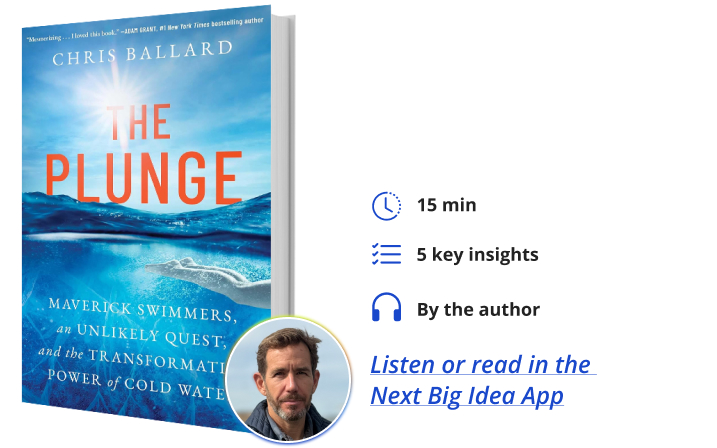
Below, Chris Ballard shares five key insights from his new book, The Plunge: Maverick Swimmers, an Unlikely Quest, and the Transformative Power of Cold Water.
Chris is the award-winning author of five books. He’s written for The New York Times Magazine, National Geographic, and Sports Illustrated, and eight of his stories have been optioned for film. Chris is also the age group U.S. ice swimming national champion in the 50 and 100 free and competed at the 2025 IISA World Championships in Italy.
What’s the big idea?
Modern life is designed to minimize discomfort, but humans grow stronger through voluntary challenges. By deliberately doing hard things—whether stepping into cold water or facing everyday adversity—we build resilience, discover hidden capacities, and learn that we are far more capable than we think.
Listen to the audio version of this Book Bite—read by Chris himself—in the Next Big Idea App, or buy the book.
1. Your body thrives on good stress.
Sixty years ago, a college student named Edward Calabrese made a fateful error. He and his classmates were supposed to suppress the growth of a peppermint plant with a chemical called Phosfon. Instead, they mistakenly diluted the solution. The result? Rather than dying, the plant grew 40 percent taller than other plants. Calabrese went on to spend the next 50 years cataloging examples of this phenomenon, known as hormesis: the idea that small doses of adversity can lead to long-term resilience.
Most of us intuitively understand this concept. When you lift weights, you are stressing your body and, in turn, it grows back stronger. What may be less obvious is context. Choosing to stress your body is a key component. Scientists refer to this as the difference between distress (a negative stress) and eustress (positive stress).
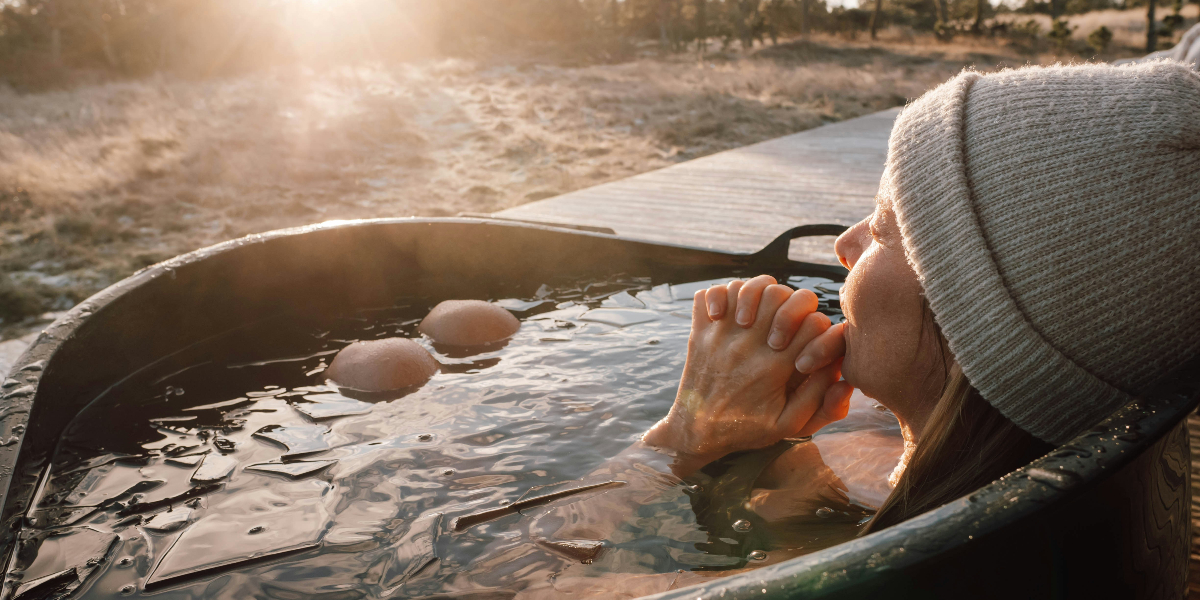
So, what does this have to do with cold water? Well, fall off a boat into the sea and panic sets in. Very little about the experience will be positive, physically or psychologically. But when you decide to lower yourself into a cold plunge or wade into a cool lake in the spring, you’ll reap the benefits. Not only will your body respond to this stressor by building back stronger—mitochondria increase, cells become more efficient at clearing waste—but you’ll feel it happening. With cold water, after only five days of exposure, you can cut the initial gasp reflex in half. That’s the hyperventilating that happens when you get in. For this reason, military units in cold weather countries like Norway purposefully train in cold water to prepare their troops. You can leverage this same reaction at home.
2. A lifeline for those “drowning on dry land.”
Every February, a few hundred hardy souls—grandmothers, teenagers, triathletes— gather in Vermont for a winter festival. Using chainsaws, they cut a “pool” out of the frozen surface of Lake Memphremagog and then, wearing only swimsuits, goggles, and silicone caps, proceed to swim in the 34-degree lake water.
Afterward, they emerge red-skinned and wild-eyed, hugging and high-fiving, bonded by surviving what is, in essence, a shared crisis of their own making. The organizer, a Gandalf-like figure with a long trailing beard named Phil White, welcomes all to the event, but particularly those who, as he puts it, are “drowning on dry land.”
“You are sharing the experience with others, now connected by this simple act.”
This is part of the allure of plunging and cold-water swimming: it operates at both the individual and communal levels. Your body is reacting to the physical triggers. Meanwhile, you are sharing the experience with others, now connected by this simple act.
For this reason, researchers in the UK are currently conducting a large-scale, multi-year study into the efficacy of cold-water swimming, viewing it as a potentially safe, non-pharmaceutical alternative to treating depression. This holds promise for men in particular, as they are often less likely to seek out therapy. As one swimmer told me, “We don’t fit anywhere else, but we all fit together here because we’re all broken in some way. The water is going to support you and welcome you in. It doesn’t matter what happened on land.”
3. The Forever Sport.
Aging has a way of narrowing the athletic world. Knees deteriorate. Tendons fray. The sports we once loved begin ushering us out the door. As Hiro Tanaka, a physiologist at the University of Texas who studies cardiovascular aging, put it to me: “The more complex the movement, the more the influence of aging shows up.” Swimming offers an elegant workaround. In water, gravity loosens its grip. No joint pounding. No contact injuries. Which is part of why Tanaka calls swimming the best sport for aging.
Water itself changes the body. Hydrostatic pressure helps circulate blood back toward the heart, and swimming appears to train the cardiovascular system in ways other forms of exercise don’t, encouraging arteries to become more supple, adaptable, and better at handling the demands of aging. One major NIH-backed study found swimmers had roughly a 50 percent lower risk of all-cause mortality than sedentary men, and even slightly lower risk than runners.
Part of the reason may simply be that people keep swimming. Unlike many sports, it welcomes you back no matter what your age, shape, or history. A seventy-five-year-old and a teenager can share the same lane, each moving at their own rhythm. And unlike land sports, swimming rewards all body types.
“Unlike many sports, it welcomes you back no matter what your age, shape, or history.”
Take Lynne Cox, the legendary open-water swimmer who set a world record crossing the English Channel at age 15. Researchers later discovered something remarkable about her physiology: her body density almost perfectly matched seawater. She neither floated nor sank. The very body type others criticized as “too chubby” turned out to be a competitive advantage.
The same pattern appears broadly in marathon swimming. Women close the performance gap with men as distances grow longer. In some ultra-distance swims, women have even outperformed men outright. The water equalizes things. Strength still matters, but so do buoyancy, efficiency, patience, and pain tolerance.
Maybe that is why swimming feels uniquely democratic. The pool does not care what you look like. It does not care how old you are. At one point, I shared a locker room with a Nobel Prize-winning scientist in his eighties. Once upon a time, he told me, he had played basketball. But now, slightly unsteady on land, he headed carefully toward the pool deck with his towel and goggles. “In the end,” he said, “we all swim.”
4. The more hard shit we do, the easier it is to do hard shit.
I met an Irish swimmer named Ger Kennedy who’d had a rough decade. A rugby player and plumber, he’d endured a hip replacement, a divorce, and challenges at work. By comparison, jumping into the frigid sea at the Forty Foot in Dublin wasn’t that hard, and Ger went on to set endurance records in the world of cold-water swimming. His theory was that as we accumulate life challenges and push through them, we get better at handling what comes next—what he calls building your “endurance brain.” This, he posited, may be partly why older athletes tend to excel in endurance sports.
Obviously, none of us want to seek out or hope for challenging life experiences. But swimmers I met tended to at least reframe them when they did occur or use them as valuable perspective. Sarah Thomas, the record-breaking marathon swimmer and only person, man or woman, to swim the English Channel four consecutive times, is a breast cancer survivor. She endured chemotherapy, surgery, and recovery, then trained her way back into shape. By the time she was in the middle of her four-way attempt and nausea overtook her, she paid it little mind. As she told me, “It’s just vomit.” She waited it out, pushed through, and reached her goal.
5. Modern life leads us to underestimate ourselves.
Our existence is built around ease. We live in climate-controlled houses, from which we drive climate-controlled cars to climate-controlled workspaces. Physical challenges have largely been replaced by psychological ones. And, in the process, we forget what we’re capable of.
I certainly learned this. When I began this book, I didn’t much like cold water and had never been a swimmer swimmer. The idea that I would one day compete at something called ice swimming, much less make the US National Team or attempt to swim a kilometer in Boston Harbor in the middle of a winter storm, seemed impossible. But the thing about swimming in cold water is that literally anyone can do it; it’s just that most people won’t.
“Eventually, my body surprised me.”
I get it. It took months for me to acclimate, building my cold water tolerance one plunge at a time. But eventually, my body surprised me. Sitting in that tub got easier.
Meanwhile, everything got a bit easier. Keeping my calm on that long cross-country flight in the middle seat. Dealing with a work crisis. By the end, my resting heart rate had dropped so low—39 beats per minute—that, if I hadn’t been doing cold water exposure and swimming, I’d have been sent to cardiology. My heart rate variability went up, and my body fat went down. But, most important, I realized that, if I needed to do something like this again—anything that seems insurmountable—I could.
Enjoy our full library of Book Bites—read by the authors!—in the Next Big Idea App: