











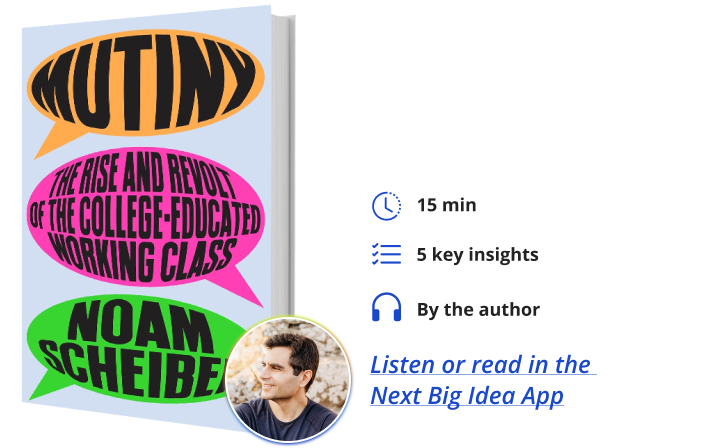
Below, Noam Scheiber shares five key insights from his new book, Mutiny: The Rise and Revolt of the College-Educated Working Class.
Noam is a reporter with the New York Times, where he has covered workers for over a decade. Before that, he covered economic policy and three presidential campaigns for The New Republic magazine.
What’s the big idea?
A growing number of college-educated Americans feel betrayed by the promise that higher education would guarantee economic security and upward mobility. This disillusionment is reshaping politics, labor organizing, and attitudes toward work.
Listen to the audio version of this Book Bite—read by Noam himself—in the Next Big Idea App, or buy the book.
1. Dashed expectations are radicalizing.
Mutiny is about the generation of people who graduated from college after the Great Recession, all the way up through this spring. This is a generation that received perhaps the strongest message in history about why they needed to go to college. Everyone, from friends and family members to presidents like Bill Clinton and Barack Obama, told them that college was no longer a luxury—it was a necessity.
They did more than any previous generation to prepare for college, whether you look at the expanded length of their school days, the amount of homework they completed, or the money spent on SAT prep. Literally 10 times as many students took AP classes as in the previous generation. And, of course, more people attended college than ever before.
But all of this was happening at precisely the moment when the return on investing in a college degree was stalling out and even shrinking. Before long, a huge gap opened between people’s expectations of what life after college would look like and the reality they encountered.
That reality included high unemployment, people working jobs that didn’t require degrees (such as baristas, retail workers, or administrative assistants), and struggling with record levels of student debt while being unable to afford a home. The gap between expectations and reality led to a deep sense of betrayal and radicalized many members of this generation.
Soon, these graduates began doing things college graduates historically haven’t done very often: forming unions, holding walkouts and strikes, and supporting left-wing political candidates like Bernie Sanders, Alexandria Ocasio-Cortez, and Zohran Mamdani in New York City.
2. Don’t give universities a pass.
People tend to enjoy their time in college for obvious reasons. It’s exhilarating to encounter new subjects and learn new ways of thinking about the world. When graduates can’t find decent jobs, they often blame large impersonal forces like the economy or technology. But universities have played a key, underappreciated role in the problems bogging down young college graduates.
They’ve aggressively marketed degree programs that cost tens or even hundreds of thousands of dollars while leaving graduates with highly questionable employment prospects. And the number of majors in this category has exploded over the past two decades. One of the fastest-growing degrees in the country is video game design. In their marketing materials, universities often suggest that graduates with game design degrees typically land jobs at prominent video game studios. In practice, thousands of people graduate with video game design degrees each year, but only a small fraction go on to support themselves by designing video games.
“One of the fastest-growing degrees in the country is video game design.”
I write about one of these graduates in my book: Dylan Burton, who accumulated nearly $70,000 in debt earning a degree in video game design at the University of Texas at Dallas. Dylan is an exceptionally talented game designer. In college, they were admitted to an advanced class called Game Lab, where they led a team that built a fully playable game called KaiJr. But after graduating in 2019, Dylan struggled even to land interviews for game design positions, much less secure a job in the field. They eventually settled for a far more tedious QA testing role—testing games for bugs—that paid $15 an hour. Dylan’s experience was fairly typical, as relatively few graduates from the UTD game design program were able to earn a living as game designers.
3. The long dress rehearsal for AI.
With artificial intelligence looming, the disappearance of good-paying white-collar work is on a lot of people’s minds. Many of us are wondering what will happen when AI cannibalizes millions of jobs traditionally done by college graduates. But we don’t have to wonder because those jobs have been quietly disappearing for more than two decades.
Research by Berkeley professor Jesse Rothstein, a former chief economist at the U.S. Labor Department, shows that the job market for recent college graduates started to soften around 2005 and then nosedived during the Great Recession. What’s especially surprising, Rothstein found, is that the market still hadn’t fully recovered by 2019. Then the pandemic hit and disrupted the labor market all over again.
Other research by economists at the Federal Reserve Bank of New York shows similar trends. For years, many college graduates earned good money in jobs that didn’t technically require degrees, such as insurance agents and human resources workers. But according to the New York Fed, those good-paying jobs started disappearing in the early 2000s and never recovered. Some vanished altogether, while others gradually paid college graduates less and less.
4. The disappearing fashion buyer.
A major part of the explanation for what’s been happening to white-collar jobs has to do with computers and automation—a story unfolding long before ChatGPT and generative AI burst onto the scene.
Back in 2018, I wrote a story about how fashion buyers were becoming vulnerable to machine-learning algorithms. Fashion buyers are the people who work for retailers like Bloomingdale’s and Nordstrom and try to predict what clothes or shoes will be fashionable a year or more in advance. They do this by attending fashion shows, talking with designers, brands, and wholesalers, and analyzing sales data to determine what’s rising or declining in popularity.
“A major part of the explanation for what’s been happening to white-collar jobs has to do with computers and automation.”
Historically, this was a highly respected, well-paid white-collar profession, with many buyers earning well into the six figures. But even in 2018, we were already seeing that early forms of AI could do the work as well as—or better than—humans. Companies were beginning to hire fewer buyers and rely more heavily on algorithms.
The same pattern was unfolding across a wide range of professions: accounting, insurance, financial planning, marketing, and law. Software and earlier forms of AI had been steadily chipping away at white-collar work for decades. The result was lower wages, fewer jobs, or both.
5. There is hope.
I first stumbled onto the group I call the college-educated working class a year or two into the pandemic. Workers at places like Starbucks, Apple Stores, REI, Trader Joe’s, and video game studios were beginning to unionize, even though those companies had never been unionized before. Every time another group or store filed paperwork for a union election, I tried to join a call or Zoom meeting with them.
Pretty quickly, I realized that a huge number of the people involved were college graduates fed up with working these jobs, especially after the pandemic made the work far more dangerous. Unfortunately, over the last few years, the college-educated working class has only grown. The unemployment rate for recent college graduates has continued to rise steadily. It’s now nearly six percent, according to the New York Fed, up from four percent in 2022.
That said, I don’t really think of the story I tell in Mutiny as a complete downer. I try to show how young college graduates are often able to assert control over their own fate in ways people might not expect. College may not have given them the jobs or incomes they anticipated, but it did equip them with confidence, a sense of agency, and an ability to figure things out in difficult situations. For example, most of these workers knew nothing about labor law or how to negotiate labor contracts when they first tried to unionize their workplaces or go on strike. But they essentially taught themselves on the fly and were often very successful.
Enjoy our full library of Book Bites—read by the authors!—in the Next Big Idea App: