









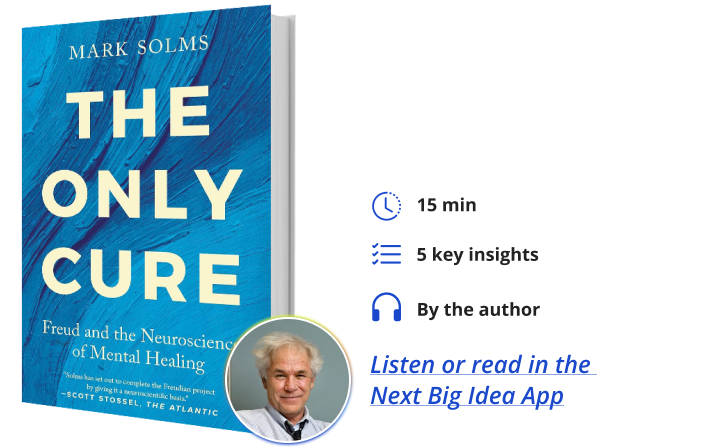
Below, Mark Solms shares five key insights from his new book, The Only Cure: Freud and the Neuroscience of Mental Healing.
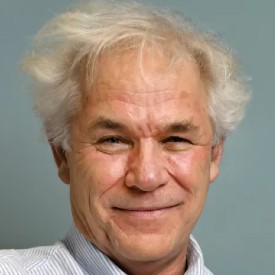
Mark is a neuroscientist who took the unusual step of also training as a psychoanalyst. For 40 years, he has used the tools of modern neuroscience to test and refine psychoanalytic theory. A pioneering figure in neuropsychoanalysis, his research uncovered key brain mechanisms involved in dreaming, reshaping our understanding of the sleeping mind. He is also the science director of the American Psychoanalytic Association.
What’s the Big Idea?
Freud should not be dismissed as an outdated or discredited thinker. Many of his core insights anticipated modern neuroscience, and the task now is to update and correct psychoanalysis using contemporary scientific evidence.
Listen to the audio version of this Book Bite—read by Mark himself—in the Next Big Idea App, or buy the book.
1. Freud was a neuroscientist.
Freud spent 23 years doing neuroscientific and neurological research. During that time, he published over 200 titles, four of which were books. He contributed to the discovery of neurons, the basic element of the nervous system, in the 1880s. In the 1890s, when the synapse was discovered—that’s the junction that connects neurons—Freud was the first person to interpret it as the site where memories are formed.
In 1895, Freud formulated the idea that neurons that fire together wire together. This is now known as Hebb’s law, even though Hebb formulated this law decades later. Freud discovered the origin of one of the cranial nerves, then called the acoustic nerve, in the brainstem. We now call it the vestibular-cochlear nerve. Every medical student learns the anatomy of these cranial nerves.
Freud was one of Europe’s leading experts on a movement disorder known as cerebral palsy. In 1891, he published a breakthrough book on the brain mechanisms of language, showing that language is the product of a functional system distributed across many different brain regions. This provided the transition to psychoanalysis because the language function is a psychological function.
2. Many of Freud’s controversial discoveries are now conventional wisdom.
Functionalism was a scientific novelty when Freud first introduced it: the idea that we are studying functional systems, which are virtual things. The introduction of functionalism into cognitive neuroscience (the mainstream view nowadays) is generally attributed to Putnam in the 1950s. Again, decades after Freud introduced the concept.
Freud also introduced the idea of multiple memory systems in 1896. The idea is that our memory system is not unitary, but rather divided over multiple different systems, each of which functions in a different way. The idea is attributed to other researchers, again, decades after Freud introduced it. Freud said there must be at least three memory systems, which he defined as conscious, preconscious, and unconscious. That’s exactly how we divide the multiple memory systems today. The mainstream cognitive neuroscience model divides them into short-term memory (conscious), declarative long-term memory (preconscious), and non-declarative long-term memory (unconscious).
Speaking of the unconscious, that was another novelty of Freud’s: the idea that mental functions can be unconscious. When Freud introduced this idea, it was considered an oxymoron. In those days, mind and consciousness were synonymous. The idea that large portions of our mental life occur unconsciously is now mainstream.
What is called predictive processing today—a highly influential framework developed by Carl Friston—was, again, actually anticipated decades earlier. Predictive processing is basically the same as wishful processing. It is the idea that once you’ve had an experience of satisfaction, you try to repeat it based on how that satisfaction was achieved in the past. Conversely, when you have a noxious experience, you try to avoid it by not repeating the circumstances that produced it. This is a fundamentally Freudian idea, and Friston acknowledges this debt.
The same is true of embodied cognition, which was often presented as a contemporary development. Freud was the first to emphasize that cognition is embodied—that human beings are a species of animal, and the mind works on behalf of the organism as a whole, learning how to meet its needs in the world.
“We often forget that this was once a novel Freudian idea.”
Freud also pioneered the idea of critical periods in mental development. Consider infantile amnesia. We cannot remember the first two years of our lives because the cortical memory systems that Freud called the preconscious (and we now call declarative long-term memory) have not yet fully matured.
Similarly, the idea that traumatic experiences in early childhood experiences can lay the foundations for later psychopathology was a Freudian idea. Today, it is widely recognized that adverse childhood experiences can increase vulnerability to conditions like depression. Yet we often forget that this was once a novel Freudian idea.
Freud also approached studying the brain from a subjective point of view, asking, in effect, what it’s like to be this brain. Today, the need to account for subjective experience is associated with what David Chalmers famously called the “hard problem of consciousness,” a problem generally regarded as being at the cutting edge of contemporary neuroscience.
3. The talking cure is a highly effective medical treatment.
In medicine and psychiatry, we measure treatment effectiveness in terms of what’s called effect size. An effect size of 0.2 is considered mildly effective, 0.4 moderately effective, and 0.8 highly effective. On average, psychiatric medications have an effect size around 0.4.
Talk therapy has an effect size of between 0.7 and 0.8, placing it in the highly effective range. The same is true of short-term psychoanalytic psychotherapy. Randomized controlled studies have established an effect size of about 0.8, but that figure does not take account of something known as the “sleeper effect.”
With most psychotherapies, symptoms are substantially relieved by the end of treatment, but at follow-up—months or years later—they tend gradually to return. Psychoanalytic psychotherapy appears to follow a different pattern. Not only do the improvements persist after treatment ends, but they may also continue to increase.
“Talk therapy has an effect size of between 0.7 and 0.8, placing it in the highly effective range.”
Long-term psychoanalytic psychotherapy has been reported to produce even larger effect sizes, 0.9 and above, with follow-up effects exceeding 1.0—which is off the charts. The effectiveness of psychoanalytic therapy is comparable to that of established medical interventions, such as glucose-lowering medications for diabetes or the HPV vaccine in preventing cervical cancer.
4. Psychiatric medications suppress symptoms while talk therapy treats the root cause.
One of the greatest fallacies to have gripped the public imagination is that psychiatric symptoms are caused by chemical imbalances in the brain. In the book, I review the evidence against this theory, including research recently summarized in Molecular Psychiatry by the eminent psychiatrist Joanna Moncrieff. The evidence suggests that the chemical-imbalance theory, at least in its familiar form, is simply not supported.
Psychiatric medications are important: they can relieve symptoms. But symptom relief is not the same as curing an underlying condition. When treatment is discontinued, symptoms may return, and these medications can also carry significant side effects and withdrawal effects. Many were not originally intended to be taken for years or even decades, yet long-term use has become increasingly common.
Freud offered a fundamentally different account. On his view, emotional symptoms arise when emotional needs are not adequately met. Psychoanalytical treatment, and talk therapies in general, aim to help patients find better ways of recognizing and meeting those needs. If unmet emotional needs are causing the symptoms, then addressing those needs means addressing the causes rather than merely alleviating the symptoms.
5. Freud got some things wrong.
The main thing Freud got wrong was his theory of sexuality. He made the point that the motive for sexual behavior is not reproductive success. He argued that pleasure-seeking is what motivates sexual behavior. He pointed to masturbation as supporting evidence for this claim, because it is a clearly sexual act that cannot result in babies. Another example he used is homosexual intercourse, which also cannot result in reproductive outcomes. Freud was convinced that people perform sexual acts ultimately because they enjoy them.
Then Freud went further: If the purpose is purely the pursuit of pleasure, then sexuality is not a reproductive function but a pleasure-seeking function. From there, he concluded that anything done purely for the sake of pleasure is sexual behavior—which is a total redefinition of the word “sexual.” This is what led Freud to say, “Look at a baby at the breast. Initially, it suckles to meet nutritional needs, but once it’s satiated, it carries on sucking. Why? For pleasure. Therefore, it’s sexual.” That’s the origin of his idea of oral sexuality, which he says is a component of the overarching sexual function.
“Scientists make mistakes, especially pioneers like Freud, but we don’t cancel them.”
Nowadays, we would say that a baby continues to suckle at the breast after its nutritional needs have been met because continued suckling meets the need for attachment. Attachment bonding is not a form of sexuality. It’s pleasurable for the child to have its caregiver present, but that’s because it meets a need all its own. It turns out there are many psychological needs like this.
There are many different pleasures in the brain and many different chemistries that mediate those pleasures. Sexual chemistry is only one type. It makes no sense to call all forms of pleasure components of one overarching function.
Scientists make mistakes, especially pioneers like Freud, but we don’t cancel them. We don’t cancel Newton because he didn’t know about quantum physics. We don’t cancel Darwin because he didn’t get everything right. Instead of canceling Freud, we should continue the job he started. It’s not just a matter of proving Freud right or wrong, but rather of finishing the job.
Enjoy our full library of Book Bites—read by the authors!—in the Next Big Idea App: