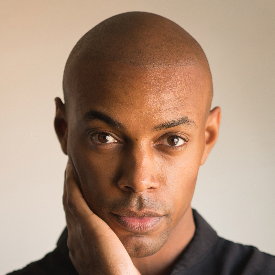










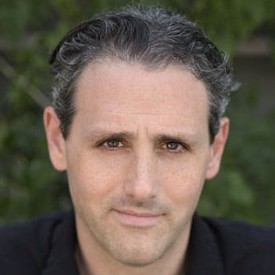
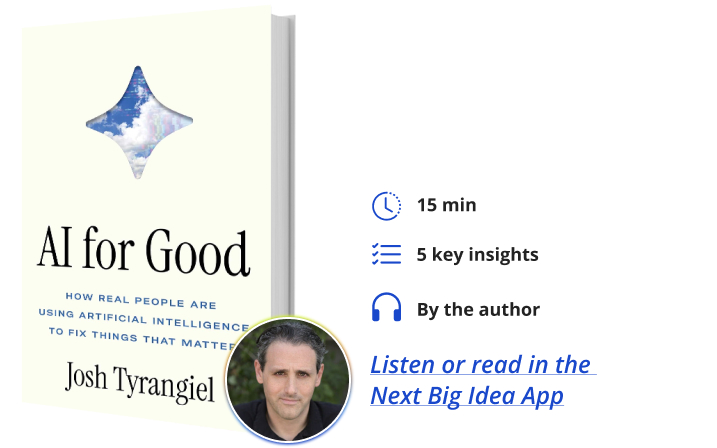
Below, Josh Tyrangiel shares five key insights from his new book, AI for Good: How Real People Are Using Artificial Intelligence to Fix Things That Matter.
Josh spent the last few years covering artificial intelligence, first at The Washington Post and now at The Atlantic. Before that, he ran Bloomberg Businessweek and Bloomberg Media, and made news and documentaries for HBO and Netflix.
What’s the big idea?
AI’s greatest impact is coming not from flashy promises but from practical tools that help people solve real problems. Ignore the hype, focus on the evidence, and see AI as a powerful assistant that can enhance human capabilities when used responsibly.
Listen to the audio version of this Book Bite—read by Josh himself—in the Next Big Idea App, or buy the book.
1. Hype is the enemy.
The biggest obstacle to AI doing genuine good in the world isn’t the technology—it’s all the talking. Every week brings a new announcement that AI will cure cancer, end poverty, or make your job obsolete by Thursday. The noise is so loud that it drowns out the signal.
What I’ve found is that the places where AI is actually working—saving lives, teaching kids, fixing broken systems—are almost never the places dominating headlines. These stories are quieter, less theatrical, and run by people who are more interested in outcomes than attention.
The hype cycle does real damage. It creates unrealistic expectations that lead to backlash. It pulls investment toward flashy demos and away from unglamorous problems. And it makes ordinary people feel like AI is something happening to them rather than something that could work for them. The first step to understanding AI’s real potential is turning down the volume on the people most loudly selling it.
2. In healthcare, AI is already saving lives.
The Cleveland Clinic is not a place that makes a lot of noise. It’s a place that does a lot of work. And a few years ago, they deployed an AI system designed to do one specific thing: catch sepsis earlier than human clinicians typically could.
Sepsis is one of the deadliest things that can happen inside a human being. It occurs when the body’s response to infection spirals out of control, triggering widespread inflammation that can rapidly lead to tissue damage and organ failure. Each year, sepsis kills approximately 350,000 Americans—more than breast cancer, prostate cancer, and opioid overdoses combined. It moves incredibly fast, and because its initial symptoms are benign, it’s very hard to spot.
“Each year, sepsis kills approximately 350,000 Americans.”
The AI the Clinic deployed monitors patients continuously, flagging early warning signs that a tired resident at 3 a.m. might not catch. The results were meaningful: earlier interventions, better outcomes.
What struck me about this story isn’t just that it worked. It’s how it worked. The doctors didn’t feel replaced. They felt supported. The AI wasn’t making the call; it was making sure the right call got made faster. That’s the model we should be striving for in the real world: AI as a very attentive colleague, not a replacement. The healthcare breakthroughs that are coming in the next few years won’t look like science fiction. They’ll look like this.
3. The best teacher you never had might be an algorithm.
Sal Khan built Khan Academy on a simple, radical idea: what if every kid had access to a one-on-one tutor? For years, that was aspirational. Then AI made it genuinely possible.
Khanmigo, their AI tutoring tool, doesn’t just give students answers—it asks them questions. It figures out where a kid is stuck and meets them there, patiently, without judgment, at 11 p.m. when no human tutor is available. For students who’ve always had access to private tutors, this might sound modest. For kids who haven’t—which is most kids—it has the potential to be genuinely transformative.
What surprised me most was the creative ways teachers used Khanmigo’s teaching tools. I spoke to a high school chemistry teacher in Indiana who told me how hard teaching had become since Covid—with kids tuning out lectures and sneaking looks at their phones. She used the AI teaching tools to turn most of her lectures into active, collaborative lab assignments. And she structured the AI as a teaching assistant, to help with basic questions and then alert the kids when they were ready for her to come over and look at their work. Watching her, I was reminded both of how bad I am at chemistry, and how joyful classroom education can be.
4. Government is where AI is most interesting—and most complicated.
The IRS processes hundreds of millions of tax returns, and for years it did a lot of that with technology roughly as modern as the fax machine. When Danny Werfel took over as IRS commissioner, one of his priorities was using modern tools—including AI—to close the tax gap, which is the difference between what Americans owe and what they pay. That gap runs up into hundreds of billions of dollars annually.
“AI is a tool, and tools reflect the intentions of whoever’s holding them.”
AI can help identify patterns of evasion that human auditors would take years to find. It can make the filing process less painful for ordinary people. It can, in theory, make government function better.
Then there’s DOGE. The contrast is instructive. What we saw there was AI—and the idea of AI—being deployed not to improve government services but to dismantle them, often without the careful implementation that makes the technology work. The lesson isn’t that AI in government is good or bad. It’s that AI is a tool, and tools reflect the intentions of whoever’s holding them. That’s the most important thing to understand about AI in public life.
5. Your job isn’t going away, but it’s likely to change.
Every few months there’s a new study saying AI will eliminate X million jobs by Y year. I’ve read most of them. I’ve also interviewed the economists behind them—David Autor, Daron Acemoglu, Austan Goolsbee—and what’s striking is how much more nuanced they are in person than in the headlines.
The honest answer is that nobody knows exactly what happens next. What history tells us is that transformative technologies tend to eliminate certain tasks, change most jobs, and create new categories of work that nobody predicted. That pattern probably holds here, but the speed and the distribution of disruption matter enormously. Who benefits first? Who gets left behind longest?
What I kept coming back to is that the people best-positioned for what’s coming aren’t the ones trying to race the machine. They’re the ones figuring out how to work alongside it by bringing judgment, context, relationships, and accountability that AI genuinely cannot replicate. That’s not a consolation prize. That’s the real job.
Enjoy our full library of Book Bites—read by the authors!—in the Next Big Idea App: